2026 Week 31 Global Macro Market Watch: Fed, BOJ, GDP, China PMI, and OPEC+ Set the Cross-Asset Test
Key Takeaways
- •The Federal Reserve meeting is the central event because U.S. rates, the dollar and liquidity conditions influence major global asset classes.
- •The Bank of Japan decision could affect the yen, carry trades, bonds and broader risk appetite beyond Japanese markets.
- •U.S. GDP and Employment Cost Index data will test whether growth remains resilient while wage and inflation pressures continue to ease.
- •Euro-area inflation and China PMI readings will provide additional checks on policy expectations, global demand and commodity markets.
- •A possible OPEC+ policy review on August 2 could shift crude prices and influence inflation expectations after the main weekday data cycle.
Why Week 31 Matters
Week 31 is not a normal data week. It is the kind of calendar that forces traders to compare several versions of the same story at once: whether inflation is still slowing, whether growth is cooling too quickly, whether central banks are comfortable with market optimism, and whether commodity prices are about to complicate the narrative.
That matters because markets entered late July with little patience for simple explanations. A soft data point can be bullish if it lowers rate expectations without damaging earnings confidence. The same soft data point can be bearish if investors read it as a recession warning. A strong number can support cyclical stocks, copper, and commodity-linked currencies, but it can also push yields higher and pressure Bitcoin, gold, and long-duration equities.
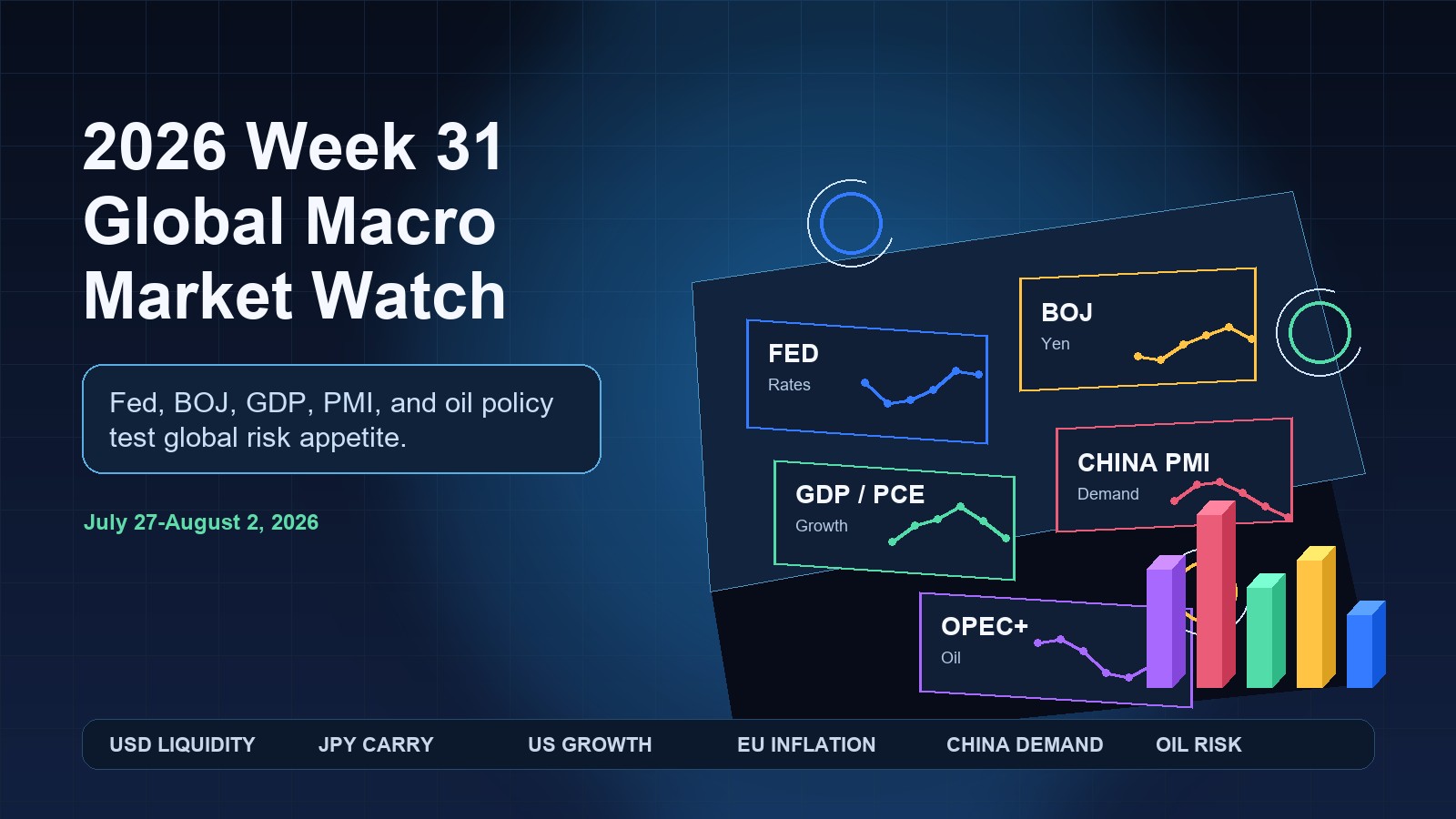
The better lens is a dashboard. The Fed supplies the global dollar-liquidity signal. The BOJ supplies the yen and global-rate-volatility signal. U.S. GDP and labor-cost data test the soft-landing case. Euro-area inflation tells investors whether Europe can keep moving toward easier policy. China PMI is the demand checkpoint for industrial commodities. OPEC+ can change the oil and inflation channel even after the main weekday data are finished.
For readers who trade across crypto, stocks, commodities, or FX, the point is not to predict every release. The point is to know which signals confirm each other, which signals conflict, and which market moves deserve skepticism until the full picture is visible.
Global Macro Calendar for July 27-August 2, 2026
| Date | Region | Event | Why Markets Care |
|---|---|---|---|
| July 28-29 | United States | Federal Reserve FOMC meeting | Sets the dollar, Treasury-yield, liquidity, and risk-appetite tone for global markets. |
| July 29 | Australia | June CPI data | Affects AUD, regional rates, gold, and Asia-Pacific inflation expectations. |
| July 30 | United States | Advance Q2 GDP and related national-account details | Tests whether U.S. growth is strong enough to support earnings without forcing a hawkish rates repricing. |
| July 30-31 | Japan | Bank of Japan monetary policy meeting | Can move JPY, Japanese government bonds, global carry trades, and risk sentiment. |
| July 31 | United States | Employment Cost Index and jobless-claims backdrop | Wage pressure is a direct input into inflation persistence and Fed patience. |
| July 31 | Euro area | Inflation flash estimate and growth signals | Shapes ECB expectations, EUR, European yields, and global relative-rate trades. |
| Late week / month-end | China | Official PMI demand signal, when released | Provides a key read on manufacturing, services, commodities, Asia equities, AUD, and CNH. |
| July 31 | Canada | GDP data | Matters for CAD, rate expectations, energy-linked FX, and North American growth sentiment. |
| August 2 | Global oil | OPEC+ monthly policy review, if confirmed | Can shift crude, inflation expectations, energy equities, CAD, NOK, and risk appetite. |
The Fed Is the Week’s Dollar-Liquidity Anchor
The July 28-29 FOMC meeting is the center of the Week 31 calendar because almost every major asset class still trades through the U.S. rates channel. Crypto investors watch the Fed through liquidity and real yields. Equity investors watch it through discount rates and earnings confidence. Commodity traders watch it through the dollar. FX traders watch it through relative policy.
The decision itself may not be the whole story. If markets already expect no dramatic policy shift, the language around inflation progress, labor-market cooling, and financial conditions can matter more than the headline rate. A Fed that sounds comfortable with disinflation can keep the risk-on trade alive. A Fed that warns against premature easing can pull liquidity-sensitive assets back into a tighter range.
What Crypto Needs From the Fed
Bitcoin and Ethereum do not need a dovish surprise to perform well, but they do need the Fed to avoid pushing real yields and the dollar sharply higher. The most constructive setup for crypto is a statement and press conference that keep rate-cut optionality alive while avoiding a growth-scare message. In that environment, traders may be more willing to hold high-beta exposure, ETF demand can remain more resilient, and leverage can expand without immediately running into a macro headwind.
The more difficult setup is a Fed that sounds worried about sticky inflation or excessive risk-taking. That can strengthen the dollar, lift front-end yields, and make crypto rallies more fragile. It can also make liquidation clusters more important because leveraged traders become more sensitive to small moves in rates and FX.
The BOJ Can Move More Than Japan
The Bank of Japan’s July 30-31 meeting is the second major policy anchor. Japan may look far removed from U.S. crypto and equity trading, but the yen sits inside many global funding and carry strategies. When BOJ expectations change, the impact can travel quickly through FX, bonds, and risk assets.
A steady BOJ message can calm the market if investors believe Japan is moving gradually. A more hawkish tone can lift the yen, pressure carry trades, and create broader risk-off pressure even if U.S. data look acceptable. That is why Week 31 should not be read as a Fed-only week.
For equities, a stronger yen can pressure Japanese exporters while changing regional capital flows. For commodities, yen strength can overlap with a weaker dollar story or, in a more disorderly move, with defensive positioning. For crypto, the BOJ link is indirect but real: unwind pressure in popular funding trades can reduce appetite for leveraged risk across the board.
U.S. Growth and Wage Data Will Test the Soft-Landing Trade
The U.S. data cluster matters because it can either validate the Fed’s patience or challenge it. Advance Q2 GDP gives the broad growth read. PCE-related national-account details help investors think about inflation composition. The Employment Cost Index gives a cleaner labor-cost signal than many noisier wage series. Weekly labor-market data add a timelier check on whether hiring is cooling gradually or breaking faster.
The bullish version is not simply strong growth. If GDP is firm while inflation and wage pressure keep easing, stocks can treat the data as earnings support and crypto can treat it as a risk-appetite tailwind. The bearish version is also not simply weak growth. If the economy slows while wages remain sticky, markets face a worse mix: weaker demand, less confidence in earnings, and less room for central banks to ease.
The Wage Signal Is the Quiet Risk
Employment Cost Index data can move markets because it goes straight to the question central banks care about: are labor costs still consistent with inflation returning to target? A soft ECI reading can support the argument that the inflation process is cooling beneath the surface. That would usually help bonds, growth stocks, and crypto risk appetite.
A firm ECI reading is more complicated. It can support consumer income, but it can also tell the Fed that services inflation may not cool fast enough. That is the kind of data point that can make good economic news look bad for duration-sensitive markets.
Europe and China Supply the External Growth Check
The euro area gives investors a second inflation test. If euro-area inflation continues to cool, the ECB can remain on a more flexible policy path, and European yields may stay contained. If inflation proves sticky, the region can become another source of rate pressure just as traders are trying to read the Fed.
China is different. The China signal is less about developed-market inflation and more about demand. Official PMI readings, when released around the turn of the month, matter because they connect directly to industrial commodities, Asia equities, AUD, CNH, and global manufacturing expectations. A better China reading can support copper, miners, and cyclicals. A weak reading can make the global growth story feel less stable even if U.S. data remain acceptable.
Commodities Need Confirmation, Not Slogans
Commodity markets often respond quickly to China headlines, but Week 31 demands confirmation. If PMI data improve while the dollar softens and oil remains stable, the demand trade looks cleaner. If PMI improves but the Fed sounds hawkish, the commodity reaction may be less durable. If PMI disappoints while oil rises on supply risk, investors face the awkward mix of weaker demand and higher energy prices.
That is why copper and crude should be read differently. Copper is the cleaner growth signal. Oil is both a growth asset and an inflation input. In Week 31, crude can become the asset that turns a decent macro setup into a more difficult one if OPEC+ policy or supply headlines push inflation expectations higher.
OPEC+ Keeps the Weekend Risk Alive
The possible OPEC+ policy review on August 2 extends the market week beyond the usual Friday data cycle. Oil policy is not just about energy traders. It matters for headline inflation, consumer sentiment, airline and transport costs, energy equities, inflation breakevens, and currencies such as CAD and NOK.
If OPEC+ signals restraint on supply, crude can stay supported and inflation expectations may firm. If the group leans toward additional supply, crude could ease, which may help the disinflation narrative but also raise questions about demand if the move is read as defensive. Either way, oil is the macro bridge between central-bank policy and real-economy costs.
For crypto traders, the oil link is second order but important. A sudden oil move can change inflation expectations, rate pricing, and dollar behavior. Bitcoin may not trade oil tick for tick, but it can trade the rates and liquidity reaction that follows.
Market Impact Map
The cleanest risk-on setup for Week 31 would combine a non-hawkish Fed, no BOJ shock, steady U.S. growth, softer wage pressure, cooling euro-area inflation, improving China demand, and no oil-price flare-up. In that world, equities can lean on earnings confidence, crypto can benefit from easier liquidity expectations, copper can find demand support, and the dollar may struggle unless U.S. growth outperforms sharply.
The harder setup would be a hawkish Fed, a hawkish BOJ, sticky wages, weak China PMI, and firmer oil. That mix would leave investors with higher rates, shakier demand, and more inflation risk at the same time. Crypto and long-duration equities would likely be the most sensitive. Commodities would split between growth-sensitive metals and supply-sensitive crude. FX would become the transmission mechanism, with USD and JPY reactions telling traders whether the market is moving toward risk appetite or capital preservation.
| Macro Signal | Risk-On Interpretation | Risk-Off Interpretation |
|---|---|---|
| Fed meeting | Disinflation confidence without growth panic | Higher-for-longer language or concern about financial conditions |
| BOJ meeting | Gradual policy path and calm yen reaction | Hawkish surprise, yen spike, carry-trade pressure |
| U.S. GDP | Resilient demand with easing inflation pressure | Weak demand or hot growth that lifts yields |
| Employment costs | Wage cooling supports rate-cut optionality | Sticky wages revive services-inflation concern |
| China PMI | Better manufacturing and services demand | Weak activity hits commodities and Asia risk |
| OPEC+ / oil | Stable crude supports inflation calm | Supply restraint or price spike lifts inflation risk |
What Traders Should Watch Next
The most important signal may be the order of reactions. If stocks rise, bond yields fall, the dollar softens, and crypto breaks higher together, markets are probably reading the week as a liquidity-friendly soft landing. If stocks rise while yields and the dollar also rise, the move may be more fragile because the rates market is not confirming easier conditions.
Watch the yen closely after the BOJ. A controlled yen move is manageable. A violent yen move can force positioning changes elsewhere. Watch oil into the weekend because a crude-price shock can rewrite the inflation takeaway after traders have already processed the Fed and U.S. data. Watch copper and AUD for the China demand read. And for crypto, watch whether BTC and ETH respond to lower yields with real spot demand, not just leverage.
The main lesson of Week 31 is simple: do not trade one headline as if it owns the whole macro picture. This is a week for confirmation. The strongest market moves will be the ones supported by policy, growth, inflation, commodities, and FX at the same time.
Trade with an Edge
In fast-moving markets, execution matters just as much as direction. That’s why more traders are turning to decentralized venues like edgeX for perpetuals and spot trading.
Unlike traditional centralized platforms, edgeX is built around self-custody, meaning you keep control of your assets and authorize fund movements yourself. For active traders, that offers a meaningful advantage: market access without handing custody to an exchange.
edgeX also combines the core benefits of DeFi with a trading experience designed for serious execution. The platform emphasizes deep liquidity, high-speed order matching, and low-slippage performance, helping traders stay responsive during volatile conditions. With support for high leverage, it gives experienced market participants more flexibility in how they express macro views and manage risk.
Beyond execution, decentralized trading infrastructure can offer structural advantages: greater transparency, on-chain verification, and reduced dependence on centralized intermediaries. For traders who want performance without giving up control, that model is increasingly compelling.
edgeX is built for that balance: bringing together a professional trading experience with the core principles of decentralized markets.
For readers looking to explore a more capital-efficient, self-custodial way to trade, edgeX is worth a closer look.
Frequently Asked Questions
What is the most important macro event in Week 31 of 2026?
The Federal Reserve meeting on July 28-29 is the main event because it influences the dollar, Treasury yields, global liquidity, and risk appetite. The BOJ meeting, U.S. GDP, wage data, euro-area inflation, China PMI, and oil-policy headlines also matter because they can either confirm or challenge the Fed-driven market reaction.
Why does the Bank of Japan matter for crypto and U.S. stocks?
The BOJ matters because the yen is tied to global funding and carry trades. If BOJ policy expectations push the yen sharply higher, leveraged risk positions can come under pressure. That can affect equities, crypto, FX, and bond markets even when the original policy decision happens in Japan.
How can China PMI affect commodities?
China PMI data can influence expectations for manufacturing activity, infrastructure demand, and industrial production. Stronger readings can support copper, iron ore, miners, Asia equities, AUD, and CNH. Weaker readings can pressure growth-sensitive assets and make the global demand story look less stable.
Should traders focus on GDP or inflation data?
Both matter, but the mix matters more than either number alone. Strong growth with cooling inflation is constructive. Weak growth with sticky inflation is difficult. Hot growth that pushes yields higher can also pressure crypto and long-duration stocks.
Why include OPEC+ in a macro market watch?
Oil prices feed headline inflation, inflation expectations, energy-sector earnings, consumer costs, and commodity-linked currencies. An OPEC+ policy surprise can change the market's inflation narrative even after central-bank meetings and weekday data releases are finished.

