Week 30 2026 Global Macro Market Watch: ECB, China Rates, PMI, and Market Implications for Crypto, Equities, Commodities, and FX
Key Takeaways
- •The European Central Bank's July 22-23 monetary policy meeting is the week's most consequential scheduled event, with its tone directly influencing European yields, the euro, global risk appetite, and crypto liquidity conditions.
- •China's loan prime rate guidance on July 20 acts as a primary demand signal for industrial commodities such as copper and iron ore, as well as for Asian equities and commodity-linked currencies.
- •U.S. weekly initial jobless claims, new home sales, and oil inventory data will collectively test whether the world's largest economy is cooling gradually enough to preserve the soft-landing narrative.
- •Flash PMI surveys later in the week will offer forward-looking evidence on whether slowing global growth is genuinely disinflationary or accompanied by persistent cost pressures.
- •The dollar functions as the central transmission mechanism for the week's macro signals, with a stronger dollar tightening conditions for crypto, commodities, and emerging markets, while a weaker dollar broadly supports risk assets.
Why Week 30 Matters
Week 30 falls after the previous week’s inflation focus and before the late-July cluster of central bank meetings. As a result, it is a transitional week that connects what came before with what comes next. Markets are not only asking whether inflation is slowing; they are also asking whether growth is cooling in a controlled way or beginning to threaten corporate earnings, demand, and liquidity.
That distinction matters for every major asset class. Crypto often responds not just to a single economic data point, but more to the combined influence of dollar liquidity, real yields, ETF demand, leverage, and risk appetite. Equities need growth to remain solid enough to support earnings, but not so hot that it forces central banks to send restrictive signals. Commodities need confirmation of demand, especially from China and industrial activity. FX markets focus on relative policy: which central bank can cut, pause, or maintain a hawkish stance for longer.
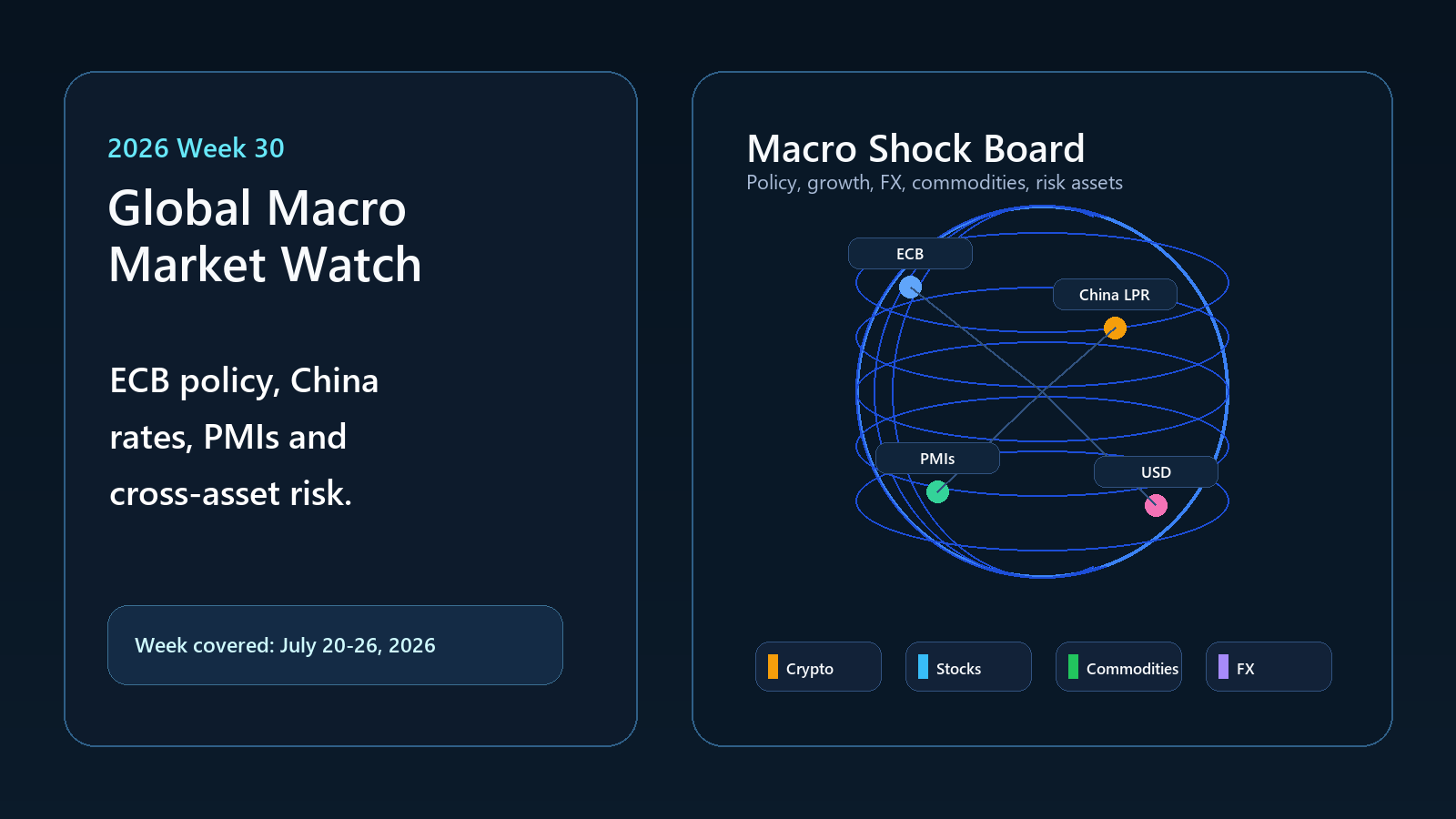
Week 30 is unlikely to be determined by a single data release. It is better viewed as a dashboard of interconnected signals: Europe provides the policy impulse, China carries the demand impulse, PMIs provide a forward-looking reading of the business cycle, and U.S. housing, jobless claims, and energy data show whether the world’s largest economy is cooling gradually or showing broader stress.
Timing also matters. Because Week 30 sits between the release of June inflation data and the next Federal Reserve decision, traders may treat every data point as a clue about central bank tolerance. If weak data points to easing inflation, it may provide support; if demand appears to be falling too quickly, it may create pressure. Strong data may help cyclical assets if it confirms resilience; but if it pushes up rate expectations, it may also hurt duration-sensitive assets. That is why this week is more about interpretation than simply trading around headlines.
Global Macro Calendar for July 20–26, 2026
| Date | Region | Event | Why Markets Care |
|---|---|---|---|
| July 20 | China | Loan prime rate guidance | Affects renminbi sentiment, China demand expectations, copper, Asian equities, and global risk appetite. |
| July 22–23 | Eurozone | European Central Bank monetary policy meeting | Affects EUR, European yields, bank stocks, global duration trades, and risk sentiment. |
| July 22 | United States | Weekly oil inventory cycle | May move crude oil, inflation expectations, energy stocks, CAD, and commodity-linked FX. |
| July 23 | United States | Weekly initial jobless claims | Provides a timely labor market pulse ahead of the next Federal Reserve meeting. |
| July 24 | United States | New home sales and housing signals | Tests the interest-rate sensitivity of a key part of the U.S. economy. |
| Later in the week | Global | Flash PMI surveys in reporting regions | Provides a forward-looking reading of manufacturing, services, pricing pressures, and demand. |
The ECB Is the Policy Anchor
The ECB’s July 22–23 meeting is the clearest scheduled policy event of the week. Its impact extends beyond Europe because the ECB decision changes the relative rates discussion. If the ECB appears comfortable with easing inflation and growth risks, EUR may weaken, European equities may receive support, and global bond markets may see the meeting as another step toward easier financial conditions.
The opposite message is equally important. If the ECB pushes back against market expectations, emphasizes wage pressure, or suggests that services inflation remains too sticky, European yields may rise and the euro may strengthen. That does not automatically mean all risk assets will fall, but it would make the week less friendly for liquidity-sensitive trades.
What Crypto Should Watch in the ECB Message
Crypto traders usually do not trade the ECB statement line by line, but they do trade the liquidity signals that emerge after it. If the Federal Reserve remains cautious, a more dovish ECB may push the euro lower, but it may also reinforce the view that major central banks are moving away from restrictive policy. BTC and ETH typically focus on second-order effects: whether global yields fall, whether the dollar strengthens or weakens, and whether investors are more willing to hold high-beta risk.
The most favorable scenario for crypto is a meeting that eases pressure on European yields without triggering disorderly currency moves. The bearish scenario is an ECB message that sounds hawkish, lifts yields, and keeps dollar demand supported through the relative policy channel.
For equity investors, the ECB also matters through banks and exporters. European banks may respond positively to “higher for longer” language if net interest margins appear protected, but the same message may weigh on higher-valuation growth stocks. Exporters have different sensitivities: a stronger euro reduces the value of overseas revenue when translated back into euros, while a weaker euro can support competitiveness, but may also imply weaker domestic momentum. Therefore, the policy message must be interpreted together with the currency reaction, not in isolation.
China Rates and PMIs Carry Demand Signals
China remains the most important marginal demand story for industrial commodities. If China’s rate guidance points to more support, copper, iron ore, energy demand expectations, and related Asian equities may all react. If policy guidance looks cautious or falls short of expectations, markets may interpret it as a sign that officials are not yet willing to push hard against weak domestic demand.
The same logic applies to global PMIs. Manufacturing surveys matter for commodities and exporters. Services surveys matter for wage pressure, margins, and inflation stickiness. Price components matter because they tell investors whether slowing growth is genuinely disinflationary, or whether costs remain stubborn even as activity cools.
For crypto, the impact of China and PMI data is indirect. A better growth pulse may support risk assets if it does not push yields too high. A weaker growth pulse may be mixed: it may raise rate-cut expectations, but it may also push traders toward defensive dollar positions. Therefore, a soft-landing interpretation is more constructive than a simple weak-data interpretation.
The Commodity Channel Is the Clearest China Link
The China narrative is most direct in copper, iron ore, crude oil demand expectations, and commodity-linked currencies. If traders see signs of stronger credit support or improving industrial activity, they may buy assets tied to real-economy demand before the improvement shows up in corporate earnings. If the message disappoints, copper, Asian equities, AUD, CNH, and mining stocks are often the first to come under pressure.
For digital assets, the China channel is more psychological than mechanical. Stronger Chinese demand can make the global risk backdrop look less fragile, which helps high-beta assets. But that is not the same as direct crypto liquidity. Traders should avoid treating China support-related headlines as automatically bullish for BTC or ETH unless the dollar, yields, stablecoin liquidity, and derivatives positioning confirm the move.
U.S. Data Will Test the Fed Outlook
The next Federal Reserve decision will arrive after Week 30, but this week’s U.S. data still matters because it will shape the market backdrop going into that meeting. Weekly initial jobless claims do not attract as much attention as CPI, but they are timely. A stable claims trend supports the soft-landing narrative. A sudden jump would raise concern that labor market cooling may be becoming more than gradual.
Housing data also deserves attention. U.S. housing is one of the most interest-rate-sensitive parts of the economy. New home sales and related housing signals may affect homebuilder stocks, mortgage rate expectations, lumber demand, and broader views on consumer resilience. Stronger housing data may support cyclical equities, but may also keep yields firm. Weaker data may benefit duration assets, but could damage confidence in earnings.
Oil inventories add the commodity layer. Crude is not just an energy trade; it also affects inflation expectations, headline CPI risk, energy stocks, and FX pairs such as CAD and NOK. A bullish inventory draw may support oil prices and commodity currencies, while an unexpected inventory build may drag on crude and reduce near-term inflation pressure.
Housing Is the Understated Rates Trade
Housing may look like second-tier data, but it is often where the impact of high rates shows up first. Strong new home sales may indicate that consumers are still absorbing higher financing costs, which supports parts of the equity market, but may keep bond markets cautious. Weak sales may support the case for lower yields, but they also raise questions about household demand and credit sensitivity.
This trade-off is especially important for crypto and growth stocks. Lower yields are usually supportive, but a growth scare can overwhelm the benefit from rates. The most constructive outcome is not a housing collapse, but a cooling report that maintains the disinflation narrative without forcing investors to price a sharper slowdown.
Market Impact Map
The clearest risk-on scenario for Week 30 would combine a non-hawkish ECB, steady China policy support, PMIs that slow but do not break, and U.S. data pointing to cooling rather than recession. In that backdrop, crypto may benefit from lower yield pressure and stronger risk appetite. Growth stocks may resume leadership. Gold may remain supported if real yields fall. The dollar may face pressure unless U.S. data clearly outperforms.
The risk-off scenario is not only about bad growth. It may also come from central bank surprises. If the ECB sounds hawkish, PMIs show price stickiness, and U.S. jobless claims remain too firm to validate easier policy, yields may rise. That usually supports the dollar, weighs on gold, drags on long-duration equities, and leaves crypto vulnerable to liquidation-driven volatility.
The Dollar Is the Transmission Mechanism
For a global macro week, the dollar often matters more than the data label. A stronger dollar may tighten conditions for crypto, emerging markets, commodities, and multinational corporate earnings. It also tends to make it harder for dollar-denominated commodities to sustain gains unless physical demand is strong. A weaker dollar does the opposite: it eases the financial backdrop and may support gold, BTC, ETH, copper, and non-U.S. equities.
That does not mean every weaker-dollar day is automatically bullish. If the dollar falls because U.S. growth is deteriorating too quickly, the risk signal may be complex. The clearer risk-on backdrop is a softer dollar caused by lower rate pressure and stable growth expectations, not by recession fears.
| Macro Signal | Crypto | Equities | Commodities | FX |
|---|---|---|---|---|
| Dovish ECB, softer yields | Supports BTC/ETH risk appetite | Helps growth stocks and rate-sensitive sectors | Gold may benefit from lower real yields | EUR may weaken; USD reaction depends on Fed expectations |
| Hawkish ECB, price-stickiness language | Suppresses liquidity trades | Drags on European and long-duration equities | Gold may come under pressure if yields rise | EUR may strengthen versus lower-yielding currencies |
| China support signals | Supports high-beta sentiment | Positive for Asia and cyclical assets | Bullish for copper and industrial demand | Supports CNH and AUD sentiment |
| Weak PMIs with falling prices | Mixed: rate-cut hopes alongside growth concerns | Defensive rotation may emerge | Industrial commodities under pressure | USD and JPY may receive safe-haven demand |
| Oil inventory draw | Complex if inflation concerns rise | Supports energy stocks | Bullish for crude oil | Supports CAD and NOK |
What Traders Should Watch Next
The most useful question in Week 30 is not “is one number good or bad?” but whether the week’s signals are aligned. A dovish ECB, stable PMIs, and supportive China policy would point to easier global financial conditions. A hawkish ECB combined with sticky PMI price components would point in the opposite direction.
Crypto traders should watch the dollar, U.S. Treasury yields, ETF flows, and liquidation maps during the same windows as macro data releases. Even if the headline is macro-friendly, the move can still fail if leverage is too crowded. Equity traders should distinguish between growth and duration: a weak-data week may help rate-sensitive stocks, but may hurt cyclicals if recession concerns rise. Commodity traders should monitor both China and oil inventories, because crude and copper do not always respond to the same impulse.
The broader message is that Week 30 is a confirmation week. Markets already know inflation is the headline-level debate. Now they need evidence that policy, growth, and liquidity can move in a direction that supports risk assets without reigniting inflation pressure.
Investors should also watch the sequence of events. If China support appears early in the week and the ECB later sounds less restrictive, markets may treat that combination as a broad liquidity improvement. If China disappoints first and the ECB then sends a hawkish signal, risk assets may enter the following week in a defensive posture. The same data may carry different weight depending on sequence, positioning, and whether traders are already crowded into the expected outcome.
Trade with an Edge
In fast-moving markets, execution matters as much as direction. That is why more traders are turning to decentralized venues such as edgeX for perpetual contracts and spot trading.
Unlike traditional centralized platforms, edgeX is built around self-custody, meaning you retain control of your assets and authorize fund movements yourself. For active traders, this offers a meaningful advantage: market access without handing custody over to an exchange.
edgeX also combines the core advantages of DeFi with a trading experience designed for serious execution. The platform emphasizes deep liquidity, high-speed order matching, and low-slippage performance, helping traders stay responsive in volatile environments. With support for high leverage, it gives experienced market participants more flexibility in expressing macro views and managing risk.
Beyond execution, decentralized trading infrastructure can also offer structural advantages: greater transparency, on-chain verification, and reduced reliance on centralized intermediaries. For traders who want performance without giving up control, this model is becoming increasingly attractive.
edgeX is built precisely for that balance — combining a professional trading experience with the core principles of decentralized markets.
For readers looking to explore a more capital-efficient, self-custodial way to trade, edgeX is worth a closer look.
FAQ
What is the most important macro event in Week 30 of 2026?
The European Central Bank monetary policy meeting on July 22–23 is the most important scheduled policy event, because it may affect EUR, European yields, bank stocks, global bond pricing, and risk appetite.
Why does the ECB meeting matter for crypto?
Crypto is sensitive to global liquidity conditions. If the ECB affects bond yields, the euro, the dollar, or risk appetite, BTC and ETH may react even though they are not European assets.
How does China’s rate guidance affect commodities?
China is a major source of marginal demand for industrial commodities. More policy support may benefit copper, iron ore, energy demand expectations, and related Asian equities, while weak guidance may weigh on those trades.
Should readers trade every macro data release?
No. A weekly macro watch is a risk map, not an instruction to trade every data point. A better approach is to identify which data could change liquidity, yields, growth expectations, or positioning.
Why include FX in a crypto and equity market watch?
FX often carries the first signal from macro data. A stronger dollar may weigh on crypto, commodities, and emerging market assets, while a weaker dollar may support global risk appetite.