DeFi’s Deadliest Lie: Why “Audited” No Longer Means Safe
Key Takeaways
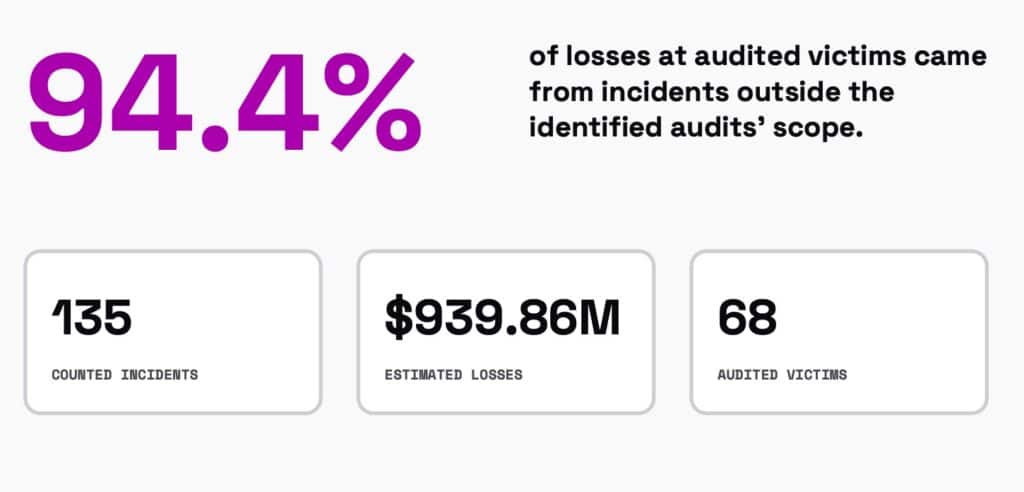
- •The first half of 2026 saw 135 verified crypto security incidents that caused $939.86 million in losses.
- •Audited projects made up 68 of the incidents and accounted for $721.24 million, or 76.7% of the total stolen capital.
- •Out-of-scope attacks caused 46 of the 68 audited breaches and $680.97 million in losses, which was 94.4% of audited losses.
- •The report highlights recurring attack paths such as compromised keys, front-end script injections, cloud and CI/CD compromises, and off-chain relayers or provers.
- •ack3 says audit protection decays over time and argues for living assurance that combines continuous monitoring, automated scanning, and human review.
In the first six months of 2026, the crypto industry lost $939.86 million across 135 verified security incidents. At first glance, the explanation may seem straightforward: projects continue to deploy unvetted code to mainnet, exposing protocol treasuries to familiar exploits.
The data, however, points to a more troubling picture.
More than half of the exploited projects, representing over $721 million in losses, had completed security audits. Yet in 94.4% of those cases, the exploit did not come from a missed reentrancy bug in a reviewed smart contract. Instead, attackers moved through areas the auditors did not examine:
- Compromised private keys
- Hijacked front-end scripts
- Leaky cloud infrastructure
- Unreviewed off-chain relayers
These findings come from a comprehensive H1 2026 security report published by ack3, an AI-native cybersecurity firm formerly known as Ackee Blockchain Security. Since 2021, ack3 says it has completed 237 protocol reviews and has watched the security boundary expand beyond isolated Solidity files to full protocol architectures. In response, the firm combines manual review, Wake-based fuzzing, off-chain threat modeling, and proprietary AI scans designed to map cross-component dependencies.
The report highlights a core weakness in how Web3 evaluates risk: the industry often treats “audited” as a permanent binary status, while attackers view protocol architectures as interconnected and constantly changing web services.
“An audit is a timestamp and a boundary, not a lifetime warranty,” says Josef Gattermayer, Founder at ack3. “The old question was: ‘Was it audited?’ The useful questions are: ‘What exactly was audited, when, and what has changed since?’ A contract report cannot protect a leaked signing key, a compromised front end, or a legacy deployment that no longer matches the reviewed code.”
The H1 2026 Loss Landscape
Across the first half of 2026, the Web3 security ecosystem recorded 135 verified security incidents, draining $939.86 million from decentralized protocols and their users. Every exploit in ack3’s dataset met a strict two-source verification standard, covering both on-chain and off-chain breaches.
When the incidents are grouped by historical audit status, the distribution appears relatively even:
- Audited victims: 68 incidents (50.4%) targeted projects with at least one completed, publicly verifiable security review before the attack.
- Unaudited victims: 35 incidents (25.9%) affected protocols that had not undergone formal third-party security reviews.
- Audit status unknown: 32 incidents (23.7%) involved projects whose audit history could not be confirmed at the dataset cutoff.
The Audit Illusion
At first, the figures might suggest that security reviews offer only limited protection. But when the incidents are measured by financial damage rather than count, the scale of the problem becomes clearer.
Audited protocols accounted for $721.24 million of the $939.86 million lost in H1 2026, or 76.7% of all stolen capital. Unaudited projects and those with unknown audit histories together accounted for $218.62 million.
This gap exposes what ack3 calls the Audit Illusion. Capital tends to flow toward projects that display security badges. Institutional allocators, yield farmers, and retail traders often treat an audit report as a green light, sending liquidity into protocols with a polished security posture.
That dynamic creates a paradox: audits attract capital, and capital turns audited protocols into higher-value targets. While a careful code review can deter opportunistic attackers looking for obvious Solidity flaws, sophisticated threat actors do not stop at the audit badge. They shift attention from reviewed smart contracts to the surrounding infrastructure that remains unmonitored.
As H1 2026 showed, attackers are no longer trying to break through the front door of audited code. They are entering through the side doors that were never reviewed.
The Scope Gap: Where $680 Million Disappeared
One of the most dangerous misconceptions in Web3 security is equating a smart contract audit with whole-system protection. In practice, an audit usually covers a specific commit hash and a defined set of Solidity or Rust files. It does not cover the deployment environment, developer workstations, cloud infrastructure, DNS records, or the private keys used to manage protocol parameters.
ack3’s research shows that this difference — the “scope gap” — is where nearly all of the stolen capital vanished. Out of 68 audited protocols breached in H1 2026, 46 were hit through attack vectors completely outside the scope of their published audits. Those 46 incidents caused $680.97 million in losses, representing 94.4% of the financial damage suffered by audited victims.
The Count vs. Value Gap
The disparity becomes even clearer when comparing incident counts with actual dollar losses.
Incidents where the exploit path ran inside audited code accounted for 20 of the 68 audited breaches, or about 29.4% by count. But those 20 in-scope exploits produced only $35.21 million in losses, just 4.9% of total audited losses.
The implication is stark. Traditional code audits appear to be doing a reasonable job of catching catastrophic smart contract bugs, keeping in-scope losses below 5% of the total. The larger problem lies elsewhere: protocol teams are leaving the back door open and losing the remaining 94.4% to infrastructure and operational breaches.
Anatomy of the Modern Attack Surface
Attackers have recognized that smart contracts are often the strongest part of the chain, so they increasingly target the operational surface around the code.
ack3 identified four recurring operational attack vectors behind out-of-scope drains:
Compromised private keys and signing authorities: Admin keys, multisig signers, and operational hot wallets remain the quickest route to a full drain. Once a signing authority is compromised through phishing or poor key management, an attacker can upgrade contracts, change parameters, or trigger emergency mints using legitimate protocol functions and bypass on-chain logic checks.
Front-end script injections and DNS hijacking: Rather than attacking on-chain logic, attackers compromise the interface users trust. By taking over DNS records or injecting malicious JavaScript through third-party web dependencies, they can swap target addresses or trick users into approving malicious spenders while interacting with what appears to be a legitimate UI.
CI/CD pipelines and cloud infrastructure credentials: Attack paths increasingly move through GitHub Actions, cloud environment variables, and build pipelines. Hardcoded secrets or leaked API keys can allow attackers to alter build artifacts or access infrastructure assets before code ever reaches the blockchain.
Unreviewed off-chain provers, relayers, and cross-chain infrastructure: Modern DeFi protocols rely heavily on off-chain systems, including provers, oracle relayers, zero-knowledge sequencers, and cross-chain messaging bridges. These services sit outside standard contract audits, yet they determine the inputs that trigger on-chain execution. When a relayer or prover fails, the smart contract simply processes the bad state update as instructed.
Point-in-Time Assurance and the Aging Problem
Even when an exploit affects code that was explicitly inside an audit’s scope, ack3’s data points to another weakness in Web3 security practices: assurance decay.
An audit report is not a continuous shield. It is a static snapshot of a system at a single moment in time. Yet protocols often present two-year-old PDF reports as if they were proof of current security. ack3’s research shows that the protection offered by a historical review declines over time, even if the underlying contract logic has not changed.
The Decay Rate of Security
Among the 20 incidents where the attack path fell directly inside a protocol’s audited scope, 17 occurred at least six months after the most relevant audit. The median time between audit and exploit was 18 months, with gaps ranging from three months to as long as 56 months.
Only three protocols suffered in-scope exploits within six months of receiving an audit report. Most in-scope failures happened long after the original review:
- Under 6 months: 3 incidents (15% of in-scope cases)
- 6 to 24 months: 9 incidents (45%)
- 24 months or more: 8 incidents (40%)
The takeaway is straightforward: an audit’s relevance fades quickly in a fast-moving ecosystem. Age alone does not create a smart contract bug, but it measures how long code remains exposed while everything around it changes. For that reason, ack3 argues that protocols should complete multiple audits regularly and avoid relying on a two-year-old report.
AI as an Attack Multiplier and the Shift to Living Assurance
Specialized AI tools have permanently changed the speed and scale of security research. Although ack3’s H1 2026 dataset does not attribute any specific incident to autonomous AI agents, it says the broader threat landscape has shifted because attackers are using AI as an operational multiplier.
The New Threat Realism
Finding a complex reentrancy bug in a heavily reviewed Solidity contract still requires significant skill and time. Finding an exposed enclave key in an unindexed off-chain repository or identifying an unpinned third-party script in a front-end build pipeline used to take tedious manual reconnaissance.
AI models have reduced that work to near zero.
Attackers now use AI tooling to ingest entire protocol ecosystems quickly, map cross-repository relationships, trace off-chain-to-on-chain parameter flows, and probe the seams between cloud infrastructure, front-end delivery networks, and smart contracts.
With benchmarks such as EVMbench actively measuring AI agents on vulnerability detection, automated patching, and exploit synthesis, the advantage goes to whoever can scan the broadest surface area the fastest. If defenders limit their view to a folder of smart contracts, AI-assisted attackers will often find the surrounding operational weaknesses first.
Replacing the PDF Artifact
Treating a static PDF audit report as a permanent security credential is now, in ack3’s view, an existential risk. A static document cannot warn a team when a developer commits an API secret to a public repository, nor can it evaluate how a contract behaves after an upstream liquidity pool changes its fee structure.
To operate in an environment where attack vectors cross component boundaries at AI-driven speed, protocols must move from point-in-time reviews to living assurance. ack3 outlines three core pillars for that transition:
-
Replace static contract lists with an active, real-time registry of the full system surface, continuously tracking:
- On-chain smart contract deployments and proxy addresses
- Off-chain infrastructure, relayers, provers, and oracle pipelines
- Administrative roles, multisig signers, and key management schemes
- Web dependencies, CDNs, and front-end build pipelines
-
Do not renew assurance on a rigid annual schedule, and do not assume it is permanent. Protocols need explicit operational triggers that immediately flag code or infrastructure for targeted re-audit, including:
- Deployment of new proxy implementations or parameter updates
- Key rotations, administrative role transfers, or multisig threshold changes
- Integration of new cross-chain bridges, oracle feeds, or upstream liquidity protocols
- Discovery of novel attack classes or exploit vectors in peer protocols
-
Use machine analysis and human expertise together before and after mainnet deployment. Automated AI scanners and Wake-based fuzzing engines are well suited to broad machine search, cross-component dependency tracing, logic-drift detection, and monitoring live infrastructure for unexpected state changes. Human security engineers then verify exploitability, evaluate economic threat models, and validate business logic.
The goal is not to eliminate audits, but to make assurance keep pace with system changes. In that model, the binary “audited” label becomes what it should have been all along: a continuous process rather than a static badge.
Conclusion: Rethinking Security Posture in Web3
The $940 million lost in H1 2026 makes one point clear: treating a historical point-in-time audit as a permanent green light is operational negligence. Smart contracts do not exist in a vacuum. An audit that covers Solidity files while ignoring front-end dependencies, administrative signing keys, cloud infrastructure, and off-chain provers is not a full security guarantee.
As capital allocation in Web3 matures, risk evaluation is shifting from point-in-time reviews toward whole-system monitoring. The future of Web3 security belongs to teams that treat assurance as an active operational discipline. Those that continue to rely on static PDF reports will remain the highest-value targets on the board.