HSC Conference Panel 'Infrastructure: Building Web3's Rails' Explores Interoperability, User Ownership and the of Web3 Infrastructure
Key Takeaways
- •Panelists from ZKsync, Monad Foundation, Base, Sonic Labs, and Dash agreed that fast execution, low fees, and sub-one-second settlement have become the baseline rather than differentiators for Web3 networks.
- •Sonic Labs CEO Matt Visser argued that true finality, which makes settled transactions irreversible, matters more to regulators than probabilistic finality, while Monad's Eunice Giarta cautioned that similar throughput can come at the cost of very different properties.
- •The panel examined the wave of corporate chains from Robinhood, Stripe, and Circle, noting that dedicated chains offer differentiated block space but risk fragmentation and the loss of network effects, with interoperability cited as the decisive factor.
- •On user ownership, Visser encapsulated the panel's view that wallets hold the session, apps hold the customer relationship, and blockchains provide the warranty, with users effectively held at every layer at once.
- •Privacy has matured from a fringe demand into an institutional requirement, with panelists favoring compliant approaches such as selective disclosure over the complete opacity exemplified by a historic unauditable Zcash bug.
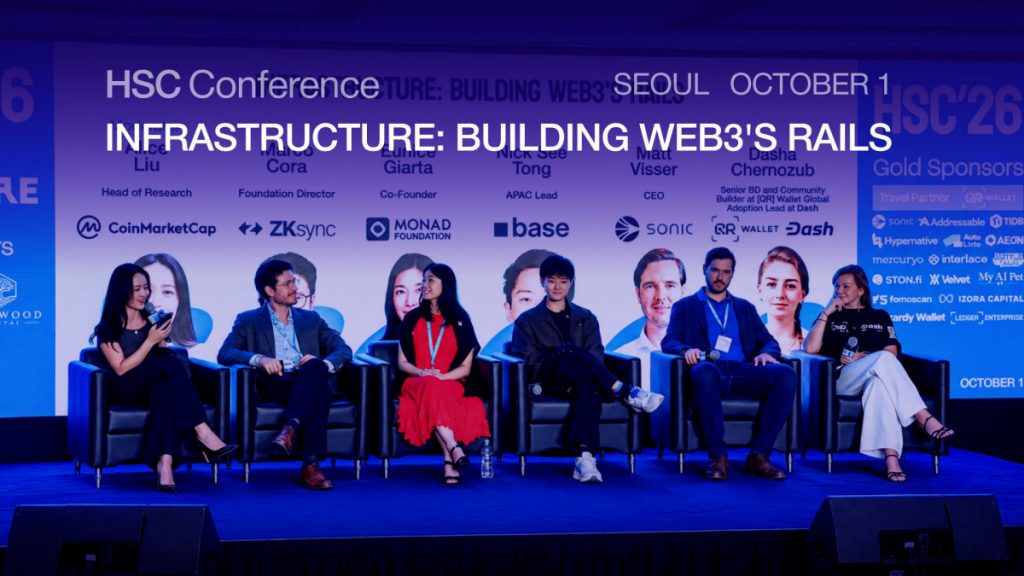
The HSC Conference is set to return to Seoul on October 1, 2026, convening senior voices from financial institutions, crypto investment funds, and technology companies to debate the direction of digital finance. Hosted by Mpost Media Group in partnership with Z Venture, the event will take place at Novotel Ambassador Seoul Gangnam. The infrastructure theme sits at the heart of that debate: every payment, application, and settlement in Web3 ultimately depends on the base-layer networks the industry calls its rails.
One of the event's most anticipated sessions, "Infrastructure: Building Web3's Rails," features the builders behind Web3's core infrastructure in a conversation on scalability, interoperability, and what it takes to support the next wave of adoption. Alice Liu, Head of Research at CoinMarketCap, is moderating the discussion. The panelists are Marco Cora, Director, Foundation at ZKsync; Eunice Giarta, Co-Founder of Monad Foundation; Nick See Tong, APAC Lead at Base; Matt Visser, CEO of Sonic Labs; and Dasha Chernozub, Senior BD and Community Builder at QR Wallet and Global Adoption Lead at Dash.
Beyond Speed: Redefining Performance
The panel opened with a question about limits: if fast execution, low fees, and settlement in under one second have become the floor, what is the ceiling?
Visser argued that raw speed is no longer the differentiator. He pointed instead to economic alignment, under which most transaction cost flows back to builders, and to the distinction between probabilistic finality and true finality, noting that regulators prefer assets that are actually settled rather than probably settled. The distinction is practical: in probabilistic systems a transaction becomes harder to reverse only as more blocks stack on top of it, while true finality makes a settled transaction irreversible.
Giarta concurred that speed is now table stakes, but cautioned that "speed is not fungible," because chains can reach similar throughput while sacrificing very different properties. For her, the higher purpose of public networks comes down to fair access and composability, the ability of applications to build directly on top of one another's components.
Chernozub added a community dimension, stressing that technology can be copied while principles. A decentralized project endures, she argued, because people believe in freedom, privacy, and control over their own money.
Cora tied the threads together, contending that value accrues where alternatives are scarce, which is one reason privacy now matters. Companies increasingly need it, credible options remain few, and privacy can become a real moat. That search for scarce, valuable properties led directly to the next question: why so many companies now prefer to build chains of their own.
Own Chains or General-Purpose Networks
The conversation then turned to the wave of corporate chains, from Robinhood to Stripe and Circle — firms that have each moved to launch dedicated blockchain networks, a marker of how far traditional finance and payments companies have traveled toward operating their own rails. Cora framed the tradeoff as fragmentation versus differentiated block space: a specialized chain can offer a valuable property, but leaving a network with large network effects carries a cost.
See Tong said dedicated chains make sense for highly function-driven products such as high-performance trading venues, yet the deeper goal of bringing the world on chain is about ecosystem. In his words, the question is less about throughput and more about "the ecosystem of apps that are built around it": whether an asset can be deposited as collateral, borrowed against, or used across structured products.
Giarta offered an intranet analogy to explain why general-purpose networks still matter. Institutions once ran internal networks because the open internet felt unsafe, but separated systems made collaboration difficult, and the same logic now applies to private and public blockchains.
Cora and Visser both stressed that the answer ultimately depends on interoperability, with Cora citing Hyperledger as an early cautionary tale — the enterprise blockchain initiative whose siloed corporate networks are often invoked as a lesson in the cost of poor connectivity — and arguing that zero-knowledge proofs, which let one party verify a claim without seeing the underlying data, can preserve privacy while keeping verification simple.
If the future is many chains that must still connect, however, the natural next question is who captures the value, and who owns the user.
Who Owns the User
On this point, the panel avoided naming a single winner. Visser delivered the sharpest summary: "the wallet owns the session, the app owns the customer and the blockchain owns the warranty."
Chernozub described what such sharing looks like in practice, explaining how Dash and QR Wallet exchange users across travel, payments, and merchant discounts, and adding that attention itself can be owned, as communities such as Pudgy Penguins, the widely known penguin-themed NFT and consumer brand, demonstrate.
Giarta reframed the debate around experience, recounting how she switched ride apps in Seoul simply because the experience was better, and arguing that loyalty follows whatever serves the audience best. See Tong described the flywheel that results, in which good apps attract users, users bring assets, and assets fund builders.
The panel agreed that users are held at every layer at once. That conclusion set up the final and most sensitive theme: the one property that both users and institutions increasingly demand, privacy.
Privacy Moves to the Center
The panel agreed that privacy has matured from a fringe demand into an institutional requirement. Cora distinguished compliant privacy from what he called scary privacy, using Zcash — the long-running privacy-focused cryptocurrency — as an example of opacity so complete that a historic bug could not be fully audited, while praising approaches that remain transparent internally and opaque externally.
Giarta emphasized that privacy is not anonymity, pointing to selective disclosure, which lets users or institutions prove specific details to a counterparty or regulator without exposing everything else, as the model institutions actually want. Visser agreed that regulation is pulling the industry forward, and Chernozub closed the theme with pride: "privacy was the narrative for 12 years and we were all alone."
The panel concluded that modern Web3 rails are judged not by speed alone but by a combination of interoperability, user experience, credible privacy, and fair access. What began as a question about the ceiling above speed ended as a broader picture of maturity, in which infrastructure wins by serving builders, institutions, and everyday users at the same time. For readers weighing new networks and chain launches, the session doubles as a scorecard drawn from the panel itself: how chains connect, who captures the value, and whether privacy can hold up under institutional scrutiny.
Source: Metaverse Post

