Senator Warren Leverages Voter Disapproval of Trump's Crypto Earnings to Challenge Clarity Act's Senate Path
Key Takeaways
- •An Echelon Insights poll commissioned by Senator Warren shows 55% of voters disapprove of President Trump's approximately $1.4 billion in cryptocurrency earnings, with 44% strongly disapproving.
- •The Clarity Act passed the Senate Banking Committee 15-9 on May 14, 2026, but remains stalled on the Senate floor with no vote scheduled.
- •Warren contends the bill's ethics provisions cover only future token launches and do not address ongoing income from Trump's World Liberty Financial venture or TRUMP memecoin royalties.
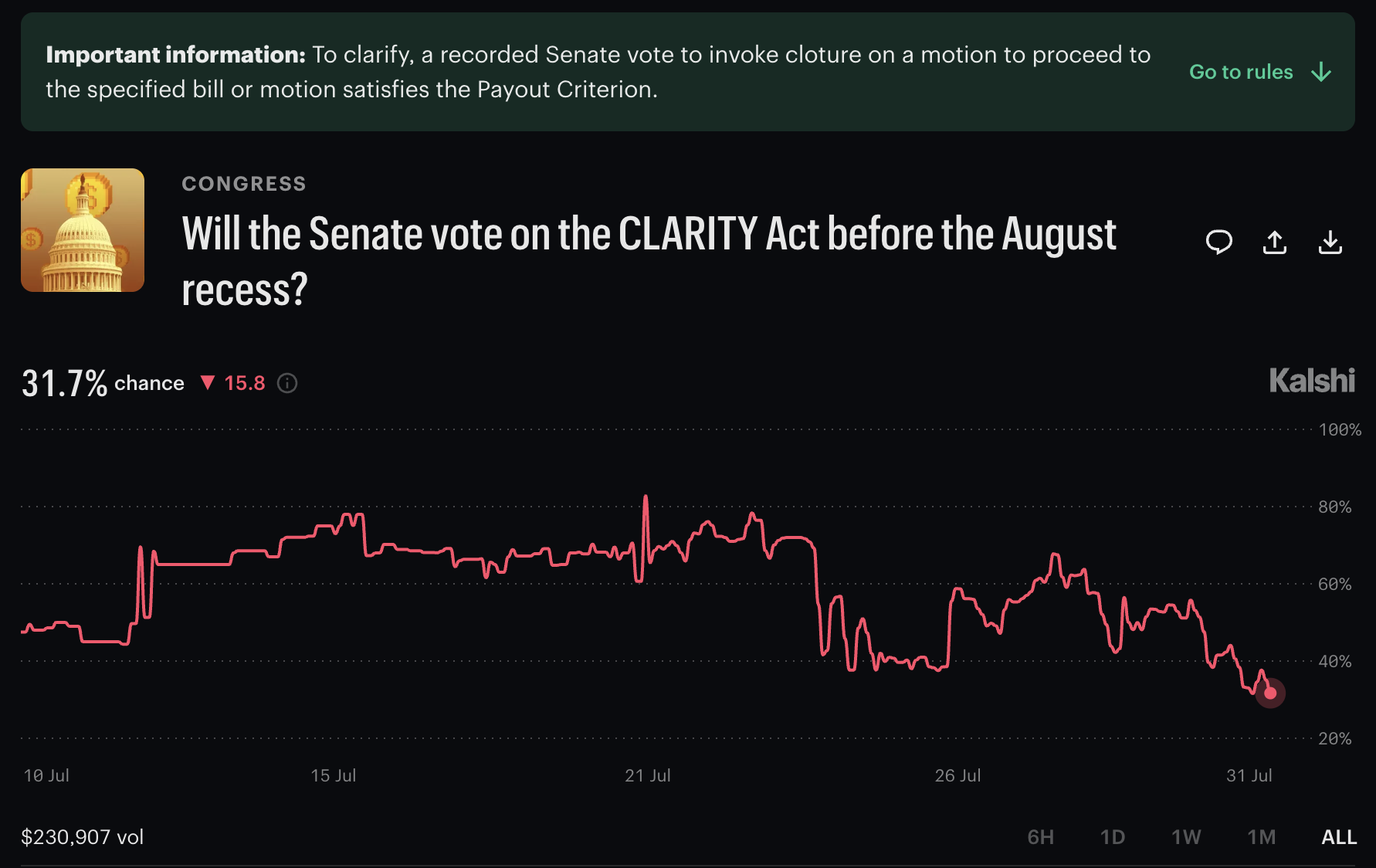
- •Passage requires at least seven to ten Democratic votes to reach the 60-vote cloture threshold, and the prediction market Kalshi estimates only a 31% probability of the bill becoming law.
- •The Clarity Act aims to clarify SEC and CFTC jurisdiction over digital assets, a step that could unlock greater institutional investment in a tokenized real-world asset market currently exceeding $65 billion.
Senator Elizabeth Warren is wielding an Echelon Insights poll showing that 55% of voters disapprove of President Trump's cryptocurrency earnings—totaling approximately $1.4 billion—as political leverage against the Clarity Act, the pending crypto market structure legislation currently stalled in the Senate.
Warren contends that the bill's ethics provisions fall short because they do not block ongoing income from World Liberty Financial or the Official Trump memecoin. The legislation requires 60 votes to advance past a cloture vote in the Senate, making the political backlash a meaningful regulatory obstacle.
In a post on X (formerly Twitter) on July 30, 2026, Warren wrote:
Tens of millions of Americans can't afford the basics, and they want the Washington to do something about the affordability crisis.
Trump's response? Using the presidency to boost his family's crypto business.
No wonder 55% of voters disapprove of Trump's crypto earnings. pic.twitter.com/6RfMzRHFWp
— Elizabeth Warren (@SenWarren) July 30, 2026
Committee Passage and Amendment Battle
The Clarity Act cleared the Senate Banking Committee on May 14, 2026, with a 15-9 vote, despite Warren's 44 failed amendments and her repeated warnings that the legislation could undermine the broader economy and weaken investor protections.
A separate poll indicates that 52% of Americans support the Clarity Act, while 70% believe crypto regulations should already be in place. That combination leaves lawmakers facing a familiar Washington split: broad support for clearer rules in principle, but sharper disagreement over how those rules should address conflicts of interest and who should be covered.
The Ethics Provision Debate
Senator Cynthia Lummis (R-WY), a co-sponsor of the bill, pushed back on Warren's criticisms in an X post on July 31, 2026:
This bill literally requires President Trump to divest his digital asset holdings or put them in a blind trust.
It's becoming painfully clear some of my Democrat colleagues would rather let consumers lose everything if a crypto exchange fails and posture for the midterms than…
— Senator Cynthia Lummis (@SenLummis) July 31, 2026
Warren's 55% disapproval figure carries particular political weight because of the intensity behind it: 44% of respondents indicated they strongly disapprove. This level of opposition provides Democratic senators with political cover to resist a cloture vote, even as some crypto-friendly Democrats weigh supporting the industry-friendly legislation.
In a letter to Senate Majority Leader John Thune and Senate Democratic Leader Chuck Schumer, Warren argues that the bill's ethics provisions address only future conduct, leaving untouched the ongoing income generated by Trump's existing crypto ventures. Trump's 2025 financial disclosure revealed over $1.2 billion in crypto-related earnings, even as he advocates for regulatory frameworks that could enhance the value of those holdings—an unaddressed conflict of interest, according to Warren.
Passing the Clarity Act requires at least seven to ten Democratic votes in the Senate. Warren's strategy of emphasizing majority voter disapproval and identifying the statutory gap makes it considerably harder for Democrats to support the bill without first confronting the issue of presidential crypto earnings.
Senate Timeline and Passage Probability
The Clarity Act remains stalled on the Senate floor. Although it has cleared the committee process, no floor vote has been scheduled. A central concern raised by Warren is that the bill's ethics language applies solely to the launching of new tokens, not to ongoing income from tokens already in circulation.
Warren maintains that any crypto legislation must prevent the President, Vice President, senior executive branch officials, and members of Congress from profiting off the crypto industry. This includes revenue from World Liberty Financial and TRUMP memecoin royalties.
The White House has dismissed the conflict-of-interest concerns, stating that all actions taken serve the American people's best interests. However, time for a compromise is running short before the congressional recess, and experts warn the legislative window is narrowing as midterm elections approach.
According to the prediction market Kalshi, the Clarity Act has approximately a 31% estimated chance of passage, reflecting the uncertainty surrounding the ethics debate and procedural hurdles.
Implications for Digital Asset Markets
For the broader crypto market, Warren's Echelon Insights poll underscores regulatory risks with tangible implications. The proposed Clarity Act is designed to delineate the respective jurisdictions of the SEC and CFTC over digital assets, a clarification that could encourage greater institutional investment in digital commodities, tokenized securities, and DeFi protocols.
The value of tokenized real-world assets currently exceeds $65 billion, but the absence of regulatory clarity continues to constrain institutional participation. Asset categories most exposed to a failure of the Clarity Act include digital commodity tokens, real-world asset (RWA) tokenization platforms, and DeFi protocols that depend on new regulatory frameworks.
Politically branded tokens, such as the TRUMP memecoin, face compounded risks, as Warren's campaign could push for stricter targeted regulations against them.
Investment manager Lawrence Lepard has cautioned that the political climate surrounding Trump's crypto earnings could produce a more restrictive regulatory environment if current dynamics shift.
Three key signals are worth monitoring ahead of any potential legislative movement: a formal floor vote scheduled by Majority Leader Thune, any amendments that name specific tokens such as the TRUMP memecoin, and Polymarket passage odds rising above 50%. None of these conditions have been met as of the time of reporting. Ethical gaps and Democratic voting dynamics remain critical variables for any regulation-sensitive segment of the digital asset market.

