Nasdaq Ends Week Down 3.4% Despite Friday Tech Rebound as Jobs Data Tops Forecasts
Key Takeaways
- •The Nasdaq Composite climbed 1.1% on Friday to close at 24,579.42 yet finished the week down 3.4%, while the S&P 500 logged a 2.7% weekly decline, its worst since June.
- •Friday's rebound was concentrated in technology stocks, as shown by the flat performance of the ProShares S&P 500 Ex-Technology ETF, with Nvidia rising 3.9% and AMD jumping 10.8%.
- •Thursday's selloff wiped out approximately $3 trillion in market value and pushed the Nasdaq into a correction as investors grew concerned about a possible slowdown in data center construction and AI spending.
- •The US economy added 165,000 jobs in October, well above the 65,000 economists expected, while September's figure was revised to 60,000.
- •Investors will focus on next week's October consumer price index to gauge price pressures and determine whether Friday's rally can hold.
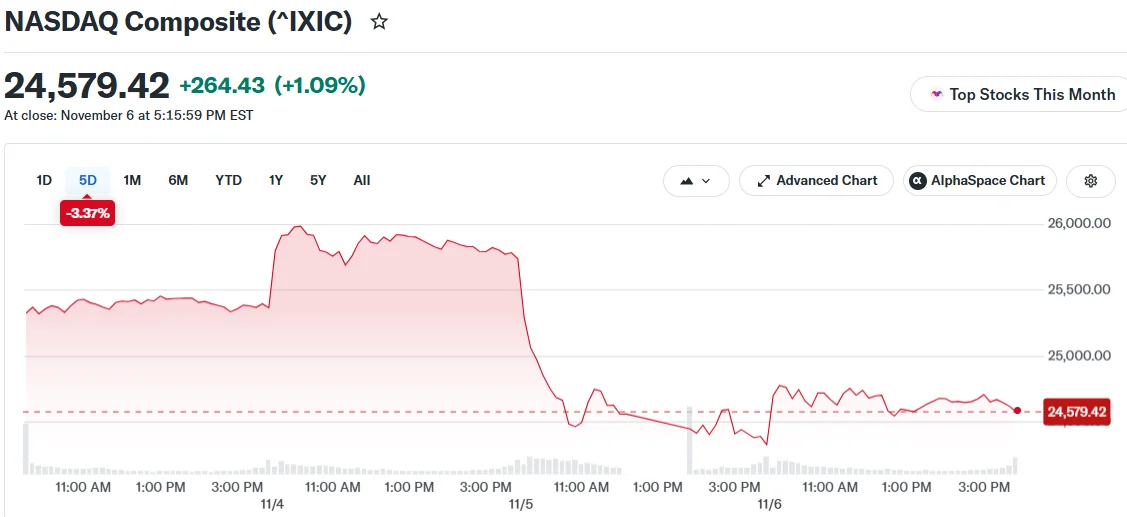
Wall Street closed a turbulent week with a rebound on Friday, but the late rally was not enough to erase the heavy losses booked earlier in the week.
The Nasdaq Composite gained 1.1% on Friday to finish at 24,579.42, leaving the index down 3.4% for the week. The S&P 500 rose 0.3% to close at 7,376.86, which left it down 2.7% over five sessions — its worst weekly result since June. The Dow Jones Industrial Average slipped 0.5%, or 236 points, to 51,285.73, taking its weekly loss to 0.9%. All three major indexes still ended the week in negative territory.
Tech Stocks Drive the Bounce
Friday's gains were concentrated in technology shares. The ProShares S&P 500 Ex-Technology ETF, which excludes technology stocks from its holdings, ended the day flat — a sign of how narrow the rebound was. That narrowness carries weight for the broader market, because technology companies hold some of the largest weightings in the Nasdaq and the S&P 500, so swings in chip shares tend to move the headline indexes.
Nvidia rose 3.9% on Friday, while AMD jumped 10.8%. Micron and Sandisk also recovered part of their recent losses after chip makers were hit hard in the prior session's selloff. Pre-market trading pointed to a broad recovery across the sector ahead of the jobs report, as noted in the following post on X:
Chip stocks are seeing a bit of a bounce in premarket trading ahead of the nonfarm payrolls report, following Thursday's AI-led rout: Micron +9.2% AMD +8.3% Intel +6.2% Nvidia +5% Broadcom +4.9% pic.twitter.com/IEQwUXVa5e
— Wall St Engine (@wallstengine) November 6, 2026
Lale Akoner, global market strategist at eToro, said the rebound suggested retail investors were buying the dip in tech. She added that she is keeping a very cautious view because the buying did not spread beyond the technology sector.
Thursday's Selloff Set the Tone
Thursday's selloff was the week's sharpest. It erased about $3 trillion in market value and pushed the Nasdaq into a correction — a decline conventionally defined as 10% or more from a recent peak — as investors grew worried about a possible slowdown in data center construction and AI spending. The VIX volatility index, a widely followed gauge of expected market swings, surged during that session. The data center angle cuts to the core of the AI industry: data centers house the processors made by companies such as Nvidia, AMD, and Micron, so construction and spending plans for those facilities serve as a direct demand signal for the chip sector.
Markets also assessed the Democrats' election sweep on Thursday, with Friday's trading following on from that reaction.
Oil Prices in Focus
Oil prices were also in focus. Brent crude futures, the international benchmark, fell below $100 per barrel. Energy traders continue to watch the war in the Middle East, where the risk of a renewed escalation has weighed on sentiment. Crude moves also ripple beyond energy markets, since fuel costs feed into consumer inflation readings — one reason oil is tracked closely alongside the official price data due next week.
Jobs Data Tops Forecasts
The Labor Department released October jobs data on Friday. The nonfarm payrolls report, among the most closely watched indicators of the US labor market, showed the US added 165,000 jobs during the month, well above the 65,000 economists had expected. The September figure was revised to 60,000 jobs, and October's number came in well above both readings. Hiring figures draw such close attention because the Federal Reserve weighs labor market conditions alongside inflation when setting interest rates, so employment surprises flow straight into the policy debate.
Looking Ahead
Investors now turn to next week to see whether Friday's rally can hold or whether it was only a short bounce. A new batch of economic data is due, including October's consumer price index — a closely tracked gauge of US inflation — which will give a clearer view of price pressures. Read alongside Friday's jobs report, the CPI print will round out the picture of an economy adding workers faster than expected while markets absorb the week's tech-led losses.

