Vitalik Buterin Tests Private AI Agents With Tor and zkAPI as ETH Holds $2,400
Key Takeaways
- •Vitalik Buterin demonstrated a privacy-focused 'paranoid mode' wrapper for his AI agent harness that assigns each conversation a separate Tor circuit, uses zkAPI zero-knowledge payments, random cover traffic, and prompts rewritten by a locally hosted language model.
- •Buterin acknowledged the setup introduces considerable latency and provides only limited protection against timing attacks in which an AI provider and a network guard collude, noting a constant-cover-traffic mixnet could be stronger but more bandwidth-intensive.
- •AI agents working with ethlabs_org generated formal proofs for Ethereum's Fast Confirmation Rule within days, identifying and fixing a fork choice bug while confirming block safety in 24 seconds.
- •Cheaper zkAPI deposit and withdrawal gas costs are expected on Ethereum mainnet, and the ethlabs proofs have not been shown to have undergone independent review or production testing.
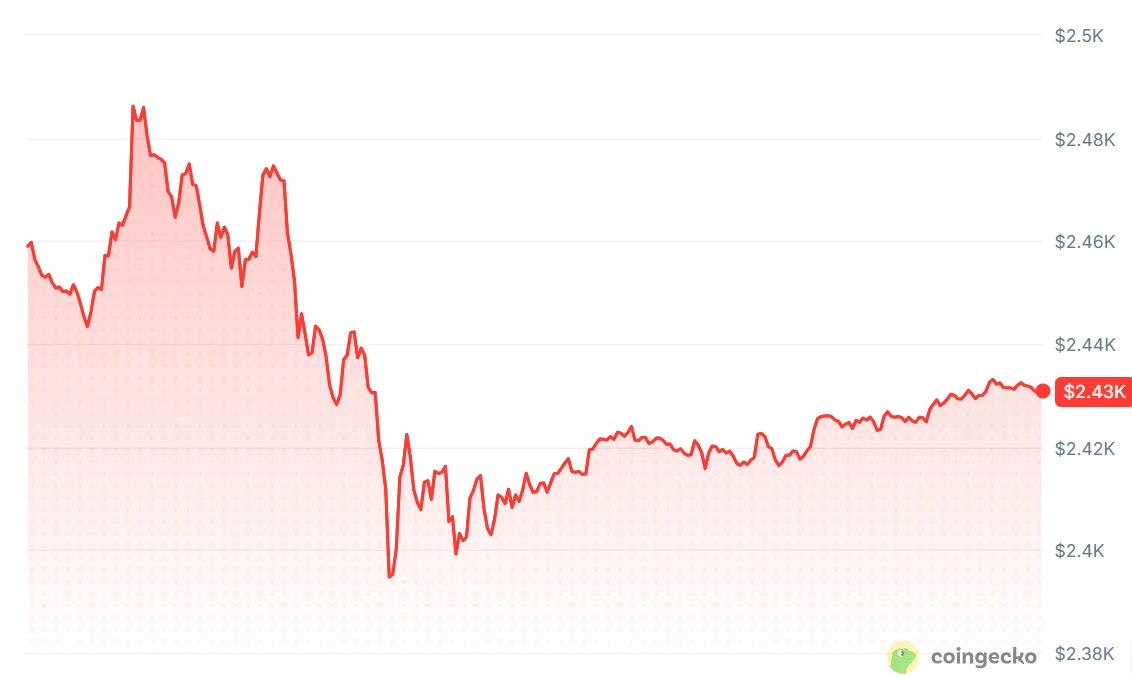
- •ETH trades at $2,428.47 with $10.83 billion in daily volume, down 1.08% over 24 hours and 2.43% over seven days, with $2,390-$2,410 identified as immediate support after a rebound stalled near $2,488.
Ethereum co-founder Vitalik Buterin has demonstrated a privacy-focused setup for running AI agents, combining Tor routing, zero-knowledge payments through zkAPI and locally hosted language models. He described the system as increasingly usable, while acknowledging that it still carries drawbacks, including added latency and limited defenses against certain timing attacks.
The demonstration, shared on X on October 16, 2026, wraps the agent harness in an open-AI compatible daemon so that less information is exposed when users interact with AI services, and so that payment activity does not reveal a user's identity. In practice, the approach targets two distinct exposure points: the content of requests sent to AI providers and the payments that cover them.
In a separate development, AI agents working with ethlabs_org reportedly generated formal proofs for Ethereum's Fast Confirmation Rule within days. That effort also identified and fixed a fork choice bug, while confirming block safety in 24 seconds.
The advances come as Ethereum's native token, ETH, continues to face price pressure. CoinGecko data shows the token down 1.08% over 24 hours and 2.43% over seven days, trading at $2,428.47 with $10.83 billion in daily volume. Market analyst Ella identifies $2,390-$2,410 as the key support zone after a rebound attempt stalled near $2,488.
Inside Buterin's "Paranoid Mode" for AI Agents
Buterin outlined a privacy-focused wrapper for his AI agent harness, combining Tor routing, zkAPI payments, random cover traffic and local prompt rewriting. The setup is designed to reduce the amount of information exposed when users interact with AI services. Tor routes traffic through a chain of volunteer-operated relays to obscure where a request originates, while zero-knowledge payment tools are built to settle transactions without linking them to a user's identity.
Wrapped zkAPI + Tor + extra cover traffic + local LLM prompt rewriting in an open-AI compatible daemon, and made a "paranoid mode" wrapper for my agent harness (pi): Each conversation gets assigned a separate Tor circuit, your requests are masked with random cover traffic, zkAPI… pic.twitter.com/2y236zA0cw
— vitalik.eth (@VitalikButerin) October 16, 2026
The wrapper is packaged as an open-AI compatible daemon around Buterin's agent harness, referred to as pi. the configuration, each conversation is assigned a separate Tor circuit, isolating network connections across sessions. Random cover traffic disguises request patterns, while zkAPI is intended to stop payment activity from revealing a user's identity.
Prompts are additionally rewritten locally by a language model supplied by the user, which Buterin identified as Qwen38-flash-next. The agent runs inside a Bubblewrap sandbox, with MicroVM isolation also under experimentation, while Torsocks routes its network activity through Tor to add another layer of protection.
Buterin acknowledged that the arrangement introduces considerable latency, especially when starting new conversations. He also warned that Tor provides limited protection against active timing attacks in which an AI provider and a network guard collude. A specialized mixnet applying constant cover traffic could offer stronger protection, he suggested, although it would require more bandwidth. Cheaper zkAPI deposit and withdrawal gas costs are also expected on the Ethereum mainnet. The trade-offs illustrate a recurring constraint in privacy engineering: stronger anonymity typically costs speed and bandwidth.
AI Agents Prove Ethereum's Fast Confirmation Rule
At ethlabs_org, AI agents reportedly generated formal proofs for Ethereum's Fast Confirmation Rule within days. The process also uncovered and corrected a fork choice bug, while confirming block safety in 24 seconds.
AI is making Ethereum more ambitious. You might have heard about the challenges that blockchains face in a post-AI world, and while security assumptions will surely be stress-tested in the coming months and years, there is another side to it. I believe AI will let us speedrun… pic.twitter.com/Ljn2mPUyoG
— Francesco (@fradamt) October 16, 2026
Formal proofs rely on mathematical reasoning to verify that a system satisfies specific properties. For blockchain infrastructure, the technique can help developers test protocol rules and surface implementation errors before they cause wider problems. In blockchain research, this kind of formal verification is used to check that consensus rules behave as intended.
Confirmation rules, the category the Fast Confirmation Rule belongs to, are designed to give Ethereum users a dependable signal that a block will remain on the canonical chain sooner than full finality, which under the network's current consensus design requires attestations spanning two epochs. Confirmation is a weaker guarantee than finality, but it arrives far sooner.
The reported results point to a potential role for AI agents in Ethereum research and protocol verification. The available information does not, however, establish whether the work has undergone independent review or broader production testing.
ETH Tests Key Support as Price Pressure Persists
ETH's price action presents a separate concern for traders. According to market analyst Ella (@Ellaweb_3), the token briefly reached $2,488 before retreating toward $2,416, leaving it below a lower-high resistance line.
The $2,390-$2,410 zone is the immediate level to watch. Holding that support could set up another attempt at $2,450 and $2,488, while a breakdown could expose $2,350.
CoinGecko's latest figures show ETH changing hands at $2,428.47, with $10.83 billion in 24-hour trading volume. The data puts the token down 1.08% over the past 24 hours and 2.43% over the past seven days.
Ethereum's AI research is advancing on multiple fronts, but the token has yet to establish a convincing price reversal. Away from the chart, concrete follow-ups include the expected reduction in zkAPI deposit and withdrawal gas costs on mainnet and whether the ethlabs proofs receive independent review.

