Vitalik Buterin Calls for Open-Source Chip Designs to Address Hardware Wallet Security Risks
Key Takeaways
- •Vitalik Buterin argued in a Nov. 26 blog post that reviewing wallet software cannot confirm the security of underlying hardware, urging manufacturers to publish detailed chip layouts and allow independent physical inspections.
- •He highlighted supply-chain attacks in which criminals altered hardware wallets before delivery, harvesting users' recovery information while the modified devices appeared genuine.
- •Buterin called on chipmakers to release Graphic Design System (GDS) files so independent researchers can compare manufactured chips against original designs and detect unauthorized modifications.
- •He identified GlobalFoundries, SkyWater, IHP, and China's ICsprout as existing open-source chip development efforts and set around 25 nanometers as a realistic target for open-source manufacturing.
- •Ethereum's price rebounded from $1,600 to roughly $1,705 on Thursday even as US spot ETH ETFs recorded $68.5 million in net outflows on Nov. 25, their eighth consecutive day of negative flows.
Ethereum co-founder Vitalik Buterin called for greater transparency in semiconductor design on Nov. 26, citing security risks affecting cryptocurrency hardware wallets. In a Nov. 26 blog post, Buterin argued that reviewing software cannot establish whether the underlying hardware operates securely, and he advocated publishing detailed chip layouts alongside expanded independent physical inspections to identify unauthorized hardware modifications.
Buterin Warns of Hardware Wallet Security Risks
In the blog post, Buterin discussed cases in which criminals tampered with hardware wallets before the devices reached customers. The modified units appeared genuine, giving users little reason to suspect a problem, but the unauthorized alterations allowed the criminals to obtain sensitive recovery information. Because the devices were altered before delivery, the compromise took place somewhere along the supply chain between manufacturing and the end user. Hardware wallets are designed to keep private keys offline, making the physical integrity of the device central to the protection they provide.
He said future attacks could involve changes to the chips themselves. Detecting such modifications could prove difficult, particularly when replacement components look identical to the original hardware.
The Ethereum co-founder questioned whether users can fully trust their private keys without knowing how their devices operate. While open-source wallet software allows developers to review its code, proprietary chips leave another part of the system beyond public inspection. Buterin wants hardware manufacturers to provide researchers with enough information to examine the components inside these devices.
Open-Source Chip Designs Could Support Security Audits
Buterin explained that publishing a chip's source code alone is not enough to verify its physical structure. Engineers use programming languages such as Verilog to describe how electronic circuits operate, and design software then converts the code into physical layouts for chip production.
He called on manufacturers to make Graphic Design System (GDS) files publicly available. These files show the exact location and arrangement of electronic components within each layer of a chip. Access to them would allow independent researchers to compare manufactured chips against their original designs, and auditors could then check for unauthorized modifications that may compromise hardware security.
Access to manufacturing specifications remains a challenge, however. Semiconductor companies often restrict access to process design kits through confidentiality agreements. These kits contain the detailed process parameters needed to produce chips on a given node, information that foundries generally treat as closely held. Whether manufacturers begin publishing GDS files in response would be the first concrete indication of traction for the open-source approach.
Existing Open-Source Manufacturing Efforts and Targets
Buterin cited several manufacturers that already provide publicly accessible chip development resources, including GlobalFoundries in Singapore, SkyWater in Minnesota and IHP in Germany. He also mentioned China's ICsprout and its 55-nanometer manufacturing process. The company has released part of its design kit, although the technology currently serves research and prototype development.
Buterin placed a realistic target for open-source manufacturing at around 25 nanometers. That goal sits well behind the leading edge of commercial chipmaking, where the most advanced nodes are considerably smaller. He noted that chips at this level could handle most everyday computing requirements, while advanced artificial intelligence applications would require more powerful hardware.
The Ethereum co-founder also discussed infrared imaging as a possible method for inspecting chips, and he recommended designing circuits that allow independent auditors to examine individual sections. He expects performance and security requirements could eventually create separate markets within the semiconductor industry, with security-focused chips running less efficiently while still meeting everyday computing needs.
Ethereum Price Update as ETH Attempts Recovery
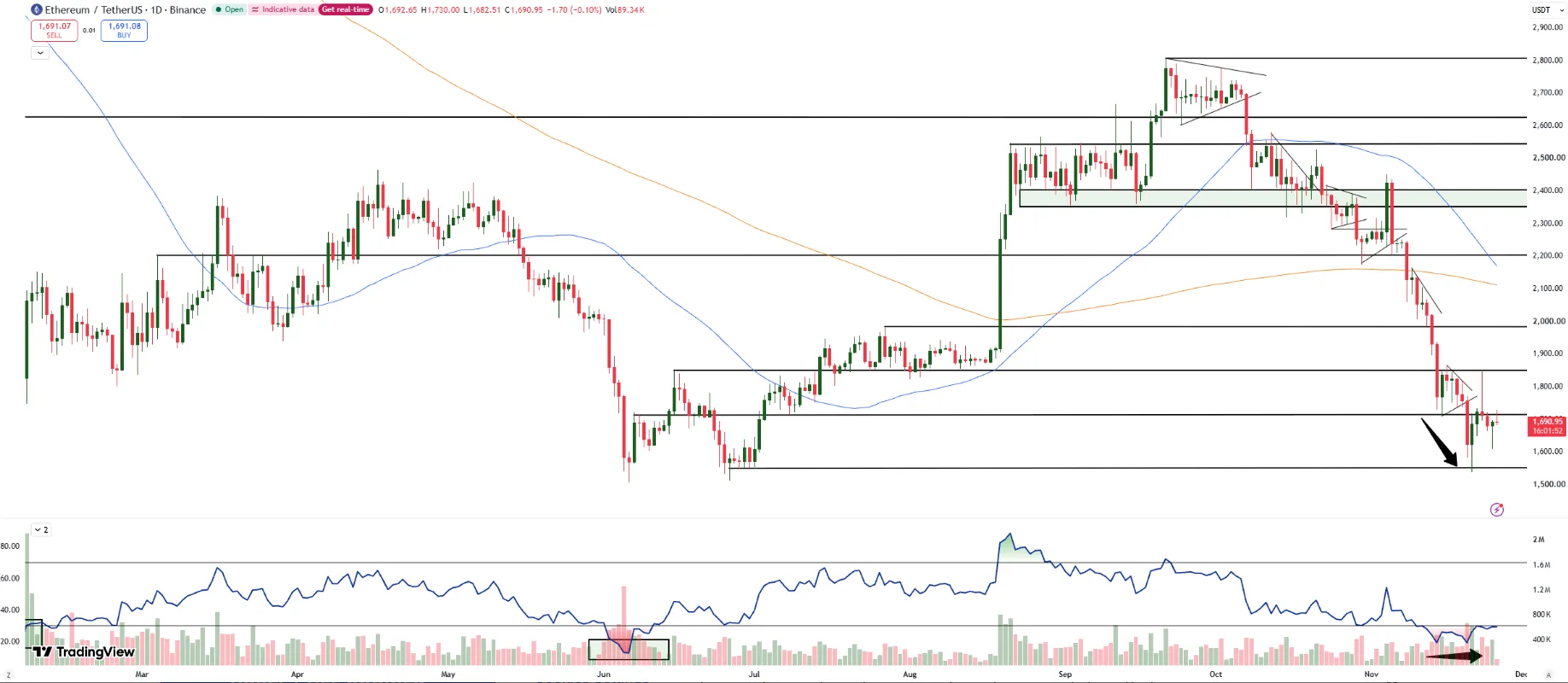
Meanwhile, Ethereum's price recovered from $1,600 to approximately $1,705 on Thursday, according to Traders Union. The recovery came amid continued withdrawals from Ethereum ETFs and selling activity among early ETH holders.
Traders Union's analysis identified $1,850 as the resistance level ETH needs to reclaim, and a move above that level could bring the 200-day simple moving average near $2,111 into focus.
Data from SoSoValue showed that US spot Ethereum ETFs recorded $68.5 million in net outflows on Nov. 25, marking eight consecutive sessions of negative flows. Separately, Arkham tracked an Ethereum ICO participant who sold 32,010 ETH worth $53.3 million within nine hours on Nov. 26.

