Vitalik Buterin Says Ethereum's 2030 Design Goes Beyond Blockchain: A 'Cryptographic World Computer'
Key Takeaways
- •Vitalik Buterin published a September 27 blog post describing a 2030 Ethereum design that combines cryptographic proofs, off-chain computing, privacy tools, and quantum-safe security.
- •The proposed model would let participants verify compact mathematical proofs instead of re-running computations, potentially increasing network capacity while keeping results independently verifiable.
- •Buterin expects the 2027 Hegota upgrade to be Ethereum's last 'normal' fork, with subsequent upgrades relying on recursive STARK proofs, automated formal verification, and quantum-resistant cryptography.
- •The 2030 outline targets block slots of roughly four to eight seconds with finality of eight to 32 seconds, faster than the current 12-second slots, while the roadmap also treats wallet request privacy as core protocol work.
- •ETH traded near $2,685 on Sept. 28 as transactions above $1 million rose nearly 500% in one week and large holders added more than 320,000 ETH worth about $864 million near a supply wall between $2,722 and $2,822.
Coverage of Ethereum has shifted toward the network's long-term architecture after co-founder Vitalik Buterin published a new 2030 roadmap. In a September 27 blog post titled "The Cryptographic World Computer", Buterin describes a design that goes beyond conventional blockchain architecture — one that combines cryptographic proofs with off-chain computing, privacy tools, and quantum-safe security.
Under the proposed model, computers would process transactions and produce short mathematical proofs demonstrating that they followed Ethereum's rules. Other participants could then verify those compact proofs instead of re-running the full computation. Buterin argues that this structure could divide work across the network while keeping every result independently verifiable. The significance is capacity: if checking a proof can replace re-executing the work, more machines could contribute processing power without weakening the guarantee that any participant can verify results on their own.
The blog post was shared by Etherealize_io on X.
Ethereum currently asks full nodes to repeat much of the same transaction processing. That approach underpins the network's verification guarantees, but adding more computers does not directly multiply capacity — a constraint that has shaped scaling debates across the blockchain industry. Buterin says newer proof systems could change that setup. Data availability sampling could also help nodes confirm that transaction information stays accessible without downloading every piece of data.
Hegota Could Mark the End "Normal" Forks
According to Buterin, Hegota — an Ethereum upgrade planned for 2027 — is expected to become the network's last "normal" fork. Upgrades that follow would rely on recursive STARK proofs — compact certificates that let a network attest to large computations without re-running them — along with automated formal verification and more optimized consensus systems. Ethereum developers also plan cryptography designed to resist attacks from future quantum computers, which remain experimental at scale today.
Before Hegota, developers expect the Glamsterdam upgrade to arrive in the fourth quarter of 2026. The Fusaka upgrade, which launched in December 2025, already introduced PeerDAS, a technique that lets validators sample blob data rather than download all of it — an early version of the sampling model already live on the network. Buterin expects the same sampling approach to eventually cover full block contents.
His 2030 outline targets block slots of roughly four to eight seconds, with transaction finality in range of eight to 32 seconds — a faster cadence than the network's current 12-second slots. Operations where transaction order matters would still need to settle on-chain.
Privacy and Verification Move Into the Core Design
The roadmap also rethinks how wallets interact with Ethereum. When a user checks an address or balance today, the wallet often queries an outside server — and that server can learn which accounts the user follows. The weakness stems from how most lightweight wallets fetch data, which is why the proposal treats request privacy as core protocol work rather than an optional add-on. Buterin wants future privacy tools to conceal those requests, along with payment details and account authorization rules.
The proposal would also change how lightweight users verify network activity. Rather than downloading and re-executing every block, nodes could sample data and check compact proofs. Buterin additionally expects off-chain signature aggregation, which would fold many signatures into a single on-chain entry per block, shifting verification further toward cryptographic evidence rather than repeated computation.
Whale Activity Rises Near a Dense Supply Zone
The long-term outlook arrives as ETH changes hands near key technical levels. ETH traded near $2,685 on Sept. 28, according to CoinMarketCap, holding close to an analyst-tracked supply zone above $2,700.
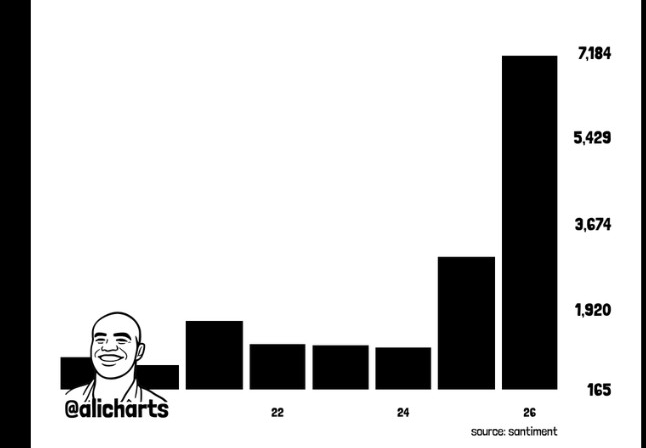
Network activity has also risen as Ethereum approaches that zone. Analyst Ali Martinez, citing Santiment data, reported that transactions worth more than $1 million rose from 1,202 to 7,113 within one week — an increase of nearly 500%. Large holders added more than 320,000 ETH over the same period, worth about $864 million, in figures Martinez shared on X (1, 2).
Glassnode data shared by Martinez places a major supply wall between $2,722 and $2,822, a range where more than 13.3 million ETH previously changed hands. The distribution profile also shows smaller concentrations near $2,970 and $3,366.
This article is for informational purposes only and does not constitute financial or investment advice. Technical levels and analyst projections remain conditional.
Source: The Market Periodical

