Vitalik Buterin Favors ETH as a Store of Value, Dismisses Fee-Burn Valuation as Ether Tests $2,200
Key Takeaways
- •Vitalik Buterin argued that ether should be treated primarily as a store of value anchored in Ethereum's decentralization, privacy, and security rather than in transaction fee burns.
- •He said fee burns offer a shaky valuation basis because speculative activity such as NFT trading between 2021 and 2023 drives fee demand that shrinks during market downturns.
- •Buterin cautioned that chasing larger burns could pressure developers to maximize revenue and shift funding and technical decisions toward centralized control, pointing to a hypothetical need for about 700,000 ETH per year to cover research and development.
- •He backed retaining EIP-1559 despite low burns, noting that layer-2 growth enabled by the March 2024 Dencun upgrade can reduce mainnet fee activity without indicating lost demand.
- •Ether traded near $2,220 on Nov. 8 while defending $2,200 support, as CryptoQuant data showed the 30-day average of wallet-to-wallet transactions falling from roughly 1.3 million to about 560,000 during 2026.
Vitalik Buterin has argued that ether (ETH) should be understood primarily as a store of value rooted in Ethereum's decentralization, privacy, and security — not as an asset whose worth depends on transaction fee burns. Writing in a post on X, the Ethereum co-founder also said he supports retaining EIP-1559 even if fee burns remain too low to offset new token issuance.
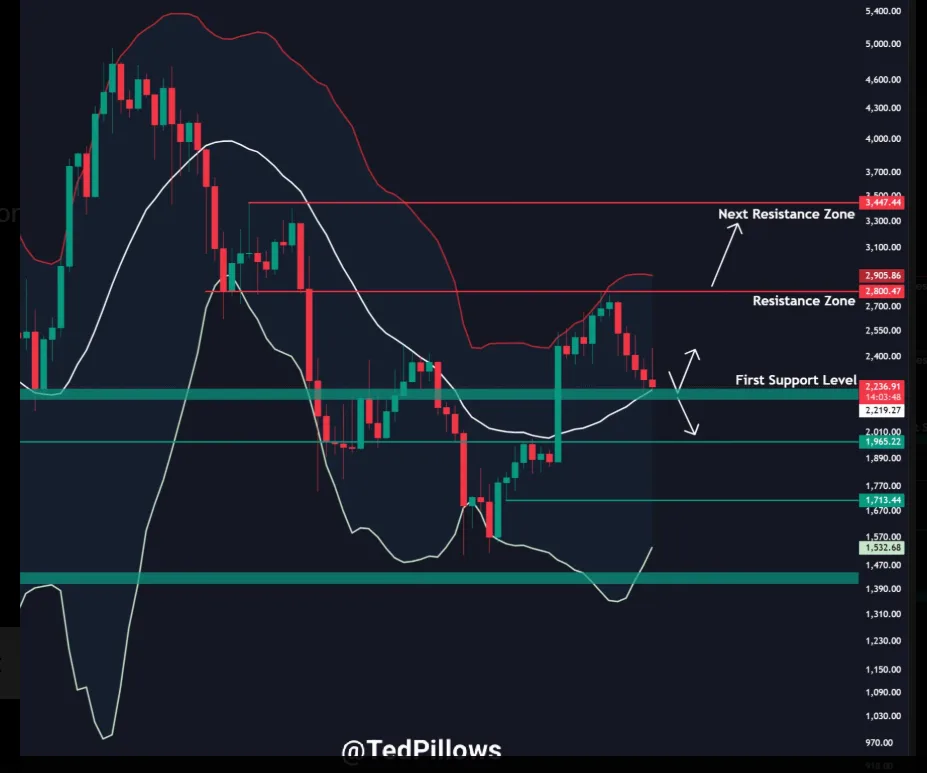
His comments arrived as Ether traded near $2,240, with buyers defending the $2,200 support level, and as questions mounted about Ethereum's monetary structure amid network issuance that continues to exceed token burns.
How that structure is framed carries weight for the network's direction: Ethereum's monetary policy is set through open improvement proposals debated by developers and the community rather than by a central authority, so arguments over what anchors ETH's value can feed into future protocol decisions.
Why Buterin Doubts the Fee-Burn Thesis
Buterin laid out three reasons for treating ETH primarily as a store of value and questioned whether transaction fee burns offer a dependable basis for valuing the asset. Ethereum burns transaction base fees, but the amount burned fluctuates with network usage.
He pointed to the speculative activity that generated high fees between 2021 and 2023, when NFT trading and other cryptocurrency transactions supplied much of the demand. When asset prices fall, traders tend to spend less on transactions, shrinking the fees Ethereum can burn.
Buterin also questioned financial models that estimate ETH's value using future burns. Such a model can assign a valuation to recurring burns, but the estimate depends on those burns continuing — a certainty that fee demand tied to cryptocurrency speculation cannot provide during market downturns.
Warning Over a Revenue-Driven Protocol
Buterin cautioned that pursuing larger burns could reshape how Ethereum operates. Developers could face pressure to maximize revenue rather than keep the network accessible, while higher transaction costs could limit participation among users who need affordable, censorship-resistant services.
He compared a revenue-driven protocol to a large company that must fund its own development. Under one hypothetical model, Ethereum would need roughly 700,000 ETH annually to cover research and development — a structure that could place more decisions about funding and technical priorities under centralized control.
The debate also unfolds as users shift activity toward lower-cost layer-2 networks. Ethereum's Dencun upgrade in March 2024 reduced certain layer-2 costs, allowing more activity without equivalent increases in mainnet fees. Lower burns can therefore accompany layer-2 growth without signaling a complete loss of demand.
Decentralization at the Core of the Bull Case
According to Buterin, Ethereum's long-term value derives from its ability to let people hold and transfer assets without depending on central authorities. He pointed to CROPS, a framework covering censorship and capture resistance, open-source development, privacy, and security.
He also addressed the growing influence of artificial intelligence, arguing that people may favor networks capable of operating reliably despite shifts in technology and institutions.
Despite his criticism of burn-centered valuation, Buterin backed keeping EIP-1559 in place. The mechanism, which Ethereum activated through the London upgrade in August 2021 to make transaction fees more predictable, destroys the base fee users pay for transactions, while validators continue receiving newly issued ETH under the network's proof-of-stake model, adopted in September 2022. Supply expands whenever issuance exceeds burns and contracts when burns exceed issuance.
Ether Defends $2,200 as On-Chain Activity Slows
Ether traded around $2,220 on Nov. 8 after sellers rejected a recovery toward $2,500. The asset broke below an ascending channel in late October and has failed to reclaim that broken support, placing attention on the $2,200 area.
A sustained move above $2,300 would mark a recovery, while a return above $2,500 could reopen the $2,800–$3,000 resistance zone. Conversely, a daily close below $2,200 could expose support near $2,000, then $1,850.
On-chain activity also remains subdued. Data from CryptoQuant shows the 30-day average of transactions between externally owned accounts fell from roughly 1.3 million earlier in 2026 to about 560,000. Beyond chart levels, the gap between issuance and burns — and whether mainnet transaction counts rebound — offers a concrete set of figures for tracking the monetary dynamics at the center of Buterin's argument.
This article is for informational purposes only and does not constitute financial advice. Cryptocurrency markets carry substantial risks, and technical forecasts do not guarantee future returns.
The report was first published by The Market Periodical on Nov. 8, 2026.

