Buterin's Store-of-Value Pivot for Ethereum Complicates Its Wall Street Pitch
Key Takeaways
- •Buterin argued that ETH should be valued as a store of value rather than a fee-burning token, framing this as consistent with decentralization and resistance to censorship and capture.
- •Treasury company executives welcomed the shift, with Bitmine's Tom Lee calling it a seismic validation of his firm's roughly 6 million ETH holdings, while Bankless co-founder David Hoffman, who sold all his ETH in May 2026, said the timing felt like it came from weakness.
- •Market indicators have deteriorated alongside the narrative change, as ETH now trades about 58% below its August 2025 peak near $4,946, is down 41% over the past year, and cumulative ETH ETF flows have dropped 23% compared with 12% for bitcoin ETFs.
- •Buterin's reduced emphasis on fee burns undermines Etherealize's defense of staking economics and supports John Pfeffer's 2017 argument that staking issuance transfers value from non-staking holders to stakers, benefiting firms like Bitmine, which stakes about 84% of its ETH and expects roughly $309 million in annual yield.
- •Bitcoin still holds the dominant store-of-value narrative among crypto assets, and since the 2017 prices cited in Pfeffer's paper, bitcoin has risen roughly 5.7 times while ether has gained less than 3 times.
Ethereum co-founder Vitalik Buterin said earlier this week that valuing $ETH as a fee-burning token “never was as strong as it seemed,” and argued that the asset should instead be valued as a store of value (SoV).
According to Buterin, optimizing Ethereum as a store of value “is aligned with decentralization and CROPS” — shorthand for censorship and capture resistance, open source, privacy, and security.
Another Narrative Upgrade for Ethereum
The “$ETH as a store of value” story has circulated for years, but making it mainstream now would follow the failed “ultrasound money” campaign and earlier attempts to frame the asset as “digital oil” alongside bitcoin’s “digital gold.”
Treasury Companies Cheer the Pivot
Reactions to the shift were mixed even among Ethereans, but leaders of $ETH treasury companies — firms that hold ether on their corporate balance sheets, a playbook popularized in crypto by bitcoin-treasury companies — welcomed it. Bitmine Chairman Tom Lee, whose company holds about 6 million $ETH, called Buterin’s store-of-value comments “a seismic shift” that validates the company’s strategy. Joseph Lubin, who controls Consensys and chairs the $ETH treasury firm Sharplink, argued that while “gold and $BTC are high-powered money and excellent stores of value, $ETH goes further.”
Etherealize — founded after Buterin and the Ethereum Foundation gave co-founder Vivek Raman a 2024 grant to persuade Wall Street executives of Ethereum’s merits — shared a post describing $ETH as a programmable store of value. Raman retweeted Buterin’s post but did not join the discussion.
The firm has already been marketing the store-of-value narrative to Wall Street. In January 2025, it positioned $ETH as “a diversified complement to Bitcoin” on the grounds that it is “a store of value with cash flow,” and it has also drawn comparisons between $ETH and oil. In April 2026, Etherealize argued, in effect, that $ETH could replace bitcoin by capturing the combined monetary premium of gold and $BTC.
If Buterin’s emphasis on the store-of-value side of $ETH gains traction, Wall Street may need to update its understanding of the asset along the lines of his explanation — and, if convinced, may also need to reevaluate its $BTC positions.
The Numbers Are Moving Down
The narrative escalation has coincided with weaker market performance. While each successive Etherealize pitch made increasingly ambitious claims about $ETH, the price briefly hit a record of around $4,946 in August 2025, but it now trades roughly 58% below that peak.
If flows into $ETH exchange-traded funds (ETFs) are taken as a measure of Wall Street’s interest in ether as an asset, those flows — measured in U.S. dollars — have been trending downward since October 2025, as have flows into bitcoin ETFs. U.S. spot ether ETFs began trading in 2024, months after the first U.S. spot bitcoin funds, and their daily net-flow disclosures have since become a widely cited gauge of institutional demand. Over the same period, cumulative flows into $ETH ETFs dropped 23%, compared with a 12% decline for $BTC ETFs.
Falling prices for both assets have also weighed on those flows: at the time of writing, $BTC is down 30% over the past year, while $ETH is down 41%.
Buterin Dismisses Earlier Arguments
Wall Street may be left puzzled not only by another narrative update, but also by the reasoning behind it. Etherealize and Buterin appear to have reached similar conclusions for somewhat different reasons.
Etherealize, for instance, claimed that fee burns send value from all Ethereum activity to $ETH and that the token is “potentially deflationary.” Buterin now downplays the importance of the burns. The burn has been part of Ethereum since an August 2021 upgrade, which routes a portion of every transaction fee out of circulation.
Buterin’s reasoning also undermines Etherealize’s response to an argument made by Bitcoiner John Pfeffer in 2017: that paying stakers with new issuance moves value from holders who do not stake to holders who do. Earlier this year, Etherealize rejected the objection that staking yield is simply inflation, arguing that the burn offsets issuance and that a meaningful share of the yield comes from transaction fees. If the burn stays small and fees prove unreliable — as Buterin now says — then most staking yield comes from new issuance, confirming Pfeffer’s point. That hurts holders who do not stake but benefits treasury firms such as Bitmine, which stakes around 84% of its $ETH. As of Monday, the firm said it expects to earn $309 million worth of $ETH annually at current yields.
What is more, Etherealize criticized Bitcoin, saying it “chose ossification because it values near-term stability more than long-term viability.” Buterin now calls for “at least partial ossification” in Ethereum as well, once its core is complete.
What Counts as a Store of Value? No Single Answer
One of the biggest challenges for store-of-value advocates in both the Bitcoin and Ethereum camps is that “store of value” has no universally agreed definition, and many assets treated as stores of value have failed. There is no consensus, for example, on how long an asset must hold its value, or how far it can fall and still qualify.
According to Buterin, “the first and most important SoV-ish metric” is “to survive.” He lists other metrics, but survival alone offers little comfort to those seeking to protect capital: the crypto space is full of altcoins that have crashed more than 90% and continued to “survive” for years.
History offers cautionary parallels. Wampum lost its value in the 17th century after people found a way to produce it more cheaply. Silver ran into its own problems when its use in coinage was suspended and the U.S. demonetized it in the 19th century. Today, both Etherealize and some bitcoiners use silver as an analogy when discussing the rival asset, as each side pursues the “digital gold” title.
Historically, though, that analogy may be imperfect: gold itself has experienced multi-decade, double-digit drawdowns. And with “digital gold” now mostly associated with bitcoin, that asset is likewise known for its sharp — though decreasing — volatility.
Two Nearly Identical Stories Collide
If the loudest Ethereans begin pushing the “$ETH is SoV” narrative, winning over traditional Wall Street investors could prove an uphill battle.
Previous attempts by Ethereum to differentiate itself from Bitcoin have seemingly failed to work as expected. Ethereum may now be entering the store-of-value narrative — a space dominated by Bitcoin among crypto assets. About half of the arguments Buterin cites for $ETH as a store of value (survival, slow change, low protocol politics, easy self-custody, and running a node on modest hardware) are already attributed to $BTC. And although both the Ethereum and Bitcoin camps have continually adjusted their pitches to appeal to investors, Bitcoin’s SoV story has remained the dominant one.
Another Attempt to Improve on Bitcoin’s Story
Some Ethereum thought leaders now claim that the blockchain has all of Bitcoin’s main benefits and adds something extra on top. One update to Buterin’s framing, for example, described $ETH as “a programmable store of value.” That echoes the “ultrasound money” campaign, which similarly borrowed Bitcoin’s “sound money” narrative and tried to show that $ETH was even better money. It did not work out.
Even one of the most prominent Ethereum influencers, Bankless co-founder David Hoffman, sold all of his $ETH in May 2026. He wrote that the “$ETH is money” thesis had played out rather than failed, and that he remained bullish on the network, while noting that he does think “only a marginal amount of that success will be reflected in $ETH.”
Reacting to Buterin’s post, Hoffman said: “The timing of this whole thing makes it feel like it’s coming from a place of weakness, not strength.” In the same thread, he added: “My thought is that the universe/[context]/environment that we live is not suited to let $ETH as an asset thrive.”
He also struck a more bullish note: “Ethereum best path [is] forwards. If you’re going through hell, keep going.”
Simpler, but Also More Complicated
On one hand, Buterin’s suggestion to value $ETH as a store of value makes the pitch simpler and clearer. On the other, the context — its similarities with bitcoin and the constant narrative changes — may make it more complicated.
For now, Bitcoin appears to still hold the SoV title among crypto assets for most investors. Only a minority are likely to examine each network closely — weighing how decentralized they really are, how prepared they are for post-quantum cryptography, which offers the better security model, their technical differences and capabilities, adoption challenges, and the developments in the pipeline for both ecosystems.
As history shows, there is no universal agreement on any of these points. That leaves investors relying on their beliefs rather than on undeniable arguments for backing either asset. For anyone tracking how this plays out, the concrete markers are public ones: daily ETF net flows, treasury firms’ holdings and staking disclosures, and any revisions Etherealize makes to its Wall Street materials.
3x SoV vs. 5.7x SoV
In his December 2017 paper, “An (Institutional) Investor’s Take on Cryptoassets,” John Pfeffer argued that there was a “possibility that $ETH replaces bitcoin and becomes the dominant non-sovereign monetary store of value simply on pure store-of-value merits,” but that “an objective observer would give bitcoin significantly higher odds than $ETH of becoming such a store of value.”
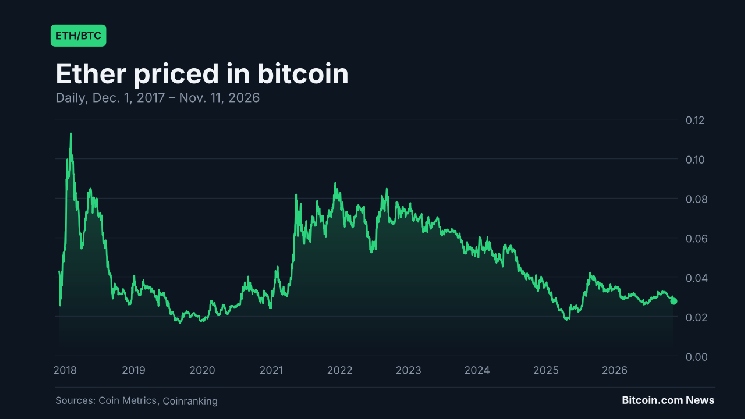
Nine years on, $BTC has preserved and increased its value better than $ETH. Based on the prices Pfeffer cited in the paper — about $13,000 per bitcoin and $700 per ether — bitcoin is up roughly 5.7x, while ether is up less than 3x.
Either way, the game of storytelling goes on.

