Vitalik Buterin Backs Ethereum Gas Overhaul and Quantum-Safe leanPCS Plan
Key Takeaways
- •Vitalik Buterin endorsed EIP-8037, a proposal that would raise gas charges for creating new accounts, storage entries, and smart contracts on Ethereum.
- •Under Buterin's examples, account creation costs would rise from 36,600 to 197,900 gas, while deploying a 24 KiB contract would increase from roughly 4.95 million to 37.8 million gas.
- •For airdrop projects concerned about higher costs, Buterin recommended Merkle-tree distributions, unspent transaction outputs, or keyed nonces instead of creating separate storage entries for each recipient.
- •Buterin also backed leanPCS, connected to EIP-8288, to help Ethereum manage quantum-resistant signatures, which can grow from 65 bytes to roughly 1-6 kilobytes, with some STARK proofs reaching 128 kilobytes.
- •The Ethereum Foundation paused Glamsterdam's activation on the Hoodi testnet after researchers identified four cases of deployed contracts, including some bridge software, that could fail under the proposed gas rules, with developers scheduled to discuss findings on November 19.
Ethereum co-founder Vitalik Buterin has endorsed two protocol proposals: one that would sharply raise the cost of creating new state on the network, and another that could speed up the handling of quantum-resistant signatures and cryptographic proofs. Neither proposal has received final approval, and Ethereum developers are scheduled to review the gas changes at their meeting on November 19. Together, the two initiatives reflect Ethereum's parallel work on scaling headroom and long-term cryptographic resilience.
On Nov. 16, Buterin defended Ethereum Improvement Proposal (EIP) 8037, which would raise gas charges for creating accounts, storage entries, and smart contracts. He separately backed leanPCS, a possible cryptographic approach connected to EIP-8288. In the meantime, developers are working through unresolved smart-contract compatibility issues ahead of the Nov. 19 call.
EIP-8037 Targets New Accounts, Storage Slots, and Contract Deployment
Buterin laid out his case for EIP-8037 in an X post as developers examined how to increase Ethereum's transaction capacity without rapidly expanding stored data. Every new account, storage entry, and smart contract adds information that network nodes must maintain, and higher charges for these operations would separate storage costs from routine transaction execution. The distinction carries weight for the network's long-term operation: because every node must hold the full state, unchecked growth raises the hardware requirements of running one, a recurring concern in Ethereum's scaling debates.
Under Buterin's examples, creating an account would require 197,900 gas instead of 36,600. Opening a new storage slot would cost 110,020 gas rather than 22,100. Deploying a 24 KiB contract would rise from roughly 4.95 million to 37.8 million gas. Actual transaction fees would still depend on prevailing gas prices, and wallets would need revised estimates.
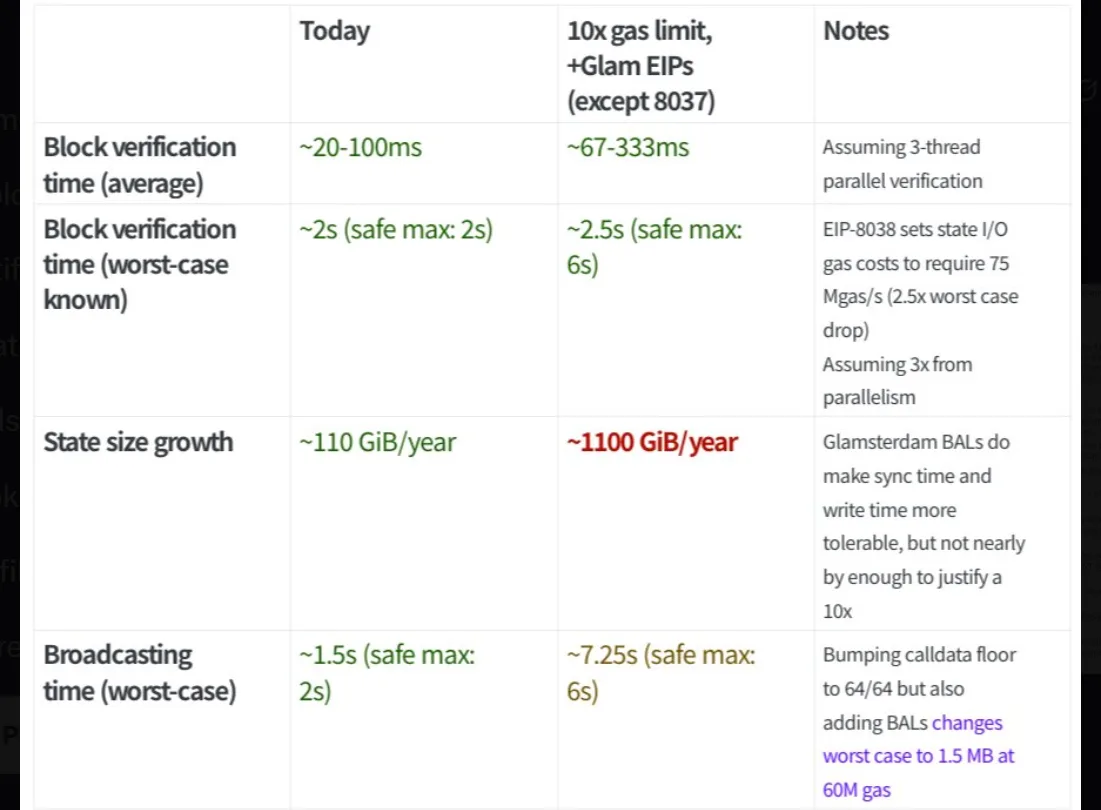
EIP-8037 also proposes a separate state-gas reservoir. The mechanism would allow large contract deployments to cover storage charges beyond the usual execution-gas ceiling. Buterin estimated that Ethereum currently adds around 110 GiB of state annually, and that a tenfold increase in the gas limit without changes to storage pricing could push that figure toward 1,100 GiB.
Alternatives Suggested for Token Airdrops
The proposal has also raised concerns among projects that distribute tokens to many wallets, since creating large numbers of new storage entries could become more expensive under EIP-8037. Buterin recommended Merkle-tree distributions, which let issuers publish a single cryptographic root instead of recording a separate allocation for each recipient. Recipients would then provide proofs of eligibility and pay the gas required to claim their tokens. He also suggested using unspent transaction outputs, known as UTXOs, or keyed nonces to represent balances over time.
leanPCS Offers Another Route to Quantum-Resistant Verification
In a separate X post, Buterin supported leanPCS as a possible addition to work around EIP-8288. That draft proposes combining large cryptographic signatures and verification proofs before transactions reach Ethereum blocks, with the network storing compact references and checking an aggregated proof.
Quantum-resistant signatures can require far more data than Ethereum's current account signatures. Buterin cited an increase from 65 bytes to roughly 1–6 kilobytes, while some STARK proofs could reach 128 kilobytes. EIP-8288 aims to reduce the amount of this material that blocks must hold. The size gap underscores a central trade-off in post-quantum cryptography: schemes built to withstand future quantum computers generally demand far more data per signature or proof than the elliptic-curve signatures securing Ethereum accounts today.
Buterin also compared leanPCS with leanSPHINCS and leanSTARK. LeanSPHINCS focuses on hash-based signatures for accounts, while LeanSTARK could support broader calculations, though developers would need to agree on a new instruction standard.
Glamsterdam Testing Paused Pending Compatibility Review
The gas overhaul has also drawn scrutiny to existing applications. Security researchers found that some deployed contracts rely on gas rules that EIP-8037 and EIP-8038 would change. Some bridge software uses fixed gas allowances, which could cause transactions to fail under the proposed pricing.
The Ethereum Foundation paused plans to activate Glamsterdam on the Hoodi testnet while developers review these risks. In a November 9 update, the foundation reported four cases involving deployed contracts that could break. Teams are weighing possible adjustments, including special treatment for older contracts. Core developers plan to discuss audit findings and potential specification changes on November 19. That call is the next milestone for observers to track: how developers weigh the audit findings and any specification adjustments will indicate whether EIP-8037 advances as drafted and when Glamsterdam's Hoodi activation can restart.
This article provides general cryptocurrency and technology information and does not constitute investment or legal advice. Cryptocurrency investments carry volatility and the risk of capital loss. Readers should consult a qualified professional before making financial decisions.
Source: The Market Periodical

