NKG Vietnam and Tchibo Partner to Build Climate Resilience Through Intercropping for Robusta Producers
Key Takeaways
- •Enveritas data from Vietnam's 2024/25 harvest shows intercropping is practiced on 87 percent of farms in Dak Lak, 86 percent in Dak Nong, 67 percent in Gia Lai, and 58 percent in Lam Dong.
- •NKG Vietnam, part of Neumann Kaffee Gruppe, supports about 16,000 Robusta farmers across roughly 21,000 hectares with technical assistance on intercropping, shade management, soil health, and regenerative practices.
- •Modelled scenarios indicate coffee-durian systems could potentially double farm returns versus coffee monocropping, while coffee-pepper systems could raise income by about 20 percent on established farms and up to around 60 percent in replanted systems under favourable conditions.
- •Tchibo's climate resilience program, delivered with NKG Vietnam in Dak Lak and Gia Lai, aims to support up to 4,000 smallholder producers and has so far established 20 demonstration farms with about 3,000 farmers targeted to adopt intercrops.
- •Key barriers to adoption include elevated coffee prices discouraging farmers from allocating land to other crops, risks such as pepper's vulnerability to pests and diseases, and excess shade potentially reducing coffee yields.
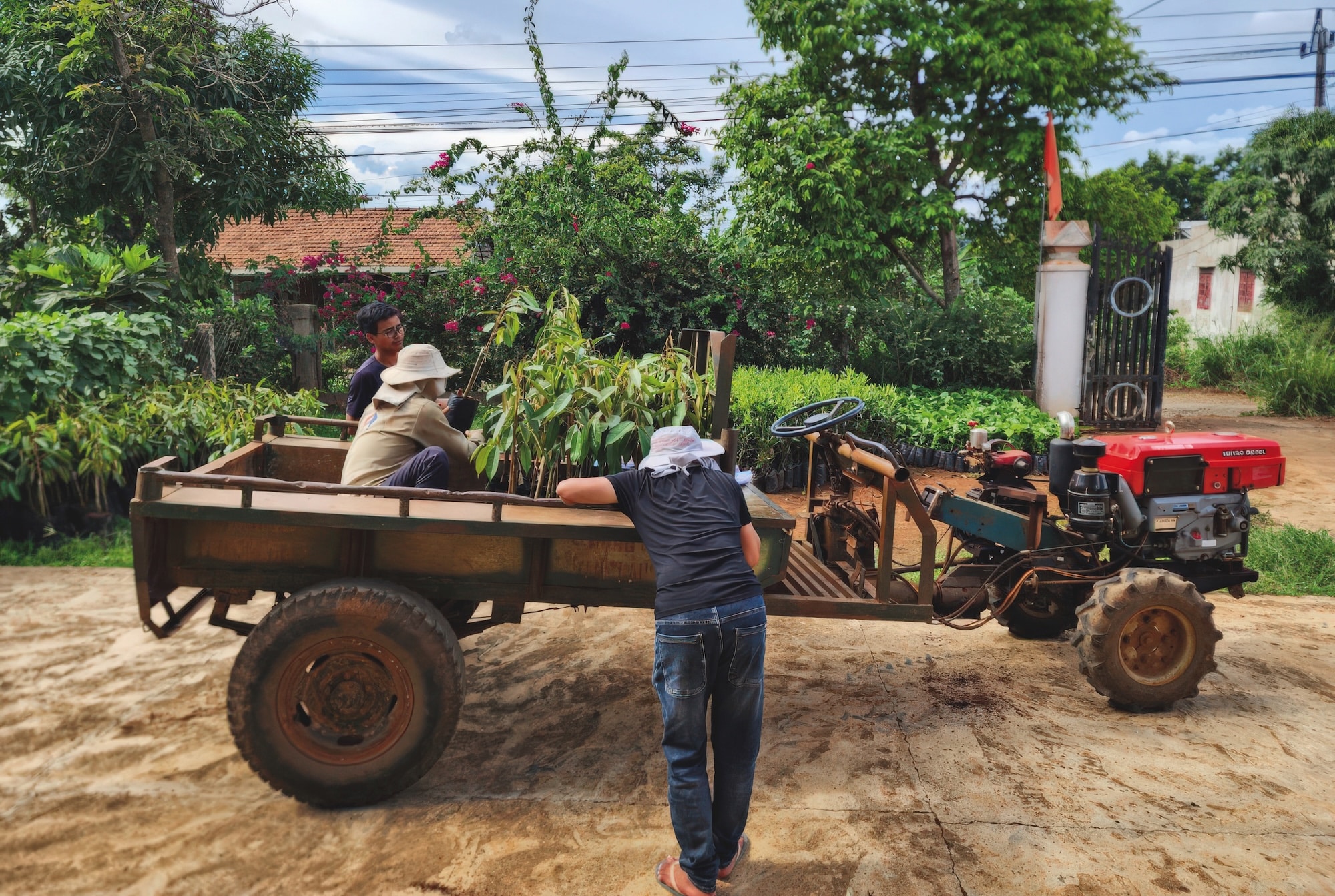
Intercropping is helping Vietnam's Robusta producers balance productivity with resilience, creating new income opportunities while adapting to unpredictable growing conditions.
Vietnam is an origin whose reputation was forged on productivity. As the world's leading producer of Robusta coffee — the bitter, caffeine-rich variety used widely in instant coffee and espresso blends — the country has spent decades refining farming systems capable of delivering some of the highest coffee yields on the planet. Vietnam is the second-largest coffee producer overall, after Brazil, and Robusta accounts for the vast majority of its output. But as climate pressures continue to intensify across the Central Highlands' growing regions, success is increasingly shaped by more than coffee yield alone.
Across the Central Highlands coffee-growing provinces of Dak Lak, Dak Nong, Gia Lai, and Lam Dong, intercropping systems that combine coffee with other agricultural products can help farmers strengthen their resilience to an unpredictable climate while creating income opportunities beyond coffee.
NKG Vietnam's Field Presence
NKG Vietnam, a group company of Neumann Kaffee Gruppe — one of the world's largest green coffee service groups — works with about 16,000 Robusta farmers across approximately 21,000 hectares in Vietnam. A growing team of sustainability and field specialists provides technical assistance on intercropping design, shade management, soil health, and regenerative agriculture practices.
NKG Vietnam Sustainability Manager Loc Cao says successful intercropping systems are built around local conditions, with species selection, spacing, and farm management tailored to growers' needs.
"In Vietnam, much of what is commonly discussed as agroforestry is, in practice, intercropping with fruit and selected timber trees rather than complex multi-layer agroforestry systems," says Loc Cao. "For farmers, agroforestry is only attractive if it improves the overall farm business through income diversification, resilience, lower risk, or long-term soil and water benefits. Intercropping, mostly with fruit trees, is a priority in the context of climate change in many parts of the Vietnamese Highlands because it helps diversify and increase farm income and make coffee farms more resilient. Shade can reduce heat and water stress, while diversified systems support biodiversity and soil health."
'Agroforestry' has become a popular term across the global coffee sector and broader agriculture industry. For growers in a region where any new farming practice must demonstrate economic value before it is widely accepted, intercropping with fruit trees can be an attractive proposition, as farmers can generate revenue from these added crops while also improving farm resilience and their coffee crop.
Commercial intercrops such as durian, avocado, pepper, jackfruit, and cashew are now commonly used across the Central Highlands. Durian in particular has seen strong demand from export markets in Asia in recent years, which has contributed to its appeal as an intercrop. Carefully managed shade trees are also sometimes added to improve farm microclimates and protect soils while providing income and timber for future generations.
According to Enveritas data from Vietnam's 2024/25 harvest, intercropping is already widespread in major coffee-growing regions: it is implemented on 87 per cent of farms in Dak Lak, 86 per cent in Dak Nong, 67 per cent in Gia Lai, and 58 per cent in Lam Dong.
"In parts of Vietnam's Central Highlands, intercropping is already a common and farmer-led practice rather than a new concept," says Edward Helmond, General Manager of NKG Vietnam. "We see agroforestry as an important part of the future of sustainable coffee production in Vietnam, but not as a one-size-fits-all model, rather as a practical tool to strengthen resilience, livelihoods, and biodiversity."
The Economics of Intercropping
In modelled scenarios, coffee-durian and coffee-pepper systems offer strong economic potential under favourable conditions, though many factors come into play in real-world applications.
These scenarios indicate coffee-durian systems have the potential to substantially boost overall farm income compared with coffee monocropping, potentially doubling returns. Coffee-pepper systems also show promise: model calculations suggest established coffee farms could see income increases of around 20 per cent, rising to around 60 per cent in replanted coffee-pepper systems under favourable conditions. At the same time, pepper is highly vulnerable to pests and diseases and can often be wiped out once it becomes unproductive, posing significant risks for farmers.
Fruit trees such as avocado, durian, and jackfruit are popular because they combine commercial returns with shade benefits, while selected timber trees can also play a role where appropriate.
Popular coffee-durian systems typically contain around 10 per cent durian trees and 90 per cent coffee trees. Established coffee-pepper systems often follow a roughly 75:25 ratio, while some replanted coffee-pepper systems utilise closer to one-third pepper and two-thirds coffee.
However, Helmond cautions there is no benefit in replacing a dependency on coffee with a dependency on another agricultural product.
"Results depend heavily on prices, costs, yields, farm management, tree age, and local suitability," says Helmond. "Income diversification is valuable, but farmers also need to avoid replacing one dependency with another. High-value intercrops such as durian or pepper can be profitable, but they can expose farmers to price volatility, disease risks, and market access constraints. For growers, the strongest argument is often economic. A well-designed system can, under suitable conditions, increase total farm income per hectare, even if overall coffee yield is not at its peak."
Positioning the discussion around coffee yields alone misses the point, he adds.
"The key is not to think about trees taking space away from coffee but as improving overall farm productivity, income stability, and resilience. For farmers, the business case is strongest when additional trees or intercrops increase total income per hectare, reduce risk, or provide practical benefits," says Helmond.
Despite these potential benefits, agroforestry is not a silver bullet that can fix all farms' problems, with excess shade posing a risk to productivity.
"The biggest misconception is that more trees or more shade are always better for coffee. The right shade level depends strongly on altitude, temperature, rainfall, and farm design," adds Loc Cao. "Too many trees can become a burden through additional labour or reduced coffee yields. Benefits depend on selecting suitable species, maintaining appropriate spacing, and actively managing the system."
What matters is balance. Altitude, rainfall patterns, water availability, market access, and soil characteristics can vary greatly between Vietnam's coffee-growing regions. A lower-elevation farm in Dak Lak facing heat stress and limited water availability may benefit from a different level of shade — and therefore different intercropping species — than a cooler, higher-altitude farm in Lam Dong.
Climate Resilience Beyond Drought
As climate variability increases across the Central Highlands, resilience has become more relevant to producers. Coffee yields remain strong overall, but farmers continue to encounter extended dry periods, high heat, intense rainfall events, and storms. Intercropping and agroforestry can help reduce exposure to many of these risks.
During dry seasons, shade trees can lower temperatures within coffee fields and reduce evapotranspiration, helping coffee trees retain moisture and experience less heat stress.
"When combined with cover crops and soil cover, intercropping can also improve soil moisture retention and reduce irrigation pressure," says Loc Cao.
The benefits extend below ground too. Increased organic matter, improved soil structure, and reduced compaction can support stronger root development and healthier soils over time.
Climate resilience is often discussed through the lens of drought, but Loc Cao notes rainfall can be equally damaging.
"In periods of excessive rainfall, well-designed tree cover and ground cover can help slow water runoff, protect the soil surface, and reduce erosion, which is especially important on sloped farms," he says. "Recent flooding and storm events in central Vietnam and the Central Highlands show resilience is not only about drought but also about helping farms better cope with intense rainfall, landslides, and harvest disruptions. Agroforestry can contribute to more stable farm systems. Shade and diversified vegetation can buffer microclimatic extremes, while additional crops help farmers manage income risks when coffee production or quality is affected by weather."
Barriers to Adoption
One important barrier is that many farmers still primarily assess success through coffee yield, especially when coffee prices are elevated. Helmond says the high coffee prices of recent years have made many farmers reluctant to reduce the space available for coffee trees.
"Current coffee prices are still quite high. When coffee is very profitable it becomes harder to convince farmers to allocate land to other crops," he says. "Farmers need to see practical benefits before they change established production systems, especially if they are concerned about losing coffee yield or taking on additional labour. However, while commodity prices fluctuate, smart intercropped systems have proven to diversify farmers' income streams and yield higher profitability in the medium- to long-term. Coffee will continue to play an important role in diversified farming practices, because it is a stable produce. There is always a market, it's relatively easy to grow, and can be stored for a long time after harvest and drying."
Social and cultural factors also influence adoption rates. Farmers often observe neighbours before changing established management practices, meaning uptake can be slower in regions where intercropping is less common. Even so, adoption has increased markedly across the Central Highlands in recent years.
NKG Vietnam seeks to address these challenges through technical support, demonstration farms, practical training, and farmer-to-farmer learning, and has initiated several targeted initiatives. Agronomists provide guidance on species selection, spacing, planting techniques, fertilisation, and pruning. In selected projects, farmers also receive seedlings to help reduce upfront investment costs.
However, distributing seedlings alone is rarely enough.
"Tree survival is not always as high as people expect," says Loc Cao. "Long-term success requires ongoing technical support, farmer engagement, monitoring, and practical management. Simply handing out seedlings does not automatically lead to strong outcomes."
Tchibo's Climate Resilience Program
One project demonstrating what this support can look like in practice is Tchibo's climate resilience program, delivered in partnership with NKG Vietnam. Tchibo is one of Germany's largest coffee roasters and retailers, and its sourcing programs are watched closely as an indicator of how European roasters are approaching sustainability requirements at origin. Operating in Dak Lak and Gia Lai, the initiative aims to support up to 4000 smallholder coffee producers while strengthening both environmental sustainability and farmer livelihoods, according to Fanny Börner, Project Manager Coffee Sustainability at Tchibo.
The program promotes practical intercropping, among other measures, designed to diversify income sources, improve climate resilience, and reduce dependence on coffee as the sole source of household revenue.
"Through workshops, demonstration farms, and on-farm coaching, participants receive training on good agricultural practices, financial management, climate adaptation, crop diversification, and sustainable farm management," Börner explains.
A practical Robusta coffee guidebook has also been developed, covering topics such as soil fertility, water management, intercropping, pest management, farm economics, and climate adaptation.
To date, 20 intercropping demonstration farms have been established, and about 3000 farmers have already been targeted to adopt intercrops on their farms.
Workshops are designed around local schedules, involve entire families, and encourage farmers to share experiences and learn from one another. Women and young people are actively included to help strengthen long-term community resilience and knowledge transfer.
For Börner, these practical, locally grounded approaches reflect the future of sustainable coffee production in Vietnam.
"Farmers do not only evaluate yields," she says. "They evaluate labour requirements, costs, market opportunities, risks, and whether a system creates reliable benefits for their household. Intercropping is only attractive if it improves the overall farm business."
For more information, visit nkg.coffee.
This article was first published in the September/October 2026 edition of Global Coffee Report.
