'Too little and too late': Michigan veterans turn on Republicans over Iran war and VA records rollout
Key Takeaways
- •Veterans led Friday's demonstration in Lansing against the war in Iran and record gas prices, timed near the 25th anniversary of the 9/11 attacks.
- •The protest was organized by the Ingham County Democratic Party, Common Defense, and Indivisible Michigan's 7th Congressional District chapter, with speakers directing frustration at incumbent Rep. Tom Barrett.
- •The U.S. Senate rejected the most recent House war powers resolution on Thursday in a -50 vote, despite Barrett's support for four such measures, though critics note his earlier votes against them in March and April.
- •Barrett defended his initial votes by citing the 1973 War Powers Resolution and said the $95 billion budget framework he supported was for military and troop readiness and did not mention Iran.
- •Advocates from the Stop the Rollout campaign urged the VA to halt the Oracle Health electronic health record implementation and for Congress to restrict its funding, citing a GAO report that only four of 18 recommendations have been fully implemented.
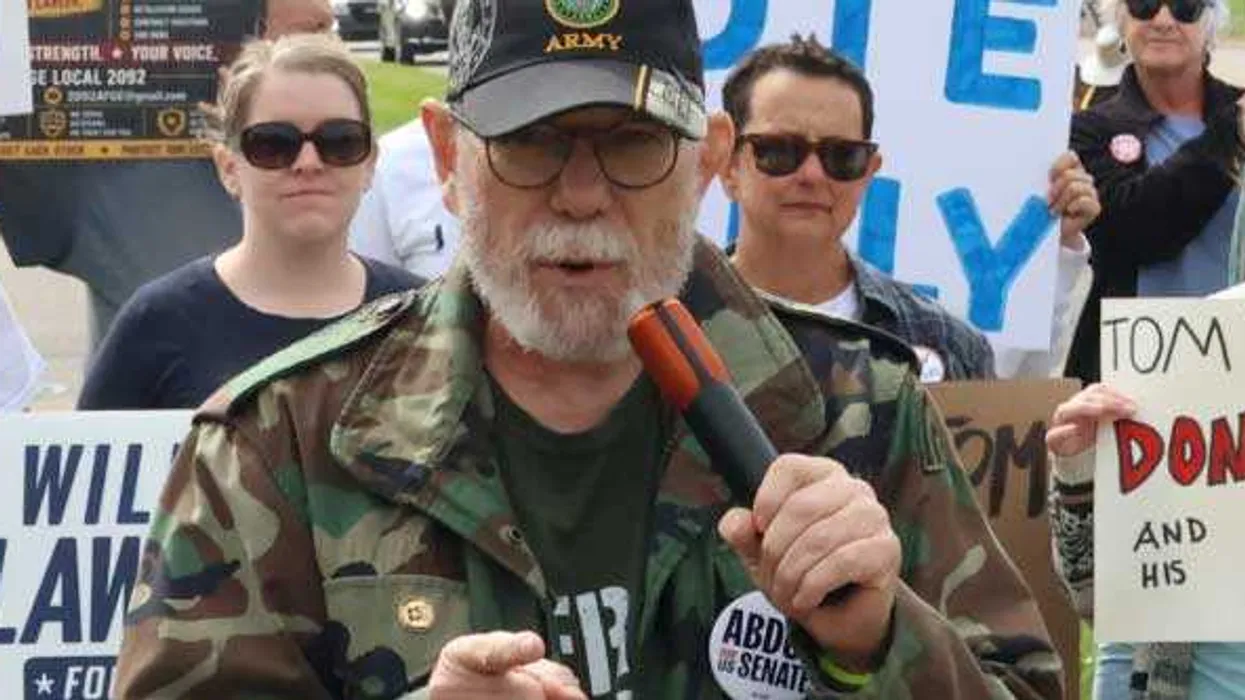
Military veterans led demonstrators outside a Lansing gas station on Friday, protesting the ongoing war in Iran as gas prices surge to record levels — and rallying against the rollout of an electronic health records system they say is harming veteran healthcare.
The demonstration came with the 25th anniversary of the 9/11 terror attacks still fresh in mind. Veterans from multiple branches of the military voiced concern that the United States has once again entangled itself in a war without a clear mission, asking what the latest overseas conflict will mean for the Americans now serving in it.
Steve Monti recalled that he was 19 years old and fresh out of Army training when 9/11 happened, and that before he knew it, he was in Iraq.
“I was fighting for freedom, peace, democracy, oil – I couldn’t tell. I was too close in. I was too close to see the big picture,” Monti said. “Twenty-three years later, and I’m still not sure of what we accomplished, whose lives we made better. Certainly not the hundreds of thousands of people who lost theirs.”
In Monti’s view, the war in Iran is the same story playing out all over again, leaving a new generation to pay the toll.
“And for what? Are we better off?” Monti asked. “Is our gas cheaper? Do you feel more safe, more secure? What about your sons and daughters and their futures? All I see are the people like us, the workers of this country, being squeezed, being run dry. The working class is asked once again to tighten our belts so that we can pay for a war that none of us wanted and none of us asked for.”
Frustrations land in a competitive House race
With an election on the horizon, rising inflation on everyday goods and increasing gas prices have generated frustration among voters. Friday’s event was organized by the Ingham County Democratic Party and other groups opposed to President Donald Trump’s agenda, including Common Defense and Indivisible Michigan’s 7th Congressional District chapter. Multiple speakers laid that frustration at the feet of U.S. Rep. Tom Barrett (R-Charlotte), the incumbent representing Michigan’s highly competitive 7th Congressional District.
Barrett has voted in favor of four resolutions asserting Congress’s war powers to limit and wind down military operations overseas, but those measures have failed to gain support in the U.S. Senate, which voted down the most recent House resolution on Thursday in a 49-50 vote. Barrett’s opponent, Lansing-area political organizer William Lawrence, and other critics, however, have noted his votes in opposition to war powers resolutions before the House in March and April.
“Tom Barrett initially voted against limiting Trump’s war powers,” said Duane Kleinhardt, a retired Army command sergeant major who served with Barrett at Guantanamo Bay. “He says now that he wants us to get out of Iran. Tommy, that is too little and too late.”
In an interview with Michigan Advance, Barrett said his initial votes against the war powers resolutions aligned with the 1973 War Powers Resolution, which requires the president to remove all troops after 60 days if Congress has not granted an extension.
“I take the issue of war very seriously. That’s reflective of my life experience. And one thing that I am not very flexible on is the issue of whether and how we send Americans into war,” said Barrett, who served in the U.S. Army for 22 years, including service during the Iraq War.
Lawrence’s campaign has also criticized Barrett for voting in support of a $95 billion budget framework that includes $60 billion for defense and $13 billion for intelligence.
“Just a few months ago, the House needed just one vote to stop a bill that authorized tens of billions of dollars in funding for this war in Iran. It passed with Tom Barrett’s support,” Lawrence said during a campaign speech Tuesday. “In other words, he could have been the one vote that would have stopped it, and he allowed it to continue.”
Barrett responded that the resolution does not mention Iran, and that the funding was for military and troop readiness.
“If William Lawrence thought that that bill was going to halt the war in Iran, then the obvious question is: since that bill has not passed the U.S. Senate, how is the war in Iran continuing today?” Barrett said.
Healthcare concerns and the Oracle Health records rollout
Alongside frustrations over rising costs, veterans at Friday’s event also raised concerns about veterans healthcare.
Steven Friday, a member of the Stop the Rollout campaignhttps://stoptherollout.org/), called for U.S. Department of Veterans Affairs officials to halt the implementation of the electronic health record system, and for members of Congress to restrict funding to Oracle Health’s contract for the system, citing issues with its performance.
“The Government Accountability Office [reported this month that the VA has fully implemented only four of its 18 recommendations concerning the electronic health record program,” Friday said. “Fourteen are still not fully implemented.”
The GAO is the nonpartisan watchdog that audits federal programs and spending for Congress, and its unimplemented recommendations give lawmakers a concrete benchmark for measuring the rollout’s progress.
Barrett, who serves on the House Committee on Veterans’ Affairs, noted that the committee recently passed a resolution to subpoena Oracle Health’s CEO and Oracle founder Larry Ellison over costly delays in implementing the new health record system. Congress is doing the oversight work, Barrett said, but he stressed that veterans need portable access to their records, noting that his father-in-law had issues receiving care at the VA in Battle Creek when he normally receives care in Tulsa, Okla.
Barrett said it is his “sincere intention and effort to make sure that we get to a point where every veteran has a health record system that is adequate in meeting their needs and allows them the portability of their healthcare.”
“We understand that where there are issues that need correction, we have to correct that. Where there are gaps that need to be filled, we need to fill that,” Barrett said.
The VA operates the largest integrated health care system in the United States. He pointed to the sheer number of records managed by the VA, noting that while this does not discount any issues or gaps in the system, the shift to an electronic records system is a significant overhaul that will require continuous oversight until it is fully implemented and operational.

