VVV Is Listed on edgeX: Venice AI Inference Access Becomes a Crypto Trade
Key Takeaways
- •edgeX has added VVVUSDC to its crypto perpetual markets, allowing eligible traders to take leveraged long or short positions on Venice Token without holding the Base-chain ERC-20 asset.
- •Venice Token is designed as an access and capital token whose staking mechanism is intended to unlock a pro-rata share of Venice API inference capacity at zero marginal cost.
- •Official materials describe a genesis supply near 100 million tokens, annual emissions near 14 million, and a platform-revenue buy-and-burn program beginning from December 2025.
- •The main risk identified is access utilization, since the token could lose its premium if staked inference capacity is not scarce and actually consumed by agents and power users.
- •VVVUSDC is a leveraged derivative that provides neither ownership of VVV nor any claim on Venice equity, platform revenue, or staked inference rights.
Quick Answer
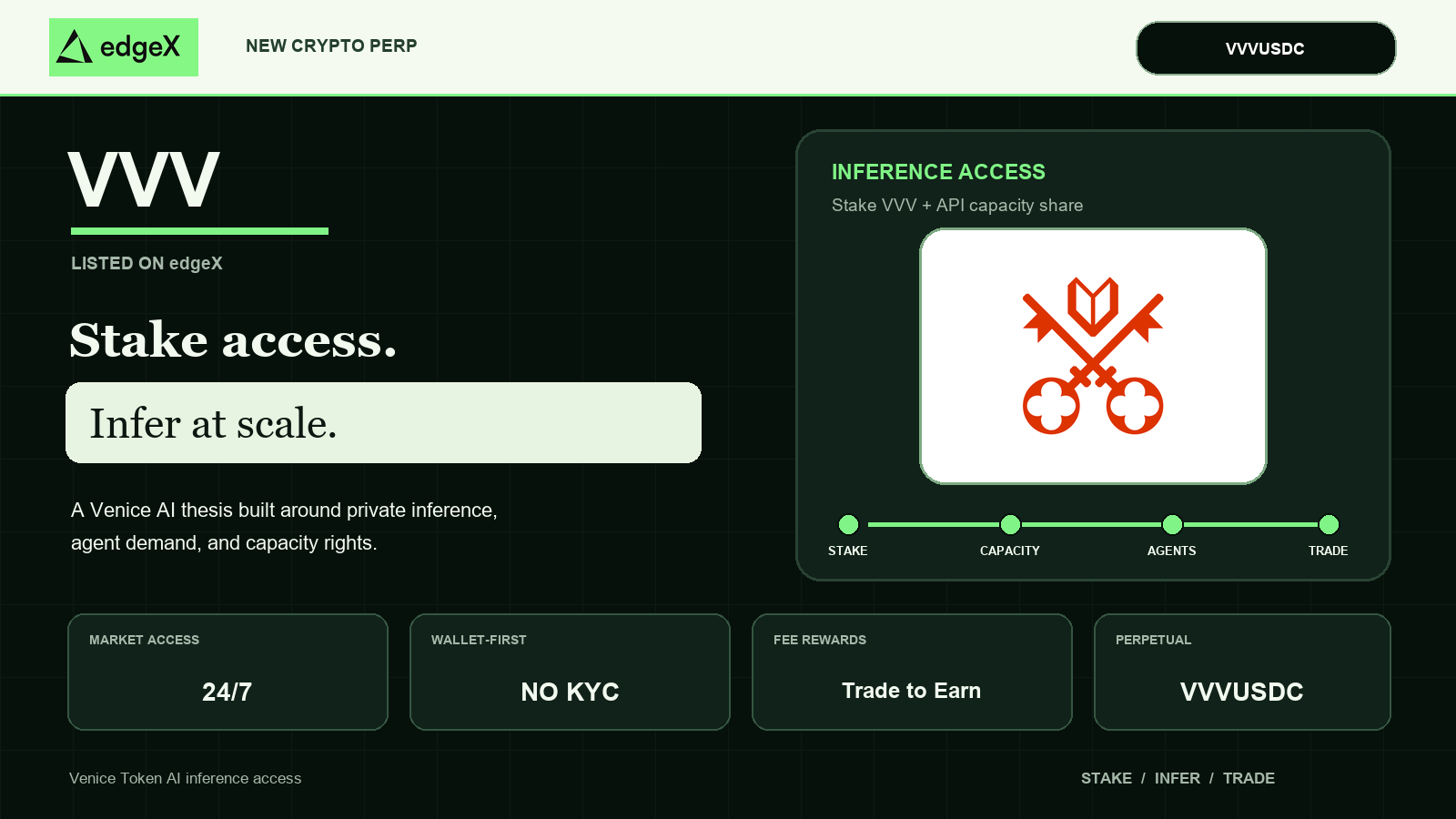
Venice Token (VVV) is the AI inference access token for Venice, a private and uncensored AI platform spanning chat, image, code, and API usage. Staking is the core mechanism: locked VVV is meant to unlock a pro-rata share of Venice API inference capacity at zero marginal cost rather than a conventional pay-per-request bill. VVVUSDC on edgeX is a crypto perpetual that lets eligible traders express a long or short view on that access thesis without holding the Base-chain ERC-20 token. A perpetual is a leveraged derivative, not ownership of VVV and not a claim on Venice equity.
https://x.com/edgeX_exchange/status/2097633790030119183
VVV Arrives on edgeX as Inference Access Becomes the Trade
edgeX has listed VVVUSDC, bringing Venice Token into its crypto perpetual complex. The listing lands in a market that already understands AI as a theme, but still underprices the difference between AI branding and AI access. Venice is not pitching VVV as a vague ecosystem badge. Official materials frame it as capital for a platform that sells private, uncensored inference, with staking as the bridge between token holdings and usable API capacity.
That framing changes the trade. Many AI tokens ask traders to believe in future governance, future airdrops, or future product vibes. VVV asks a sharper question: can demand for private inference, agent workloads, and uncensorable API capacity turn staked tokens into a scarce access right that markets repeatedly reprice? A continuous derivatives venue fits that question. Inference demand does not wait for equity earnings calendars, and agent traffic can spike or stall without notice.
Traders should therefore start with the right unit of analysis. The unit is not "AI is big." The unit is whether Venice can keep converting staking into consumed capacity, whether emissions and burns leave a coherent supply path, and whether the market treats access rights as durable rather than as a temporary narrative wrapper.
What VVV Actually Is
VVV is best understood as an access and capital token for the Venice AI platform. Venice presents itself as a private and uncensored environment for chat, image generation, code work, and API-driven inference. In that setup, the token is not framed as a board seat or a protocol governance lever. It is framed as the asset that sits between platform capacity and users who want ongoing inference rights.
That distinction matters for pricing. A governance token can rally on process theater. An access token has to survive contact with usage. If stakers cannot turn holdings into meaningful inference rights, or if those rights are not scarce relative to available capacity, the market eventually stops paying a premium for the wrapper. Conversely, if API demand rises faster than usable capacity, staking becomes the bottleneck that speculative capital tries to front-run.
Public references reinforce the market identity without inventing a live valuation. The official Venice token page and the project's introducing VVV blog describe the access thesis. CoinGecko tracks Venice Token as a listed crypto asset, while the Base ERC-20 contract `0xacfE6019Ed1A7Dc6f7B508C02d1b04ec88cC21bf` can be verified on Basescan. Traders should still confirm the live edgeX index and market reference before treating any spot representation as identical to the perpetual.
Staking turns tokens into ongoing inference rights
The staking design is the heart of the VVV story. Instead of asking users to buy inference one request at a time, Venice ties access to staked VVV. Stakers receive a pro-rata share of Venice API inference capacity and can use that share at zero marginal cost. In practical terms, the token is meant to behave less like a coupon and more like a claim on a slice of platform throughput.
DIEM supplies the credit-unit framing around that claim. Official materials use DIEM as a $1-per-day style way to think about inference credits, which helps translate abstract capacity into a budget language users and traders can compare. The important editorial point is not the branding of the unit. The important point is the mechanism: staking is supposed to convert idle tokens into ongoing rights over inference capacity.
That creates a two-sided market under one ticker. On one side sit users and agents that want private, uncensored API access without per-request friction. On the other side sit capital holders deciding whether locking VVV is worth more than keeping the token liquid. If utilization rises, the opportunity cost of not staking can increase. If utilization stays weak, liquid trading can dominate and the access premium can compress. The perpetual market then becomes a way to trade that tension without taking delivery of the Base-chain token.
Why AI Inference Demand Is the Real Driver
Two forces dominate the VVV setup.
The first is the shape of AI demand itself. Chat interfaces matter, but the heavier long-term pull sits in API and agent workloads: code assistants, image pipelines, autonomous research loops, and private enterprise or crypto-native agents that prefer uncensorable endpoints. Venice's product surface spans chat, image, code, and API access, which means the token thesis is tied to whether those workloads become recurring rather than experimental.
The second is the scarcity logic of staked capacity. If Venice expands usable inference capacity and stakers absorb a meaningful share of it, VVV can trade as a claim on a growing access base. If capacity expands faster than real usage, or if users prefer ordinary pay-as-you-go alternatives, staking becomes an underused entitlement. In that world, emissions, narrative fatigue, and liquidity preference can weigh more heavily than the AI theme.
The bull case is rising capacity and agent demand
The constructive path is straightforward. Venice grows API capacity. Agents and power users prefer private or uncensored endpoints. Staking utilization rises because the zero-marginal-cost access is valuable enough to lock tokens. Platform revenue then supports the buy-and-burn narrative described from December 2025 onward, tightening the supply story as demand for access increases. In that path, VVV behaves like a leveraged proxy on whether inference rights stay scarce and useful.
The bear case is underused capacity and narrative fade
The negative path is equally concrete. Capacity can exist on paper while remaining lightly consumed. Agents can route elsewhere. Privacy and uncensorability can matter less than price, latency, or model quality. If staked rights are not binding, VVV can slide back into a generic AI-narrative token with emissions near 14 million tokens per year and no durable access premium. Derivatives traders feel that fade quickly because funding, thin books, and forced reductions do not wait for the product story to recover.
The Latest Evidence Behind the VVV Thesis
The most useful evidence is structural. It shows how the token is supposed to work, not what any live USD print says today.
| Proof point | What current public sources show | Why traders should care |
|---|---|---|
| Product identity | Venice is framed as a private/uncensored AI platform for chat, image, code, and API use | Anchors VVV in inference access rather than vague AI branding |
| Token role | Official materials present VVV as a capital and access token, not a governance instrument | Prevents mispricing the asset as a DAO-control trade |
| Access mechanism | Staking unlocks a pro-rata share of Venice API inference capacity at zero marginal cost | Makes utilization the core fundamental, not slogans |
| Credit framing | DIEM is described as a $1/day credit-unit style way to think about inference rights | Helps translate capacity into budget language without inventing a live price |
| Supply path | Genesis supply is described near 100 million, with emissions near 14 million per year in the intro blog | Sets the dilution backdrop against which access demand must compete |
| Burn narrative | Token materials describe platform-revenue buy-and-burn beginning from December 2025 | Links real usage and revenue to potential supply absorption |
| Settlement surface | Base-chain ERC-20 contract `0xacfE6019Ed1A7Dc6f7B508C02d1b04ec88cC21bf` is publicly verifiable on Basescan | Gives traders a concrete identity check before confusing lookalikes |
| Market access | edgeX lists VVVUSDC as a crypto perpetual for eligible traders | Creates continuous long/short expression without spot delivery |
This evidence supports a thesis checklist, not a finished verdict. A clear staking design can launch a narrative. Only repeated capacity consumption, credible burn linkage to platform revenue, and clean market structure can keep the narrative tradable. Treat the table as an ongoing monitor: capacity, utilization, agent demand, emissions, and burn cadence can all move without a neat quarterly script.
What Could Strengthen or Break the VVV Thesis
Signals that would strengthen the setup
The constructive path is rising useful capacity plus rising willingness to lock tokens for that capacity. Clear growth in Venice API throughput, higher staking utilization, denser AI-agent demand for private or uncensored endpoints, and a burn cadence that visibly tracks platform revenue would all support the access premium. Clean contract recognition and usable perpetual liquidity would then let traders express the view without fighting microstructure first.
Signals that would weaken the setup
The negative path starts when capacity is announced faster than it is consumed. Soft staking participation, weak agent retention, model or latency disadvantages versus competing APIs, and a burn story that fails to keep pace with emissions would compress the thesis into a generic AI beta trade. Confusing token representations, thin books, or abrupt narrative rotation out of AI-access names would make the fade worse for leveraged accounts.
The Risk That Is Unusually Important for VVV
Every crypto perpetual carries funding, liquidation, spread, and gap risk. VVV adds a sharper cluster: access utilization risk.
Because the demand engine is staked inference capacity remaining scarce and useful, the asset can lose its bid even while AI remains a mainstream theme. No governance crisis is required. No exchange outage is required. If agents and power users do not consume the capacity that staking is supposed to unlock, the market can re-rate VVV from "inference access" to "another AI ticker with ongoing emissions." That re-rating can happen quietly through underuse before it shows up violently in price.
Leverage then multiplies the problem. An underused access right becomes a weaker spot bid. A weaker spot bid becomes a thinner perpetual book. Thin books plus funding plus forced reduction create exits that are worse than the product thesis alone would imply. Position size, funding awareness, and live contract verification are therefore not secondary for VVV. They are part of reading whether the access mechanism is still doing economic work.
Before opening a position, re-check the live VVVUSDC page for current leverage, funding, fees, liquidity, index methodology, contract specifications, and regional availability. Those terms can change, and they determine whether a correct view of Venice remains a survivable leveraged expression.
VVV Bull, Base, and Bear Cases
| Scenario | Operating path | What traders need to see |
|---|---|---|
| Bull | API capacity grows, agents and power users consume private inference, staking utilization rises, and revenue-linked burns absorb a meaningful share of emissions | Higher useful capacity, sticky agent demand, rising locked VVV, credible burn cadence |
| Base | Venice remains a recognizable private-AI venue, but access demand is uneven and VVV trades mainly with broader AI-crypto sentiment | Intermittent utilization improvements, adequate liquidity, no decisive scarcity premium |
| Bear | Capacity stays underused, the access narrative fades, and emissions weigh on a token no longer priced as scarce inference rights | Soft staking, weak agent retention, narrative rotation, disorderly leveraged exits |
These scenarios keep the next checkpoint honest. VVV does not need every AI headline to go right. It needs evidence that staking still converts into consumed inference rights and that the market continues to treat those rights as scarce.
Trade VVV Perpetuals on edgeX
The VVVUSDC perpetual on edgeX lets eligible traders express a long or short view on the Venice inference-access narrative without taking delivery of the Base-chain ERC-20 token. It is a leveraged derivative, not ownership of VVV, and it does not confer a claim on Venice equity, platform revenue, or staked inference rights. Before trading, verify live leverage, funding, fees, liquidity, index methodology, contract specifications, and regional availability on the market page, because those mechanics decide whether an AI-access view can survive contact with volatility.
Put VVV Trading Fees Back to Work with Trade to Earn
VVV can reprice quickly when Venice API capacity expands, when staking utilization jumps, when AI-agent demand for private inference accelerates, or when burn cadence surprises the market. Trade to Earn gives active VVV traders a direct benefit in that catalyst cycle: eligible trading-fee value can come back through edgeX rewards rather than disappearing as pure friction. That makes repeated positioning around capacity, utilization, agent demand, and burn updates more efficient, while the actual VVV thesis still depends on whether inference access remains scarce and useful rather than on rewards alone.
The Bottom Line
VVV is a cleaner AI-crypto trade than most theme tokens because its official story is specific: stake for inference access on a private and uncensored Venice platform. The edgeX listing makes that story continuously tradable through VVVUSDC. The opportunity is that API capacity, agent demand, staking utilization, and revenue-linked burns can turn access rights into a repeated speculative focus. The risk is that those same variables can fail quietly, leaving traders with emissions, narrative fade, and leveraged exits. The edge is not pretending VVV is Venice equity. The edge is reading whether staked inference capacity is actually being used hard enough to matter.
Frequently Asked Questions
What is VVV in the edgeX market?
VVV is Venice Token, the AI inference access token for the Venice platform. VVVUSDC is the edgeX crypto perpetual tied to that access narrative.
What does Venice do?
Venice is positioned as a private and uncensored AI platform covering chat, image, code, and API inference. VVV sits on top of that stack as a capital and access token.
How does staking relate to inference access?
Staking VVV is designed to unlock a pro-rata share of Venice API inference capacity at zero marginal cost, rather than requiring a pure pay-per-request model for that staked share.
What is DIEM in the Venice framing?
DIEM is used as a $1-per-day credit-unit style framing for thinking about inference rights. It is a way to express capacity in budget terms, not a substitute for live market pricing.
What supply facts should traders keep in view?
Official materials describe a genesis supply near 100 million tokens and emissions near 14 million per year in the introducing-VVV blog, plus a platform-revenue buy-and-burn narrative from December 2025. Always verify current circulating details on primary sources before trading.
Does VVVUSDC mean ownership of VVV or Venice equity?
No. VVVUSDC is a perpetual derivative. It does not provide ownership of VVV, staked inference rights, or any claim on Venice equity.
What should traders verify before opening a VVVUSDC position?
Check the live edgeX market page for current leverage, funding, fees, liquidity, index methodology, contract specifications, and regional availability. This article does not publish a live VVV price.
