Venezuela's Crypto Activity More Than Doubles to $39.1 Billion, Fastest Growth Among Latin America's Largest Markets
Key Takeaways
- •Venezuela's cryptocurrency activity grew 107.2% to $39.1 billion in the year ending June 30, 2026, the fastest pace among Latin America's five largest crypto markets, according to Chainalysis.
- •Chainalysis attributed the surge to the US detention of President Nicolás Maduro in January 2026, with crypto outflows from Venezuela rising 891.7% in the following quarter.
- •Despite its rapid growth, Venezuela ranked fourth in regional transaction value, trailing Brazil at $252.5 billion, Argentina at $88.5 billion, and Mexico at $77.6 billion.
- •Latin America's overall crypto economy expanded 9.8% to $593.8 billion, the sixth-largest of any region, with Brazil topping both market volume and Chainalysis's global adoption index.
- •Venezuelans have increasingly used dollar-pegged stablecoins such as Tether's USDT to pay wages, send remittances, and settle vendor payments, reflecting adoption driven by economic necessity.
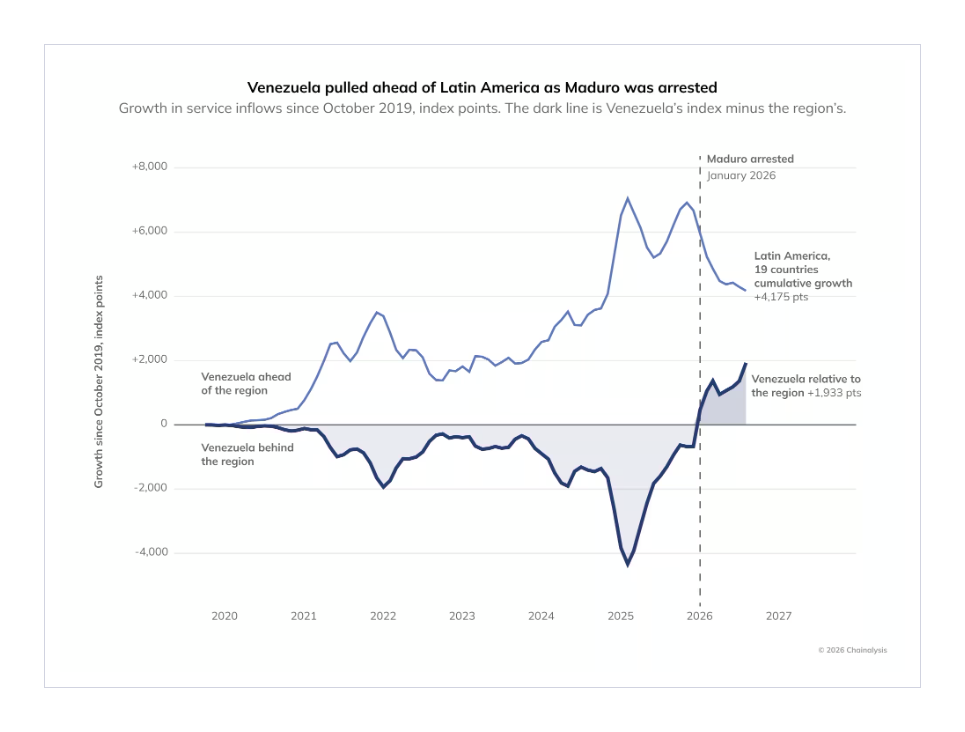
Venezuela's cryptocurrency activity more than doubled in the 12 months to June 30, 2026, rising 107.2% to $39.1 billion, according to blockchain analytics firm Chainalysis, which published the findings in its 2026 Latin America adoption report. It was the fastest growth recorded among the region's five largest crypto markets.
Despite the surge, Venezuela ranked fourth in the region by overall activity — a measure of total transaction value rather than growth — behind Brazil at $252.5 billion, Argentina at $88.5 billion, and Mexico at $77.6 billion. Colombia rounded out the top five at $29.1 billion.
Growth among the region's biggest otherwise ranged from 13.8% to 25.5%: Mexico expanded 25.5%, Argentina 15.3%, and Colombia 13.8%, making Venezuela's pace nearly eight times that of Colombia. Smaller markets grew even faster, with Honduras up 361.6% and Nicaragua up 186.4%.
Latin America's crypto economy as a whole grew 9.8% to $593.8 billion, the sixth-largest of any region. Brazil remained the region's biggest market and topped Chainalysis's global adoption index, which weights usage by population size and purchasing power.
Outflows Spiked 891.7% in the Quarter After Maduro's Arrest
Chainalysis linked Venezuela's surge to January 2026, when the United States detained President Nicolás Maduro. Stablecoin payments surged as Venezuelans moved out of the bolívar into dollar-based crypto assets, the firm said. Stablecoins are cryptocurrencies pegged to a reference asset, most often the US dollar, making them a common vehicle for payments and cross-border transfers.
In the quarter following Maduro's arrest, 891.7% more crypto left Venezuela than in the previous quarter. Domestic peer-to-peer stablecoin growth peaked around early February, roughly 65 points above the region's three largest markets, before slipping back to the regional trend by March. Peer-to-peer markets match individual buyers and sellers directly, without a centralized intermediary.
The figures run through June 30, 2026, and the next edition of the report will show whether Venezuela's faster pace holds.
Chainalysis wrote that in Venezuela and Argentina, crypto offers an alternative to traditional financial services or a route to scarce foreign currency.
In December 2025, Cryptopolitan reported that Venezuelans were using dollar-pegged stablecoins, such as Tether's USDT, to pay wages, send remittances, and settle payments with vendors.
"Here in Latin America, all this adoption comes from necessity," said Carlos Peralta, senior public policy expert at Bitso. "It's not just adoption for adoption's sake."

