VanEck Withdraws SEC Registration for Proposed Lido Staked Ethereum ETF
Key Takeaways
- •VanEck voluntarily withdrew its SEC registration for the proposed Lido Staked Ethereum ETF, so the fund cannot launch under the terms of the original filing.
- •The withdrawal was not a rejection by the SEC, and VanEck has not confirmed an official explanation for pulling the application.
- •The proposed ETF was tied to Ether staked through Lido, meaning its returns would have reflected staking yields in addition to Ether price movements.
- •Staking-based fund structures face unresolved securities-law classification questions that distinguish them from the spot Ethereum ETFs the SEC has already approved.
- •VanEck continues to pursue staking-related crypto products, including a staking objective for its VBNB ETF and BNB ETF filings alongside Grayscale, and it could refile the Ethereum fund with revised terms.
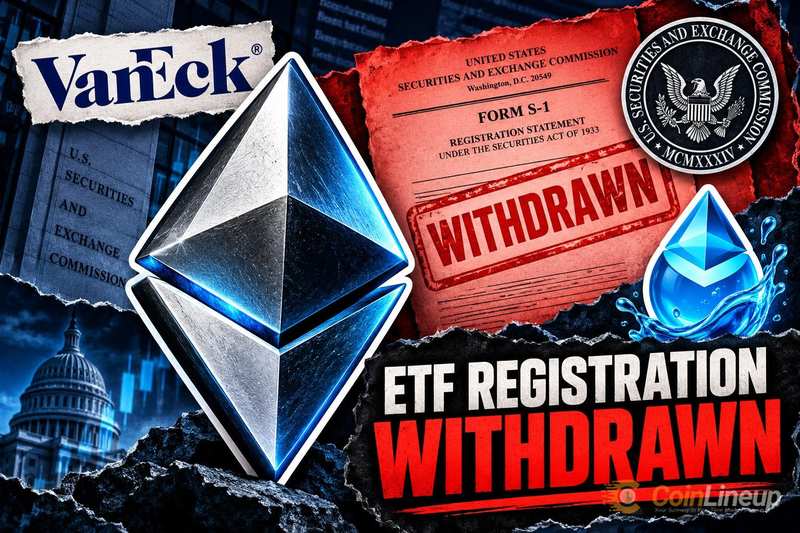
VanEck has withdrawn its registration with the U.S. Securities and Exchange Commission (SEC) for a proposed fund called the Lido Staked Ethereum ETF, ending the product's current path forward. The withdrawal means the fund will not launch under the terms of the registration that was filed with the U.S. Securities and Exchange Commission.
What the Withdrawal Means
A registration withdrawal is a specific legal action. It is not a rejection by the SEC, and it is not an approval. VanEck, a New York-based asset manager with a suite of crypto-linked investment products, chose to pull the filing, removing the proposed ETF from active review. The firm's current filing status is reflected in the SEC's EDGAR company search, which lists the firm's registered products and active submissions.
A withdrawn registration means the proposed fund cannot proceed as described under that filing. No official statement from VanEck has been confirmed explaining the reason for the withdrawal.
VanEck has nonetheless remained active in the crypto ETF space more broadly. Recent moves include an update to its VBNB ETF to add a staking objective, as well as updates to SEC filings for BNB ETFs alongside Grayscale. Those parallel efforts underline that staking remains a live theme across the issuer's product line, even as this particular Ethereum vehicle steps off its current regulatory path.
What Made This ETF Different From a Standard Ethereum Fund
A standard spot Ethereum ETF holds Ether directly. The proposed Lido Staked Ethereum ETF was tied to staked Ether — specifically, Ether deposited through Lido, a liquid staking protocol. Lido is among the most widely used liquid staking services on Ethereum. Staking is the process by which Ether holders commit tokens to help support the Ethereum network and receive rewards in return. Liquid staking lets users earn staking rewards while keeping their assets accessible and tradeable, unlike traditional staking, which locks up funds.
Lido issues a token called stETH, which represents staked Ether and accrues rewards over time. A fund tracking staked Ether would therefore have had a different return profile than a plain spot Ethereum fund, because it would also have reflected staking yields in addition to price movement.
That distinction matters for regulation. The SEC has approved standard spot Ethereum ETFs, but a fund incorporating staking rewards raises separate questions about how the product is classified under securities law. Until those questions are resolved, staking-based fund structures remain in a distinct regulatory category from the spot products investors can already access. Regulatory withdrawals in the crypto space are not uncommon; for context, FinCEN also withdrew proposed rules on crypto wallet and mixing activity earlier this year, illustrating how fluid the U.S. regulatory picture remains.
What Investors and Crypto Watchers Should Know Now
The immediate practical consequence is straightforward: there is no active SEC registration for this product. The proposed fund does not exist in an approved form and cannot be accessed by investors.
What remains open is whether VanEck will refile. Asset managers sometimes withdraw and refile ETF registrations with revised terms to address regulatory concerns or update the fund structure. The SEC's full-text filings search allows anyone to monitor new submissions from VanEck or other issuers pursuing staking-based Ethereum products.
For a regular Ethereum holder, or someone considering their first crypto investment, the takeaway is simple: a staked Ethereum ETF product from VanEck is not available for now. Anyone interested in accessing staking yields through a regulated fund wrapper should watch for a possible new filing.
Disclaimer: This article is for informational purposes only and does not constitute financial or investment advice. Cryptocurrency and digital asset markets carry significant risk. Always research thoroughly before making any financial decisions.

