Offline AI explained: How to run AI without an internet connection — and where it falls short
Key Takeaways
- •Offline AI runs entirely on a device after a one-time model download, requiring an internet connection only for the initial installation.
- •Technext tested Google's AI Edge Gallery and PocketPal AI on an Android phone with 4GB of RAM, downloading the Gemma3-1B-IT model at 584.4MB (about ₦234) and the LFM2.5-1.2B-Instruct model at 730.9MB (about ₦292).
- •The test phone lagged while models ran locally, and desktop tools like LM Studio require a minimum of 8GB of memory, with 16GB recommended for smooth operation.
- •Gemma in AI Edge Gallery wrongly gave February 27, 2027 as Nigeria's next election date, since its knowledge cutoff is around October 2023, while INEC's revised timetable sets the vote for January 16, 2027.
- •Offline AI works well for drafting, rewriting, summarising and privacy-sensitive tasks in areas with poor coverage, but it is unreliable for news, prices or election information, so its answers should be checked manually.
Switch off mobile data and Wi-Fi, enable aeroplane mode, open an already installed AI app on a phone and ask who Nigeria's president is. The answer arrives in 32 seconds — delivered confidently, with the wrong date.
That was the result when Technext tested Google's AI Edge Gallery on an Android phone with no network connection. The takeaway: yes, AI can work without the internet, but only a smaller kind of AI, and users should understand its limits before relying on it.
How offline AI works
Mainstream assistants such as ChatGPT, Claude and Gemini run on remote servers, which is why they need an internet connection. Offline AI works differently: a compact model — the kind the industry calls a small language model — is downloaded once and stored on the device, which then does the processing itself.
It is the same logic device makers have been applying at the system level, where Google's Gemini Nano already powers certain features directly on Pixel phones; the difference here is that the whole chatbot, not just a background feature, lives on the device.
The connection is needed only for the initial download and installation; once installed, the model can run without it.
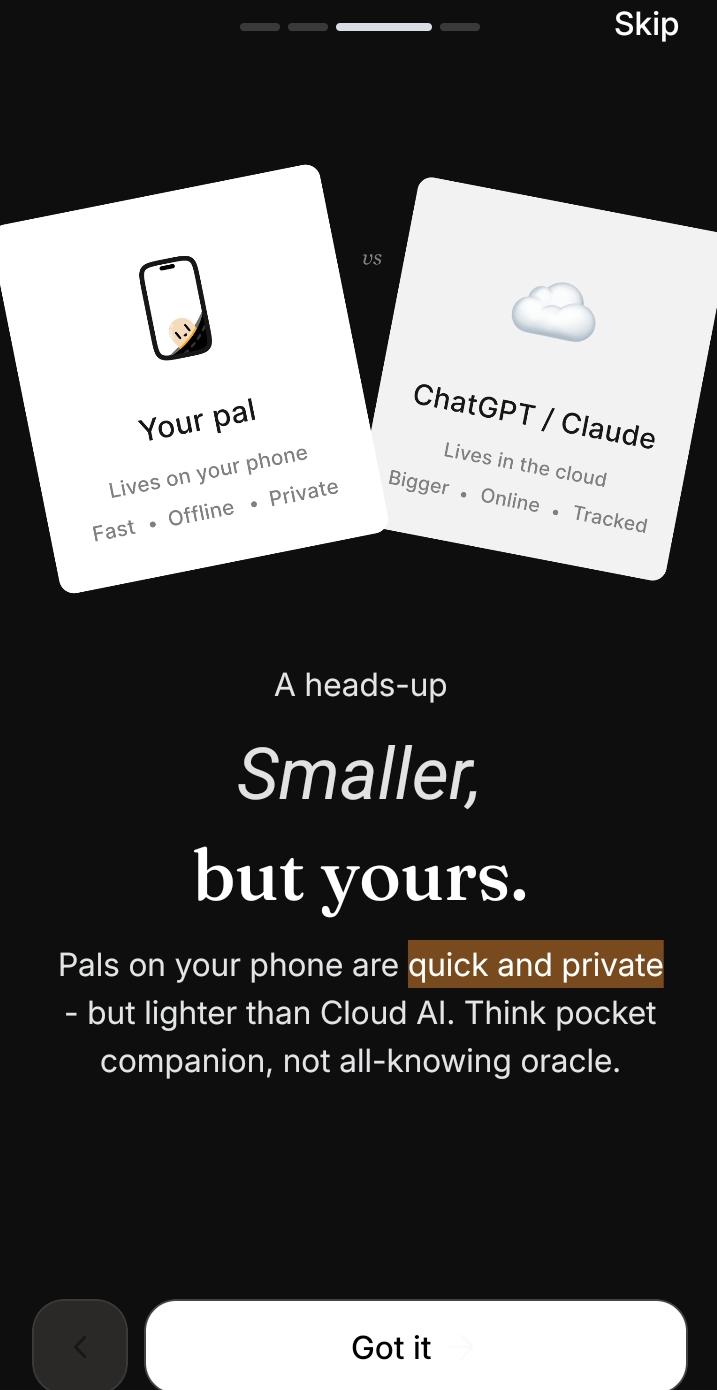
The trade-off is size. PocketPal AI says in its onboarding that models on a phone are quick and private but lighter than cloud AI — a “pocket companion, not all-knowing oracle”.
What we tested on mobile
Technext tested two free apps on a phone with model number 25078RA3EA, running Android 16 with 4GB of RAM plus 4GB of extended memory. Both apps were used in aeroplane mode.
AI Edge Gallery is published by Research at Google and carries an early access label on Google Play. Its listing shows more than 1 million downloads and a 12+ rating — and because it is early access, its feature set and model list can still change as updates roll out. By Technext's count, it offers 11 features, including AI Chat, Ask Image, Audio Scribe and Prompt Lab, and 16 models in total.
Technext tested AI Chat with its smallest model, Gemma3-1B-IT from Google's Gemma family, a 584.4MB download. At Glo's rate of ₦400 per 1GB — the rate Technext used — that works out to about ₦234 in data.
The phone lagged while the model ran. That lag is the hardware reality of running models locally: the model loads into the same memory the phone needs for everything else, which is why the desktop guides below treat 8GB as a floor and 16GB as the comfortable target. When asked to help generate copy, though, it responded sensibly, asking what the copy was for, who the audience was and what tone was wanted.
PocketPal AI also has more than 1 million downloads and a 3+ rating. It matched the test phone with LFM2.5-1.2B-Instruct, a 730.9MB model that costs about ₦292 to download at the same rate.
Asked to trace Nigeria's history and its former leaders, it produced a structured overview that began with pre-colonial kingdoms such as the Hausa states and Yoruba kingdoms, and laid out a detailed account of all previous leaders.
Where it gets things wrong
When asked for the current president and the next general election date, Gemma in AI Edge Gallery named Bola Tinubu but placed today's date in October 2023. It then gave the election date as February 27, 2027.
That is wrong. INEC revised the timetable, moving the presidential and National Assembly elections to January 16, 2027, after the Electoral Act 2026 was signed. The date the model gave matched neither that nor the earlier February 20 date.
The reason for the mistake in dates is simple: an offline model knows only what it learned before it was built, and it cannot look anything up. Developers call this its knowledge cutoff — Gemma's picture of the world stops around October 2023, so the Electoral Act 2026 and the timetable it reshaped simply do not exist for the model, no matter how the question is phrased.
How to set up and use AI without internet on your phone and computer
On your phone (Android)
- Connect to a stable network and make sure you have at least 2GB of free storage.
- Install AI Edge Gallery or PocketPal AI from Google Play.
- In AI Edge Gallery, open AI Chat and choose the smallest or desired model on the list. In PocketPal AI, pick Smart Chat or another specific type when it asks what your “pal” is for, and the app suggests a model that fits your phone.
- Download the model. This is the only step that uses data.
- Switch on aeroplane mode, then start chatting.
If the phone lags, close other background apps first and try to free up more space.
On a computer
Technext did not test the desktop version, so these steps come from the developer's documentation and published guides.
- Check your machine. One guide gives 8GB of memory as the minimum, with 16GB recommended for smooth operation.
- Download LM Studio from lmstudio.ai. It is free for personal use and runs on macOS, Windows and Linux.
- Open the model browser. The shortcut is Ctrl + Shift + M on Windows and Linux, or Cmd + Shift + M on a Mac. The app shows estimated memory needs and warns if a model is too big for your machine.
- Download a model that fits. They are typically 2.5GB to 5GB each — far bigger than the phone models above — so expect a larger data bill.
- Disconnect from the internet and chat.
Ollama is another desktop option, but it is run through commands.
How best to use it
Offline AI suits drafting, rewriting, brainstorming, summarising text you paste in and practising for exams. There are also models for transcription, image explanation, translations and even audio generation. Because the processing is local, data stays on your own computer, which helps with sensitive documents — and because it needs no signal, it keeps working in areas with poor network coverage, where a cloud assistant would not respond at all.
It is a poor choice for news, prices, election information or anything recent, and any fact it produces should be checked manually.
The honest answer, then, is that offline AI is a useful assistant for writing and learning when the network fails, but it is not a source of facts — especially recent ones.

