Bitcoin vs. USDT on Ethereum in 2026: Why Lower Gas Fees Don't Eliminate Conversion Risk
Key Takeaways
- •Ethereum mainnet gas fees dropped significantly by 2026 due to upgrades including Dencun, Pectra, and Fusaka, alongside increased block gas limits and migration of roughly 95% of ecosystem transactions to rollups.
- •Converting USDT to Bitcoin is a cross-chain exchange rather than a bridge transfer, involving separate settlement processes on Ethereum and Bitcoin with costs that extend well beyond gas fees.
- •Bitcoin's average 1% market depth declined from over $8 million in 2025 to approximately $5 million by February 2026, meaning smaller orders could trigger sharper price moves during market turbulence.
- •Lower Ethereum fees do not remove the requirement for ETH in standard wallets, as conventional accounts still need ETH to pay gas unless fee sponsorship through account abstraction is explicitly supported.
- •Tether reported freezing approximately $4.2 billion in tokens linked to suspected illicit activity as of February 2026, highlighting that USDT carries issuer-control risks that Bitcoin does not, while Bitcoin introduces direct market volatility instead.
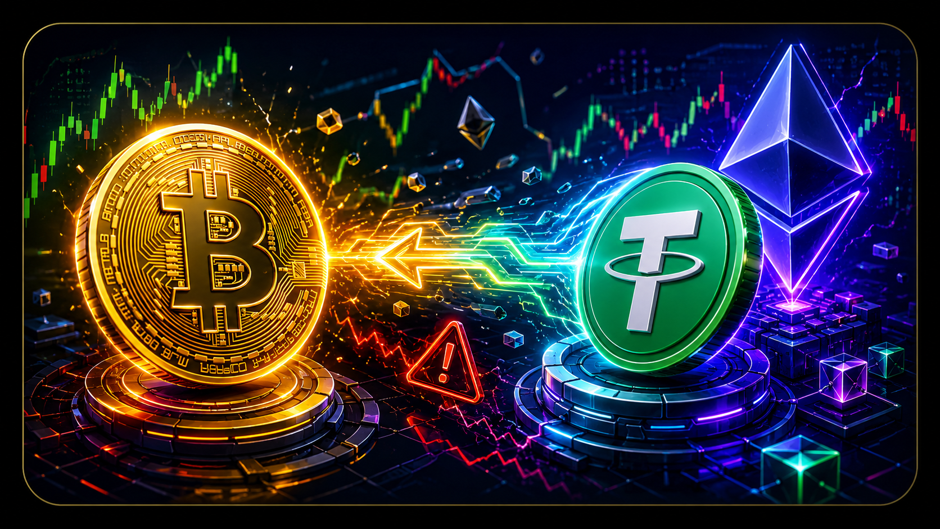
For years, transferring USDT on Ethereum carried a well-known drawback: network fees could be high enough to render modest transfers impractical. In 2026, that assumption is increasingly difficult to justify.
Ethereum mainnet fees have dropped significantly from the peaks many users recall from 2021–2023. According to an official May 2026 example on Ethereum.org, an ERC-20 transfer consuming approximately 65,000 gas would cost about $0.08 at 0.5 gwei with ETH priced near $2,350. While the figure was illustrative rather than a fixed tariff, it underscored a genuine shift: sending ERC-20 tokens on mainnet had become remarkably inexpensive.
That development makes the initial step of converting USDT into Bitcoin cheaper. It does not, however, make the conversion itself straightforward, predictable, or free of market risk.
A USDT-to-BTC exchange involves two blockchains, two settlement models, and at least one source of market liquidity. Ethereum gas covers the cost of transferring USDT to a deposit address. It reveals little about the price at which the stablecoin will be converted, how much BTC will be available near that price, or how quickly the outgoing Bitcoin transaction will confirm.
How Ethereum Became Cheaper — and Why It Only Affects One Part of the Route
Ethereum's lower fees resulted from multiple upgrades rather than a single change. The Dencun upgrade introduced a separate data market for rollups through blob storage. Pectra expanded blob capacity, and Fusaka brought PeerDAS along with further scaling infrastructure. Ethereum's block gas limit also increased during 2025, while a substantial portion of ecosystem activity migrated to rollups rather than competing for mainnet execution space. Ethereum.org estimates that rollups now process approximately 95% of the ecosystem's transactions.
Ethereum's own documentation is measured about causality. Fusaka was designed primarily to expand data capacity for Layer 2 networks and was not expected to reduce Layer 1 gas fees directly. Mainnet became cheaper through a combination of increased capacity, reduced demand for the same blockspace, and the migration of activity to rollups.
For anyone holding ERC-20 USDT, the practical outcome is simple: sending tokens from a wallet can cost far less than it once did. Yet gas is merely the fee for requesting Ethereum to execute a transfer. It is not the total cost of converting one asset into another.
USDT to Bitcoin Is an Exchange, Not a Bridge Transfer
USDT on Ethereum is a token issued through an ERC-20 smart contract. ERC-20 USDT represents a substantial portion of Tether's total circulating supply, and many users accumulate it through centralized exchange withdrawals, DeFi activity, or direct on-chain purchases—making Ethereum gas costs a recurring practical concern for a large segment of stablecoin holders. Bitcoin is the native asset of an entirely separate blockchain. The two cannot be moved between networks as though they were variations of the same coin.
To convert USDT to BTC, a service must receive one asset on Ethereum and deliver another through Bitcoin. It may rely on its own reserves, an external trading venue, a liquidity provider, or a combination of these routes. The user may see a single interface and one estimated result, but underneath, several distinct settlements take place:
- ERC-20 USDT is transferred and confirmed on Ethereum.
- USDT is exchanged for BTC at an available market rate.
- A separate Bitcoin transaction sends BTC to the recipient.
Calling the process a bridge would obscure an important distinction. A bridge typically moves or recreates an asset across networks. In this case, the user ceases holding an issuer-backed dollar token and begins holding a volatile native asset.
The Full Cost Begins Where Gas Ends
A user sending USDT observes the Ethereum network fee because it is deducted directly from the wallet. Other costs are less transparent.
The amount of BTC ultimately received can reflect:
- The spread between buying and selling prices
- The depth available to the execution venue
- Market movement while the deposit is being confirmed
- The provider's service margin
- The cost of sending BTC on-chain
- The size and structure of the outgoing Bitcoin transaction
Some of these costs may be folded into the displayed rate rather than itemized separately. ChangeNOW's integration documentation, for instance, distinguishes between service commissions and deposit- and withdrawal-network fees.
This produces a different cost structure for small and large exchanges. On a $100 conversion, a fixed payout cost, minimum amount, or modest spread can matter far more than a few cents of Ethereum gas. On a $10,000 conversion, gas becomes nearly irrelevant as a percentage of the total. Execution quality becomes the dominant concern. For even larger orders, available market depth and price impact can outweigh everything else.
The cheapest Ethereum transaction does not necessarily yield the best final exchange rate.
Cheap Does Not Mean Gasless
Another distinction is easy to overlook: lower Ethereum fees do not eliminate the need for ETH in a standard wallet.
A conventional externally owned account still pays Ethereum gas in ETH when sending ERC-20 USDT. Pectra's EIP-7702 and the broader account-abstraction ecosystem enable compatible wallets to support fee sponsorship, transaction batching, and arrangements in which another party pays gas on the user's behalf. An application may then recover the cost in USDT or absorb it as part of its service.
These features depend on the specific wallet and application. They are not automatically applied to every Ethereum address. A user can therefore hold sufficient USDT for an exchange yet remain unable to send it because the wallet contains no ETH. The network may be inexpensive, but the transaction stays blocked until the gas balance issue is resolved.
A Quote Can Change While the Deposit Is Moving
The conversion rate displayed when an exchange is initiated may not be the rate applied when the trade is executed.
With a floating rate, the received amount typically depends on market conditions once the deposit arrives and meets the provider's confirmation requirements. If Bitcoin moves during that interval, the final BTC amount can differ from the initial estimate.
A fixed-rate exchange shifts some of that short-term price risk to the provider. The quoted amount is protected only when the user follows the stated conditions, including the correct asset, network, amount, and deposit window. ChangeNOW's help centre states that its fixed-rate flow guarantees the rate during the time shown for depositing the exchange funds.
The exact time window should always be checked in the live interface. Separate ChangeNOW help pages currently show inconsistent figures, making a general phrase such as "within the displayed deposit window" more reliable than citing a specific number in an evergreen article.
A fixed rate also does not protect against sending USDT through the wrong network, entering an invalid BTC address, or transferring an amount that does not match the order. It addresses exchange-rate movement, not every operational error surrounding the transaction.
Deep Liquidity Can Still Thin Out
Bitcoin is among the most actively traded crypto assets, and USDT is central to crypto-market liquidity. The BTC/USDT pair consistently ranks among the highest-volume trading pairs across major crypto exchanges, meaning even modest inefficiencies in this conversion route can affect a large number of users. Neither fact guarantees identical execution at every moment or on every venue.
Liquidity is specific to the market route available to the provider. One platform may access multiple exchanges and counterparties, while another relies on a narrower set. The same order can therefore produce different results even when the global BTC/USDT market appears deep.
This distinction became apparent during the market turbulence of early 2026. Reuters reported that Bitcoin's average 1% market depth, based on Kaiko data, had declined from more than $8 million in 2025 to approximately $5 million by February 2026. With less liquidity available near the market price, smaller orders could trigger sharper price moves than before the contraction.
Market depth is not synonymous with daily trading volume. Volume measures how much has already traded. Depth indicates how much can be bought or sold near the current price before an order begins pushing through less favorable levels.
During a fast-moving market:
- Spreads may widen
- Fixed quotes may include a larger safety buffer
- Floating-rate exchanges may return less BTC than initially estimated
- Larger orders may experience greater slippage
- Providers may route orders differently or reduce available limits
None of these effects is mitigated by a low Ethereum gas price.
Confirmation Time Creates a Market Gap
Ethereum and Bitcoin do not settle transactions in the same manner.
An Ethereum transaction may appear in a block within seconds, but protocol finality currently requires approximately 15 minutes. Exchanges and payment services do not necessarily wait for full finality; each sets its own deposit policy based on the asset, transaction size, and risk controls.
Bitcoin relies on probabilistic confirmation. A block is produced roughly every ten minutes on average, but this does not guarantee that any particular transaction will be included in the next block. Higher confirmation counts make a chain reorganization increasingly improbable, while services set their own thresholds for accepting a payment. The Bitcoin developer guide notes that a single confirmation sharply reduces double-spend risk, though high-value transactions may warrant waiting for six or more.
This creates a natural timing gap:
- The exchange is created
- The user sends USDT
- Ethereum processes the deposit
- The provider recognizes sufficient confirmation
- Market execution occurs
- BTC is sent
- The Bitcoin transaction waits for confirmation
Bitcoin's price can move throughout this sequence. The effect is minimal in a calm market and more pronounced during a sudden sell-off, breakout, or weekend liquidity squeeze.
The Bitcoin Payout Has Its Own Fee Logic
The outgoing BTC transaction is not a continuation of the Ethereum transfer. It operates under Bitcoin's UTXO model.
Bitcoin fees depend primarily on the signed transaction's size and the fee rate required to compete for blockspace. A transaction with multiple inputs can cost more than a simpler transaction moving a much larger dollar amount.
The exchange provider determines which UTXOs to spend, what fee rate to apply, and whether multiple customer withdrawals should be batched into a single transaction. Consequently, the payout cost presented to the user may not correspond to a simple one-input, one-output Bitcoin transfer.
Low Bitcoin fees can make the payout inexpensive, but they do not guarantee immediate block inclusion. A provider may select a conservative fee during a quiet mempool period, only for demand to rise before the transaction confirms. Conversely, paying a higher fee may accelerate inclusion without changing how long a receiving platform waits before crediting the deposit.
The Address Can Look Right While the Network Is Wrong
The proliferation of Ethereum-compatible networks has introduced another source of confusion.
Ethereum, Base, Arbitrum, and several other EVM networks use addresses beginning with "0x." USDT sent through one of these networks does not automatically arrive on another. An exchange order requesting USDT ERC-20 on Ethereum mainnet expects a deposit on Ethereum mainnet, even when the same address string can be displayed across multiple networks.
The visible address format alone is insufficient. The selected blockchain must match the deposit route. ChangeNOW lists Ethereum USDT separately from its TRON, Solana, TON, Polygon, and Arbitrum versions, reflecting that each represents a distinct network path.
This distinction matters more than a minor fee difference. Recovering a deposit sent through an unsupported network may require manual intervention and may not be possible at all.
The Conversion Replaces One Set of Risks with Another
USDT mitigates short-term price volatility by tracking the US dollar. It does not carry the same properties as cash held in a bank account.
Tether remains the token's issuer. It controls the smart contract and can freeze USDT at specified addresses in response to law-enforcement requests or compliance decisions. In February 2026, Reuters reported that Tether stated it had frozen approximately $4.2 billion in tokens linked to suspected illicit activity, demonstrating that this control is operational rather than theoretical.
Bitcoin eliminates issuer and blacklist risk at the native asset level. In its place, it introduces direct market exposure. Its price can move sharply in either direction, settlement is probabilistic, and self-custody places responsibility for keys, backups, and address accuracy entirely on the holder.
A May 2026 working paper from the Federal Reserve Bank of Philadelphia found that USDT functioned as a liquidity refuge for Ethereum holders during periods of stress, particularly among retail participants. The effect was more muted for native Bitcoin holders, suggesting that USDT's role depends partly on the surrounding network and market structure.
Viewed from that perspective, converting USDT into BTC represents a shift away from relative price stability and back into market risk. Lower gas makes that shift cheaper to initiate. It does not make the resulting exposure less volatile.
What Matters Before Confirming the Exchange
The Ethereum fee is worth checking, but it should not dominate the decision. A more thorough review starts with the final BTC amount and works backward.
Users should verify:
- That the order expects USDT on Ethereum mainnet
- That the wallet contains enough ETH, unless gas sponsorship is available
- Whether the quote is fixed or floating
- How long the quote or deposit window remains valid
- Whether the amount meets the current minimum
- Which Bitcoin address format the destination accepts
- How the final estimate accounts for the outgoing network cost
- How much the BTC amount may change if the market moves before execution
For a small conversion, the headline gas saving may be overshadowed by payout costs and the quoted spread. For a large one, market depth and route quality matter more. During volatile trading, the interval between deposit and execution can become the primary risk.
Ethereum's lower fees have removed one of the most visible obstacles to moving ERC-20 USDT. What remains is less obvious and often more consequential. A USDT-to-BTC conversion spans two settlement systems and changes both the asset and the risk profile borne by its owner.
Gas now accounts for a smaller share of the journey. It was never the whole journey.
Disclaimer: This article is for informational purposes only and does not constitute financial or investment advice. Cryptocurrency and digital asset markets carry significant risk. Always conduct your own research before making decisions.

