How One USDC Collateral Pool Can Support Multiple Markets
Key Takeaways
- •A shared USDC collateral pool lets one account balance cover margin for crypto, stock, commodity, and FX derivative positions at the portfolio level.
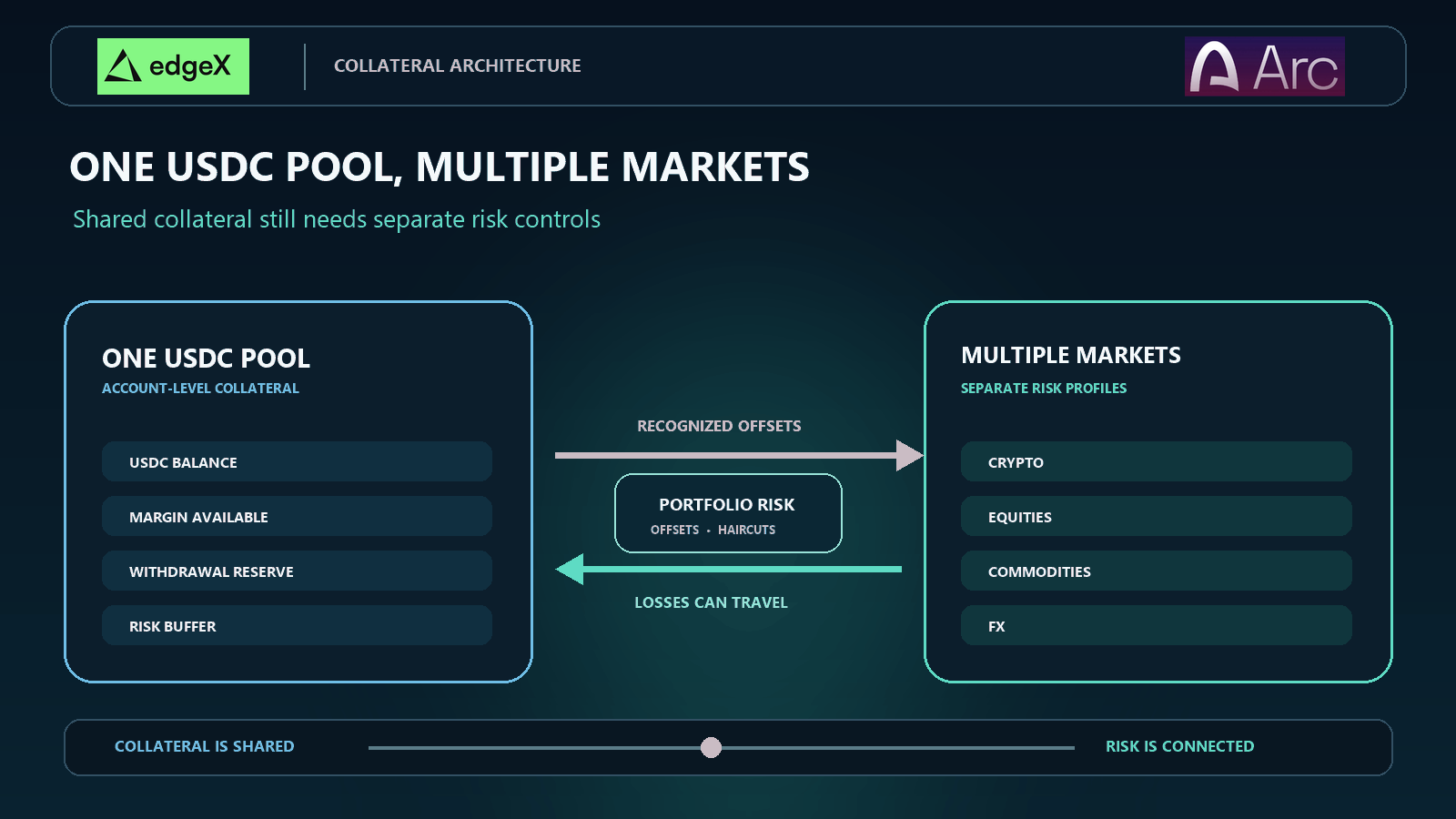
- •Cross margin allows multiple positions to draw on one balance, while portfolio margin goes further by measuring scenario risk and potentially recognizing approved offsets.
- •Shared collateral improves capital efficiency but creates transmission channels, meaning a loss in one market can weaken margin protection for every position in the pool.
- •Displayed, withdrawable, and margin-available balances can differ because platforms apply valuation rules, haircuts, withdrawal reserves, and pending-deposit restrictions.
- •edgeX plans new FX perpetuals alongside existing markets, with the Arc mainnet launch scheduled for September 16, 2026, keeping margin and settlement in native USDC.
Quick Answer
One USDC collateral pool can support multiple markets by serving as the common account balance against which a trading platform measures total portfolio risk. The platform converts positions in crypto, stocks, commodities, or FX derivatives into a shared collateral requirement. Available USDC can then cover margin across those positions rather than being manually divided into separate market wallets.
This structure can reduce idle balances and make hedging easier. It can also connect losses that would otherwise remain isolated. The central question is not simply how many markets one deposit can access. It is how the risk engine values every position, recognizes or rejects offsets, and decides which positions to reduce when the account no longer meets its requirement.
One Pool Means One Account-Level Source of Collateral
A collateral pool is the balance that a platform recognizes as available to support trading obligations. In a simple USDC-denominated account, deposits, realized profit and loss, fees, funding, and withdrawals all change that balance. Open positions then create initial and maintenance margin requirements against it.
“One pool” does not necessarily mean that every USDC token sits in one smart contract or one blockchain address. It is primarily an account and risk concept. A platform may use several wallets, custody arrangements, ledgers, or settlement accounts while presenting one usable collateral balance to the trader.
The practical difference appears when a trader opens more than one market. In isolated accounts, the trader might assign 2,000 USDC to a BTC perpetual, 2,000 USDC to an equity-index contract, and 1,000 USDC to an FX position. Unused margin in one compartment cannot protect another. In a shared account, the risk engine sees the 5,000 USDC together and allocates capacity under the portfolio rules.
Cross margin shares the balance
Coinbase’s derivatives margin documentation describes cross margin as a structure in which positions use the same collateral in a derivatives portfolio. This captures the basic benefit and the basic risk: more of the account can support each position, but more of the account can also be consumed by a losing position.
| Account design | How collateral is assigned | Main advantage | Main risk |
|---|---|---|---|
| Isolated margin | A fixed amount supports one position | Losses can be contained | Capital may sit idle elsewhere |
| Cross margin | One balance supports several positions | Available collateral is reused | One loss can weaken every position |
| Portfolio margin | Scenario risk is measured across eligible positions | Recognized hedges may reduce requirements | Model and correlation errors matter more |
The Margin Engine Turns Positions Into One Requirement
A platform cannot simply add market values and call the result safe. It needs a margin engine that converts different positions into a common risk measure. A BTC perpetual, a gold contract, a stock-index perpetual, and an FX position may all settle in USDC, but they have different volatility, liquidity, gap, and trading-hour characteristics.
The engine first marks each position using an approved price. It then estimates how much the portfolio could lose under defined scenarios. Initial margin controls whether new risk can be opened. Maintenance margin determines whether existing positions can remain open. Fees, funding, pending orders, and unrealized profit or loss may change the available balance or the requirement.
CME’s SPAN methodology illustrates the broader principle: portfolio risk is tested across market scenarios rather than reduced to one current-price snapshot. A crypto venue may use a different model, but the same discipline applies. Common settlement currency does not make different market risks identical.
Every input needs a valuation rule
USDC provides a common denomination, but the platform still needs explicit valuation rules. It must decide whether deposited USDC receives full collateral value, how unrealized profit is counted, when funding becomes final, and whether pending withdrawals remain available. If other assets are accepted, each may receive a haircut.
Cross-collateral documentation distinguishes an asset’s market value from the collateral value recognized after platform rules. That distinction matters even when USDC is the primary unit. A displayed balance, withdrawable balance, and margin-available balance can be three different numbers.
Shared Collateral Improves Capital Efficiency
Separate market wallets force traders to predict where collateral will be needed. They may overfund a quiet market while another position approaches its margin threshold. Moving funds can take time, incur network or operational friction, and fail during the period when the transfer matters most.
A shared USDC pool reduces that fragmentation. Realized gains in one eligible market can increase account equity available elsewhere. Unused collateral does not need to be manually reassigned before every trade. A trader can add a hedge without first moving settlement assets between product silos.
The value is clear across markets that respond to the same event in different ways. A desk may hold crypto exposure, a U.S. equity contract, commodity risk, and an FX hedge. One settlement denomination makes profit, loss, fees, and margin easier to compare. It also lets the platform monitor one account-level buffer.
Capital efficiency should be measured after constraints. Position limits, concentration charges, liquidity add-ons, withdrawal reserves, and risk buffers can make USDC unavailable for new orders. The useful metric is collateral remaining after the platform applies its rules.
Offsets Must Be Earned, Not Assumed
Cross margin and portfolio margin are often treated as synonyms, but they answer different questions. Cross margin asks whether several positions can draw on one balance. Portfolio margin asks whether the risk model recognizes that some positions reduce the risk of others.
A long position and a short position may appear to offset, but the relationship can break. The contracts may use different indices, trade in different hours, have different liquidity, or react differently during stress. A hedge against normal daily moves may not protect against a weekend gap, oracle failure, funding shock, or market-specific halt.
CME’s portfolio-margining material shows why recognized offsets can reduce collateral requirements when related exposures are assessed together. The principle is useful, but the discount must be governed. A risk engine should limit offsets, stress correlations, and increase requirements when markets diverge.
Gross exposure still matters
Two offsetting positions can have low net directional exposure while maintaining large gross exposure. Both legs can generate fees, funding, slippage, and liquidation risk. If one leg becomes difficult to trade or its reference price fails, the account may be left with the other leg unprotected.
Traders should therefore track both net risk and gross notional. A low portfolio-margin number is not proof that the portfolio is easy to exit. It is a model result based on specified shocks, prices, and relationships.
A Shared Pool Also Creates Transmission Channels
Shared collateral turns market diversification into account connectivity. When one position loses value, account equity falls for every position using that pool. A commodity gap can reduce the margin protecting a crypto trade. An FX liquidation can force the closure of an otherwise profitable equity position if the platform needs to restore the account buffer.
This is the main trade-off. Isolated margin creates firebreaks but strands capital. Shared margin mobilizes capital but allows stress to travel.
| Stress event | What changes in the pool | Possible account effect |
|---|---|---|
| One market gaps | Unrealized loss rises quickly | Maintenance buffer falls across the account |
| A hedge diverges | Expected offset weakens | Margin requirement can increase |
| Funding becomes extreme | Cash transfers reduce equity | Unrelated positions lose available collateral |
| An index becomes stale | Valuation confidence declines | Haircuts, limits, or pauses may tighten |
| Withdrawals are pending | Spendable balance may fall | New orders can be rejected |
| Liquidation begins | Positions are reduced under platform rules | Profitable legs may be closed with losing legs |
Concentration controls matter because a common denomination can hide a concentrated portfolio. Ten markets do not create diversification if they all respond to the same dollar, rate, technology, or risk-on shock. The platform should measure common factors, not just count symbols.
Liquidation sequencing matters as well. A risk engine may close the largest risk, the most liquid position, the worst-performing position, or positions according to another rule. Each choice affects execution cost and the remaining hedge. Traders need to know whether they can reduce risk themselves before automatic liquidation begins.
Valuation and Settlement Determine What the Balance Means
USDC can simplify account denomination because positions, collateral, fees, and settlement can use one dollar-based unit. Circle publishes information about USDC and its reserve transparency. Those properties address the stablecoin itself. They do not remove trading-platform, custody, smart-contract, bridge, oracle, or market-liquidity risk.
The platform must also define when gains become reusable and when losses become binding. An unrealized gain may increase displayed equity without being immediately withdrawable. A completed trade may change a position before settlement records or external transfers finish. Pending deposits should not support risk until the platform has a reliable completion rule.
Withdrawals create another boundary. If every displayed USDC unit can be withdrawn while open positions depend on it, the account can become undercollateralized. Platforms therefore distinguish total equity from available margin and withdrawable balance. During stress, they may reserve more collateral, delay transfers, or reduce limits.
One pool works best when trading and settlement states remain synchronized. The account should show which value is final, which is estimated, which is reserved, and which can leave the platform.
How Traders Should Evaluate a Multi-Market Pool
Start with the account model. Determine whether the platform uses isolated margin, cross margin, portfolio margin, or a combination. Ask which products share collateral and whether subaccounts can create operational firebreaks.
Then inspect the risk inputs: mark prices, index sources, volatility shocks, correlation assumptions, liquidity add-ons, concentration charges, funding treatment, and pending-order requirements. The CFTC and SEC’s portfolio-margining request for comment reflects the broader importance of evaluating margin efficiency, collateral use, liquidity effects, and risk outcomes together.
Finally, test the operating paths. Check deposits, withdrawals, transfer cutoffs, reduce-only orders, position limits, liquidation warnings, and incident communication. Model a case in which one market gaps while another closes, the hedge diverges, and the platform raises margin requirements.
The best shared pool is not the one that reports the lowest margin. It is the one whose requirement remains understandable and whose controls preserve orderly exits when market relationships change.
Investor Summary
One USDC collateral pool can make a multi-market trading account more useful by reducing idle balances, simplifying denomination, and allowing eligible positions to share account equity. These gains come from account design and risk measurement, not from USDC alone.
Investors should evaluate the full mechanism: collateral custody, valuation, margin scenarios, concentration, offset limits, liquidation sequencing, withdrawals, and settlement. A platform that offers many markets against one balance has built a connected risk system. Its quality depends on how well that system behaves under stress.
Final Takeaway
A single USDC balance can support crypto, stock, commodity, and FX derivative positions when a platform measures obligations at the portfolio level. This can make collateral more mobile and hedging more practical.
The same structure means that every market can reach the same pool. Traders should use shared collateral for deliberate capital allocation, not as permission to maximize leverage. The strongest systems make available collateral, recognized offsets, stress charges, and liquidation consequences visible before conditions deteriorate.
Trade Perpetual Markets on edgeX With Arc Settlement
Put your USDC to work across a market layer built for active traders. edgeX brings an order-book trading experience to perpetual markets across crypto, U.S. stocks, commodities, and FX, with its white paper describing the execution stack behind the platform. Arc is designed to provide the stablecoin-native settlement environment underneath. The announced integration is designed to keep margin and settlement in native USDC, so the trading workflow and the settlement asset work together instead of being split across disconnected systems.
Ready to trade beyond a single market? Explore edgeX to find the platform and available perpetual markets. For the Arc-specific path, see edgeX on Arc and follow the announced rollout. edgeX has announced plans for new FX perpetuals alongside its existing markets, with the Arc mainnet launch scheduled for September 16, 2026. Availability, markets, and launch details may change.
Perpetuals are built for traders who want flexible, always-on market access, but they are not passive products. Leverage, funding rates, oracle design, liquidity, and liquidation can all affect results. Review the product terms and risk controls before trading.
Frequently Asked Questions
Does one USDC pool mean every market uses the same risk?
No. The collateral denomination can be shared while each market keeps different volatility, liquidity, price, and concentration parameters. The risk engine converts those different exposures into one account requirement.
What is the difference between cross margin and portfolio margin?
Cross margin allows several positions to use one collateral balance. Portfolio margin goes further by measuring combined scenario risk and may recognize approved offsets. A platform can offer cross margin without granting portfolio-level offset benefits.
Can profits in one market support losses in another?
They can if the platform includes those profits in account equity and both markets share the same collateral pool. Unrealized gains may receive different treatment from realized funds, so traders should check the valuation and withdrawal rules.
Is a shared collateral pool safer than isolated margin?
Not automatically. Shared collateral can prevent a small position from being liquidated while unused funds sit elsewhere, but it can also allow one loss to consume collateral supporting every position. The safer design depends on position size, diversification, and the platform’s controls.
What should traders check before using unified USDC collateral?
Review mark prices, margin formulas, offset limits, concentration charges, liquidation sequencing, funding, pending withdrawals, subaccount options, and incident procedures. Also confirm when deposits and profits become available and when they can be withdrawn.

