World Liberty Financial Launches USD1 Stablecoin on Canton Network
Key Takeaways
- •USD1 is now issued natively on the Canton Network rather than being bridged from another blockchain.
- •World Liberty said USD1 has exceeded $4 billion in circulation since its March 2025 launch.
- •Canton is used by regulated financial firms and supports tokenized assets, including U.S. Treasurys and other real-world assets.
- •World Liberty said USD1 can be used for institutional lending, derivatives, cross-border payments, and onchain asset issuance and redemption.
- •Before USD1’s launch, Brale’s USDA was the largest stablecoin on Canton with more than $4 million in circulation.
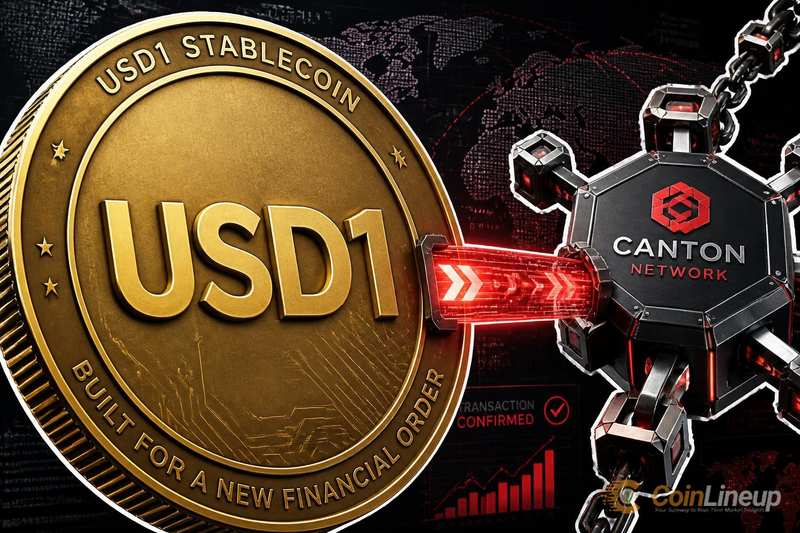
World Liberty Financial has launched its USD1 stablecoin on the Canton Network, a blockchain built for large financial institutions. The move places the multibillion-dollar, dollar-pegged token in front of the banks and asset managers that use Canton to move tokenized real-world assets.
USD1 is now available on Canton and is issued natively on the network, World Liberty Financial said in its August 25, 2026 announcement. A stablecoin is a crypto token designed to hold a steady value, usually one U.S. dollar. USD1 already operates on other blockchains; the Canton deployment extends its reach toward institutional users.
Why the Canton Network matters for USD1
“Natively issued” means the token is created directly on Canton, not bridged over from another chain. According to World Liberty, that allows institutions to use USD1 as a built-in settlement option when they bring tokenized real-world assets onto the network.
The Canton Network is a blockchain designed for regulated financial firms that need privacy and control over their data. It was developed by Digital Asset, an enterprise blockchain company, and its participants have included banks such as Goldman Sachs and BNP Paribas. It is used to issue and move tokenized assets — traditional holdings such as U.S. Treasurys represented as digital tokens, a corner of the market where major traditional asset managers have also arrived, most notably BlackRock with its tokenized money-market fund BUIDL.
World Liberty said more than $9 trillion in tokenized assets are issued or processed on Canton each month, and over $350 billion in onchain U.S. Treasurys move across the network daily — figures echoed in Canton's earlier deployment plans. Those numbers indicate the scale of activity USD1 is now joining.
Canton first signaled the deployment on December 16, 2025, describing the same institutional use cases before the token went live. This week's launch turns that plan into reality.
On Canton, USD1 can be used to back derivatives and institutional lending, settle cross-border payments around the clock, and fund the issuance and redemption of onchain assets. In plain terms, it gives large financial players a dollar token that can move money instantly, on any day of the week.
How big USD1 already is
World Liberty said USD1 has surpassed $4 billion in circulation since it launched in March 2025. World Liberty Financial itself is a crypto venture associated with President Donald Trump and his family, a connection that has kept the project in the public and political spotlight. The token is issued by BitGo Bank & Trust, National Association, a federally regulated trust overseen by the Office of the Comptroller of the Currency. That regulatory backing matters for a stablecoin.
World Liberty said USD1's reserves consist of short-term U.S. Treasurys, U.S. government money market funds, dollar deposits, and other cash equivalents, so each token is meant to be covered by safe assets — the kind of high-quality backing now mandated for payment stablecoin issuers in the U.S. under the GENIUS Act, the federal stablecoin law signed in July 2025.
Public data confirms that scale. DefiLlama shows roughly 4.048 billion USD1 in total circulation, giving an independent read on how many tokens exist. Even at that size, USD1 remains far smaller than the two tokens that dominate the global stablecoin market, Tether's USDT and Circle's USDC.
USD1 recently traded near its $1 target, slipping about 0.05% over 24 hours. World Liberty and USD1 have drawn attention this year, including a public dispute involving Tron founder Justin Sun and scrutiny over the token's ability to reallocate funds from frozen wallets.
What the rollout signals for the stablecoin market
USD1 is entering a network where it faces competition. On August 18, 2026, rival issuer Brale said its USDA token had grown past $4 million in circulation and was the largest stablecoin on Canton before USD1 arrived. The gap is substantial: USD1's multibillion-dollar circulation dwarfs USDA's few million. The size difference illustrates how quickly stablecoin dominance rankings on a given network can shift when a large player enters a new venue.
The launch is aimed at banks and asset managers rather than everyday users, but it shows stablecoins pushing deeper into traditional finance. For holders of any dollar token, the rollout also underlines the importance of understanding how a stablecoin is backed and the depeg risks that have affected even large stablecoins. The early markers to watch from here are whether USD1 takes hold in Canton's institutional settlement and tokenization flows, and how issuance practices develop under the new federal stablecoin rules.
Source: CoinLineup
Disclaimer: This article is for informational purposes only and does not constitute financial or investment advice. Cryptocurrency and digital asset markets carry significant risk. Always do your own research before making decisions.
