US-UK Digital Asset Pact Released as CLARITY Act Stalls in Senate
Key Takeaways
- •The US and UK jointly committed to establishing comparable stablecoin reserve standards requiring high-quality, liquid assets backing issued stablecoins at a ratio of at least one-to-one.
- •The UK is developing a unified approach for tokenized wholesale markets through a 54-company task force that includes BlackRock and JPMorgan, with Christopher Woolard CBE appointed as Wholesale Digital Markets Champion.
- •The CLARITY Act, which would define digital assets as commodities or securities and expand CFTC jurisdiction, remains stalled in the Senate due to disagreements over ethics provisions, illicit finance protections, and competing text from the Senate Agriculture Committee.
- •Analysts estimate the Senate may be ten votes short of the sixty needed to invoke cloture on the CLARITY Act, with Senator Elizabeth Warren likely to object to expedited procedures.
- •The broader cryptocurrency market capitalization rose 1.5% overnight to $2.29 trillion, with daily trading volume reaching $55.1 billion.
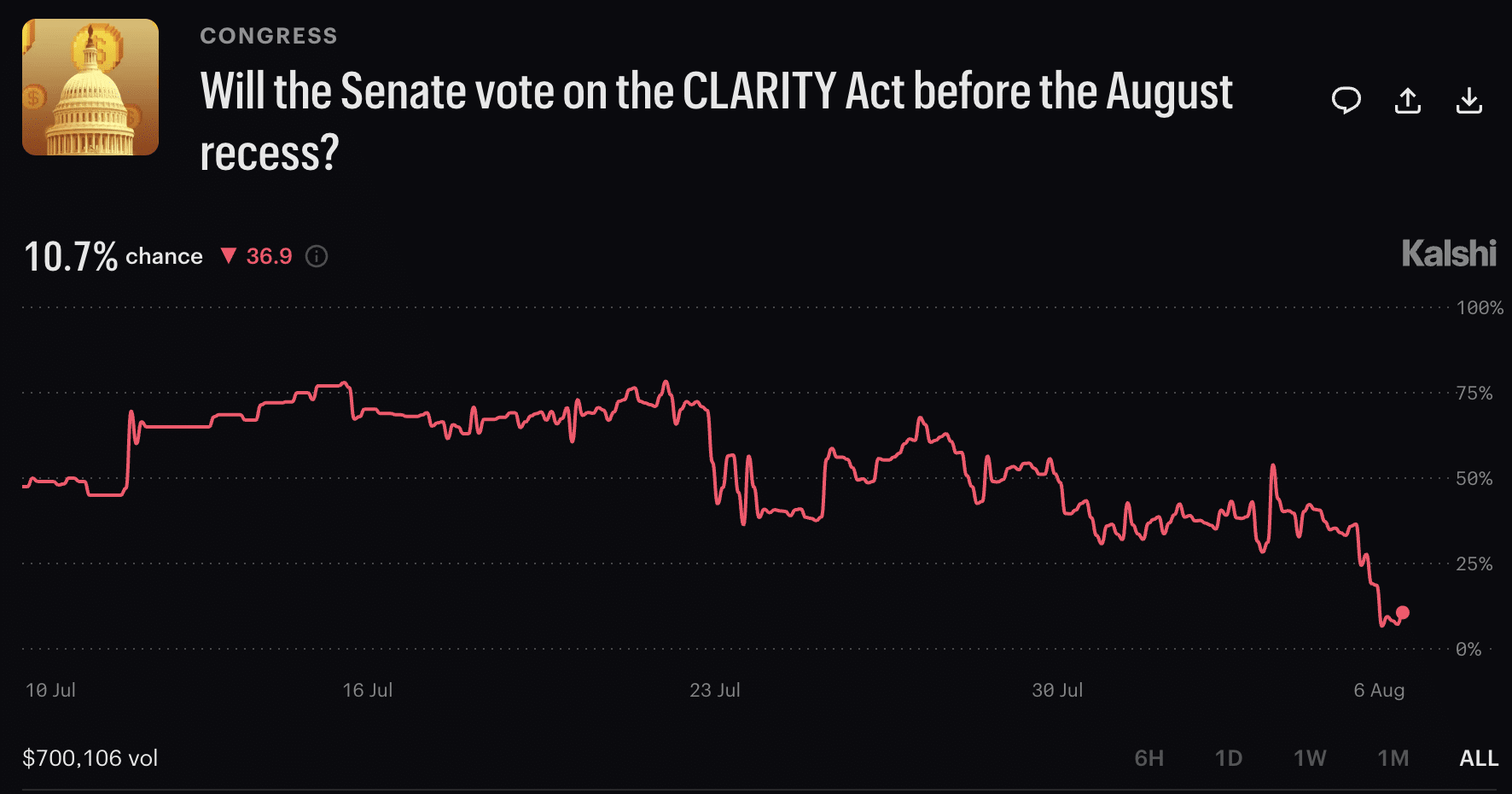
This week brought two significant developments in cryptocurrency regulation pulling in opposite directions: the United States and the United Kingdom published a joint statement expanding their transatlantic digital asset framework, while the CLARITY Act — landmark domestic legislation that would create the first comprehensive federal framework for crypto market structure — remains stalled in the Senate just hours before the chamber's August recess.
The broader crypto market capitalization rose 1.5% overnight to $2.29 trillion, with daily trading volume at $55.1 billion.
US-UK Joint Statement: Stablecoins, Tokenization, and AI
On August 4, the US Department of the Treasury published a joint statement with the United Kingdom outlining an expanded transatlantic digital asset framework covering stablecoins, tokenization, payments, and artificial intelligence.
The statement summarizes discussions from the UK-US Financial Regulatory Working Group (FRWG) meeting held on July 8 in London. Participants included officials from both countries' Treasury departments, the Bank of England, the Federal Reserve, and various regulatory bodies.
A central focus was on stablecoins — digital assets designed to maintain a stable value. Both parties committed to establishing comparable standards for stablecoin reserves, specifically requiring high-quality, liquid assets backing issued stablecoins at a ratio of at least one-to-one. US officials discussed the GENIUS Act, a stablecoin law enacted in July 2025, for which the FDIC is currently proposing regulations covering reserves and redemption practices. The GENIUS Act authorizes the US Treasury Secretary to enter into reciprocal arrangements with jurisdictions meeting comparable stablecoin standards, underscoring the significance of this alignment discussion. The push for cross-border stablecoin interoperability also comes as the European Union's Markets in Crypto-Assets (MiCA) regulation has been fully in effect since December 2024, establishing the world's first comprehensive crypto regulatory regime and creating competitive pressure on other major economies to coordinate standards.
On tokenization, the UK is developing a unified approach for tokenized wholesale markets through a 54-company task force that includes BlackRock and JPMorgan, exploring commercial applications. Christopher Woolard CBE was appointed as the UK's Wholesale Digital Markets Champion, with a follow-up meeting planned for early 2027.
(SOURCE: Kalshi)
CLARITY Act Stalled: Three Key Obstacles
While the GENIUS Act addresses stablecoins, the CLARITY Act — formally the Digital Asset Market Clarity Act — aims to define digital assets as commodities or securities and expand the CFTC's jurisdiction over digital commodities. The bill seeks to resolve a regulatory gray area that has persisted for years, where overlapping claims of authority between the CFTC and the SEC have left crypto firms uncertain about which disclosure, registration, and compliance regimes apply to their operations. However, progress on the legislation has stalled.
As of August 5, Senate Majority Leader John Thune had not filed a necessary cloture vote before the Senate's monthlong recess. A Democratic staffer identified three key issues hindering support: ethics provisions regarding Trump's crypto interests, illicit finance protections, and disagreements with the Senate Agriculture Committee's competing text. The Agriculture Committee's involvement stems from its oversight jurisdiction over the CFTC, meaning any expansion of the agency's authority requires coordination with the committee.
No CLARITY Act voting is scheduled until Friday. Senator Cynthia Lummis says voting could even happen on weekends.
Are we getting the Clarity Act or not?
— Ted (@TedPillows) August 6, 2026
The ethics debate centers on the extent of restrictions on public officials and their family members. Trump's previous proposal, which aimed to limit coverage, was rejected by Democrats. Analysts suggest the Senate may be ten votes short of the 60 needed for cloture, with Senator Elizabeth Warren likely to object to expedited procedures.
Despite the standoff, the staffer indicated that the bill could still advance in September if ethics language is strengthened, noting a desire for bipartisan support. Missing the pre-recess window could further complicate the legislative path, particularly as midterm elections approach and the congressional calendar narrows for substantive financial regulation work.

