US Treasury Expands Iran-Related Sanctions Across Five Sectors, Naming Crypto Among Them
Key Takeaways
- •The Treasury expanded its Iran-related sanctions regime from prior sector-based coverage to five sectors, and digital assets were explicitly named as one of them.
- •The designation means crypto is now treated as a sanctionable sector under OFAC enforcement, with broader legal risk for transactions tied to Iran-related activity.
- •The move follows earlier US actions involving crypto exchanges and sanctions settlements linked in part to Iran-related accounts or users.
- •Crypto firms may need to strengthen sanctions screening, wallet monitoring, and counterparty checks, while ordinary user trading is not the stated target.
- •The announcement did not indicate an immediate price effect, and any longer-term impact will depend on future Treasury guidance and enforcement actions.
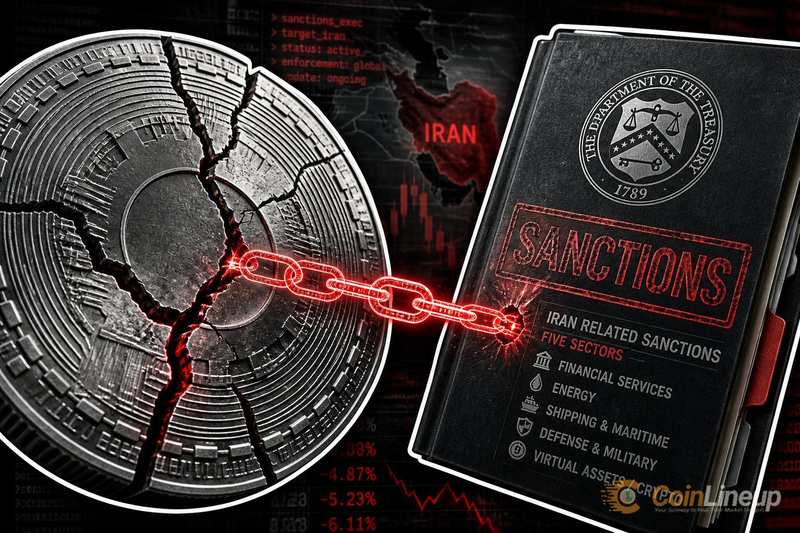
The US Treasury has broadened its Iran-related sanctions program to cover five sectors, and digital assets are now explicitly on that list. By naming crypto as a covered area, the department has positioned digital assets as a recognized channel for enforcement — a development that puts exchanges and compliance teams on notice.
What the expanded sanctions cover
The measure originated with the US Treasury itself, making it first and foremost a financial enforcement action, according to the official Treasury announcement. Sanctions are government rules that prevent individuals and companies from conducting business with designated targets. Day to day, that work is carried out by the Treasury's Office of Foreign Assets Control (OFAC), which maintains the Specially Designated Nationals (SDN) list; US persons are generally barred from transacting with listed parties, and assets touching those parties must be frozen. Sector-based designations are a long-standing tool of Iran policy — past campaigns have swept in areas such as energy, shipping, and finance — so adding digital assets to the list extends an established playbook rather than inventing a new one. For related coverage, see US sanctions two crypto exchanges over alleged Iran-linked funds.
Widening the regime "across five sectors" means the Treasury enlarged the set of activities that can trigger penalties. In practical terms, a broader range of transactions connected to Iran-related activity now carries legal risk for anyone operating under US jurisdiction. For related coverage, see Cosmos Health says its crypto treasury fell 46% by end of June.
Crypto was specifically called out among the covered areas. The designation signals that digital assets are being treated as a sanctionable sector, as detailed in TRM Labs' analysis of the action, which describes the measures under the name "Operation Economic Outcast" and covers nearly 60 sanctioned Iran-linked targets. TRM Labs is itself a blockchain-analytics firm whose screening tools crypto businesses use, so the assessment comes from inside the compliance industry this designation affects. For related coverage, see Capital.com UAE spot crypto launch plan explained.
Why crypto was named in the five-sector push
Naming crypto directly indicates that the Treasury is monitoring digital asset channels within its sanctions work. The move extends a pattern of scrutiny that previously reached two crypto exchanges over alleged Iran-linked funds, and it fits a documented enforcement record: Kraken agreed to a roughly $362,000 OFAC settlement in 2022 over accounts apparently opened from Iran, and BitMEX agreed in 2024 to pay $100 million to resolve US actions tied in part to users in sanctioned jurisdictions including Iran.
For crypto companies, the story is fundamentally an AML story. AML stands for anti-money-laundering — the rules firms follow to keep illicit funds out of their systems. Sanctions screening is the process by which a firm checks a customer or wallet against government blocklists.
A distinction is worth drawing here. Sanctions exposure means dealing, even indirectly, with a blocked party. Under OFAC's 50 Percent Rule, companies majority-owned by blocked persons are themselves treated as blocked even when not individually listed — one concrete way "indirect" exposure arises. Ordinary buying and selling of crypto by regular users is not the target of this action.
The crypto angle also matters because it stretches the measure beyond conventional banking and trade restrictions. It fits a wider effort that recently reached Iran-linked procurement networks.
What this could mean for crypto compliance and monitoring
Whenever the Treasury broadens a sanctions regime, wallet screening, transaction monitoring, and counterparty checks — the practice of confirming who sits on the other side of a transaction — all grow in importance. The stakes are high by design: OFAC can impose civil penalties for sanctions violations on a strict-liability basis, meaning intent is not required, while willful violations can trigger criminal prosecution.
Companies with US exposure frequently tighten internal controls after moves of this kind. That points to additional work for exchanges, custodians (firms that hold crypto on behalf of clients), and blockchain analytics providers that trace on-chain activity.
The announcement contains no evidence of an immediate price impact, and none should be assumed. Compliance pressure and market prices are distinct issues — a separation also visible in tax-enforcement stories such as the UK's wave of crypto tax warnings.
For an ordinary user holding a small amount of Bitcoin on a US exchange, the practical effect is limited. Platforms may run more identity and screening checks, but everyday holding and trading is not what this action targets. Future Treasury guidance and enforcement decisions will shape the longer-term effect — in practice, that means watching for additions to OFAC's public SDN list, any general licenses or guidance that clarify scope, and whether further crypto businesses are named in follow-up designations.

