US Treasury Debt Hits $40 Trillion as Auction Yields Rise, Prompting Buyback Expansion
Key Takeaways
- •Treasury debt hit $40 trillion on Wednesday after increasing by $1 trillion over three months and $3 trillion over 12 months.
- •About $32.3 trillion of the total is held by the public, while $7.7 trillion is held in internal government accounts.
- •The 30-year Treasury bond auction last week cleared at 5.22%, the highest auction yield since 2001, before rising to 5.31% on Monday.
- •The Treasury Department announced it will double buybacks, with the higher amounts set to begin on September 9.
- •The announcement pushed long-term yields lower immediately, but the article said the effect is likely temporary compared with the scale of ongoing issuance.
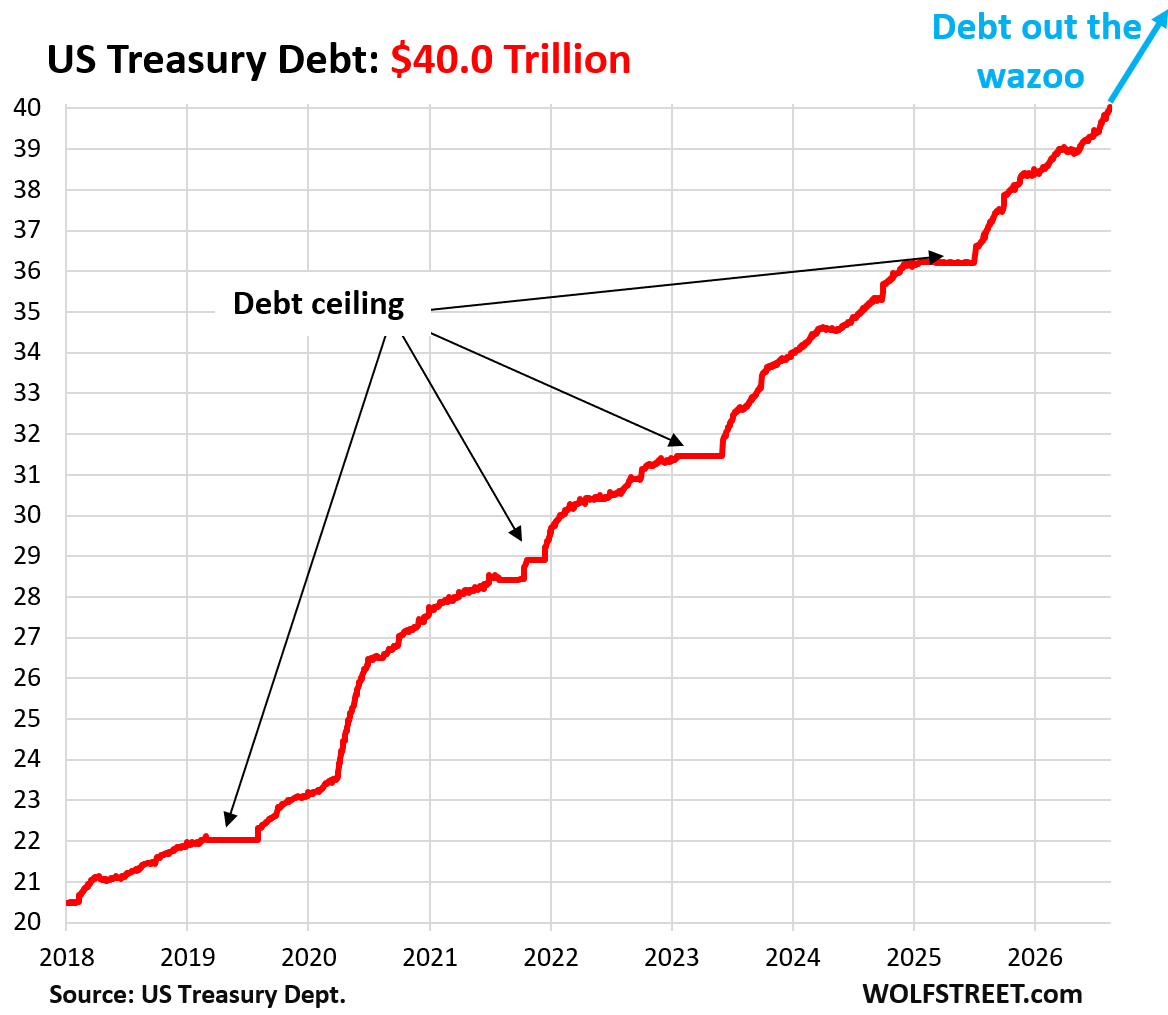
The U.S. Treasury debt reached $40 trillion on Wednesday, after rising by $1 trillion in three months and by $3 trillion over the past 12 months. Wolf Street said the increase was accelerated by tax cuts, profligate spending, the war in Iran, and Supreme Court-triggered tariff refunds.
Those trillions were financed through large Treasury auctions week after week, including $742 billion in auction sales last week. Repeated debt-ceiling episodes in Congress, the article said, only created the appearance of flat spots in the debt chart, followed by catch-up spikes.
Of the $40 trillion in Treasury securities, $32.3 trillion are “held by the public,” meaning they are publicly traded and held by investors, hedge funds engaged in the basis trade, banks, insurance companies, the Federal Reserve, other central banks, and similar buyers. Of that total, $9.3 trillion are held overseas. Some Treasury securities are not publicly traded, including Series I Savings Bonds, or I-bonds.
The remaining $7.7 trillion is held in federal government pension funds, Social Security Trust Funds, and other internal government accounts. These amounts are owed to beneficiaries of those accounts and represent real debt, but they are not publicly traded and are not exposed to second-by-second market pricing.
Wolf Street said investors had to absorb $1 trillion in new Treasuries over the past three months, which is what it means when the amount held by the public increased by that amount. That new supply had to be purchased in addition to the refinancing of maturing debt, which required new buyers to be drawn into the market.
According to the article, that is the role of yield. Yields rose over the three-month period until they became high enough, auction by auction, to attract enough buyers despite concerns about inflation, heavy government spending, and the possibility of still higher yields ahead. In that sense, the article said, yield did its job.
The rise in yields, however, became a problem for Treasury Secretary Scott Bessent. The 30-year Treasury bond sold at auction last week with a 5.22% yield, the highest auction yield since 2001, and then rose further to 5.31% by Monday.
On Wednesday, the Treasury Department announced that it would double Treasury buybacks, a program that former Treasury Secretary Janet Yellen had started in April 2024 after the 10-year Treasury yield briefly exceeded 5% in October 2023.
The Treasury Department cannot create money, unlike the Federal Reserve. To buy back old securities, it must sell new ones, so the buyback program is essentially a debt swap. Wolf Street noted that Bessent could achieve a similar result on a much larger scale by keeping long-term note and bond auctions unchanged while increasing T-bill issuance, which would shift more borrowing toward shorter maturities. The Treasury is already doing that, the article said.
Still, the announcement appeared aimed at calming the bond market on the day Treasury debt hit $40 trillion. Long-term yields fell immediately after the announcement, although the higher buyback amounts will not begin until September 9. Even then, the volumes are small compared with the $1 trillion in new debt investors must absorb every three to five months going forward, and tiny relative to the $40 trillion in outstanding Treasury securities.
That scale matters because Treasury yields help determine the government’s financing costs in real time as new debt is sold and old debt is rolled over. Wolf Street said yields will still need to be high enough to attract buyers for an additional $1 trillion in Treasury securities roughly every three to five months, while offsetting worries about inflation, government profligacy, and the risk that new supply will push yields even higher.
The article argued that Bessent cannot change the amount of debt heading into the market. His job, it said, is to sell the bonds, come hell or high water, and at the lowest possible yield.
It added that debt-swap announcements are unlikely to alter those underlying dynamics. At the beginning of August, another Treasury-related announcement — described by Wolf Street as the “big kahuna” U.S.-Japan joint intervention — pushed the 30-year yield down by 11 basis points over two days, from 5.28% on Friday, July 31, to 5.17% on Tuesday, August 4, mostly immediately after the announcement. The move proved temporary, and the yield later zigzagged higher, reaching 5.31% on Monday.
On Wednesday, after the latest Treasury announcement, the 30-year Treasury yield fell by 9 basis points, after having declined by 3 basis points the day before, to close at 5.19%. Wolf Street described the move as “just another squiggle in the trend.”
