U.S. Treasury Expands Long-End Buybacks as Yields Hold Above 5%
Key Takeaways
- •The Treasury's Oct. 1 buyback targets nominal coupon securities maturing in 10 to 20 years, with a published ceiling of at least $4 billion rather than the $6 billion amount circulating in social-media posts.
- •An Aug. 19 statement raised the per-operation buyback size from $2 billion to at least $4 billion, citing strong participation in longer-dated sectors, with the expansion running through the refunding quarter ending Nov. 4.
- •Long-term yields rose broadly in late September, with the 10-year climbing from 4.96% to 5.26%, the 30-year from 5.29% to 5.59%, and the 20-year reaching 5.64% on Sept. 29.
- •Treasury describes the buybacks as liquidity support for less-active off-the-run securities rather than emergency intervention, and purchased bonds are retired, distinguishing the program from Federal Reserve quantitative easing.
- •Elevated real yields of 2.91% on the 10-year and 3.29% on the 30-year tighten financial conditions for assets without cash flows, maintaining pressure on Bitcoin, which traded near $83,000 on Sept. 30.
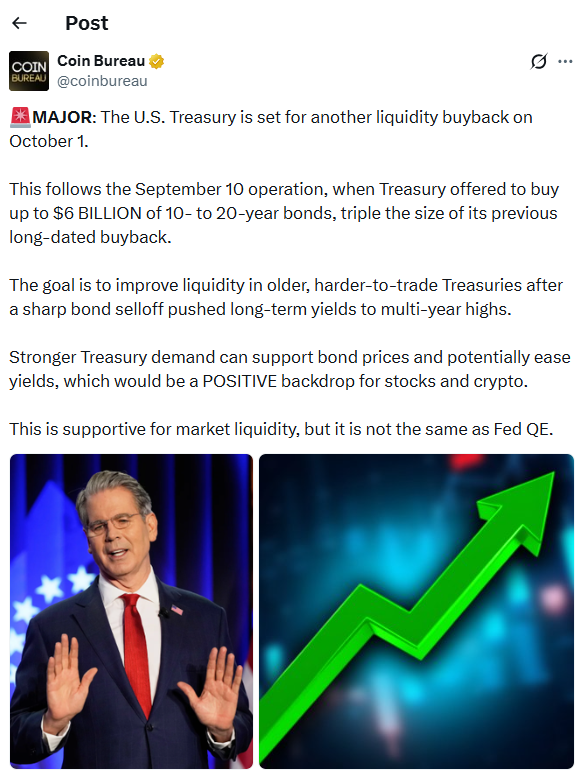
The U.S. Treasury moved back into the center of market attention after officials scheduled another long-end debt buyback for Oct. 1. The operation targets nominal coupon securities maturing in 10 to 20 years, and the department's official schedule currently sets the maximum purchase amount at $4 billion or more.
The operation carries weight because long-term borrowing costs climbed sharply through late September. Treasury data showed the 10-year yield at 5.26% on Sept. 29, while the 30-year rate stood at 5.59% — levels that kept financial conditions tight across risk assets, including Bitcoin.
Larger Long-End Buybacks on the Schedule
The Treasury's Sept. 9 schedule set the Oct. 1 operation between 1:40 p.m. and 2:00 p.m. ET, with settlement scheduled for Oct. 2. Eligible securities mature from Oct. 2, 2036, through Oct. 1, 2046.
Notably, the published schedule did not specify a $6 billion maximum for the Oct. 1 operation. Instead, it listed a ceiling of at least $4 billion. Treasury used a $6 billion maximum for its Sept. 10 operation in the same maturity sector.
That distinction matters because several social-media posts described the Oct. 1 ceiling as $6 billion — a figure Treasury's latest public schedule does not yet confirm. An operation-specific announcement could still set a higher amount before trading begins.
The department had already expanded its longer-dated liquidity support program ahead of the latest operation. An Aug. 19 statement said buybacks would rise from $2 billion to at least $4 billion per operation. Officials attributed the larger size to strong market participation in longer-dated sectors, and the temporary expansion runs through the current refunding quarter, which ends Nov. 4. The program itself is a recent revival: Treasury reintroduced regular buybacks in 2024, the first recurring operations of this kind since 2002, to manage the composition and liquidity of the outstanding debt.
Yield Pressure Builds Across the Long End
The Treasury yield curve had already moved higher before the planned buyback. Treasury data placed the 20-year yield at 5.64% on Sept. 29. The 10-year rate had risen from 4.96% on Sept. 22, and the 30-year yield increased from 5.29% over the same period. The broad climb pointed to continued pressure across longer maturities rather than isolated weakness in a single tenor.
Real yields, which adjust nominal rates for inflation, also remained elevated. Treasury data put the 10-year real yield at 2.91% on Sept. 29, with the 30-year real yield at 3.29 The shift widened the gap between short-term policy rates and long-term market borrowing costs — a divergence that can pressure equity valuations and leveraged positions.
Crypto traders often track the same rates because higher yields compete with speculative assets for capital. Elevated real yields raise the return available on inflation-adjusted government debt, tightening financial conditions for assets without contractual cash flows, such as Bitcoin. Bitcoin traded near $83,000 on Sept. 30, according to TradingView market data, and the cryptocurrency remained sensitive to rates as traders watched inflation data and Federal Reserve policy expectations.
Liquidity Support, Not Emergency Intervention
Treasury describes these transactions as liquidity support operations rather than emergency market intervention. Its official buyback guidance says the program creates predictable opportunities to sell older, off-the-run securities, and it states that liquidity support buybacks are not designed to address acute market stress. Off-the-run issues are securities that are no longer the most recently auctioned at their maturity, and they typically trade less actively than the newest issues.
Purchased securities are retired after settlement rather than held for later resale. That design separates the program from Federal Reserve quantitative easing: Treasury uses the transactions to manage the composition and liquidity of federal debt, not to add net stimulus.
The Federal Reserve separately raised its policy range by 25 basis points on Sept. 16. The Federal Open Market Committee set the federal funds target at 3.75% to 4.00%, approving the decision unanimously and citing elevated inflation and its 2% inflation objective. That policy backdrop helps explain why longer-dated yields remain central to broader market pricing.
Crypto Traders Keep Watching Rates
For crypto markets, the immediate question is the direction of long-term yields after the Oct. 1 operation. A buyback can improve trading conditions in less-liquid Treasury securities without directly lowering benchmark yields.
Treasury guidance also allows officials to purchase less than the announced maximum. Final amounts depend on submitted offers and Treasury's evaluation of those bids, meaning the accepted amount will provide more information than the headline ceiling alone. Traders can also compare the outcome with the Sept. 10 operation and later long-end transactions.
The next verified milestone arrives on Oct. 1, when Treasury conducts the 10- to 20-year buyback. Results will show how much debt officials accepted and at what prices.
This article was originally published by The Market Periodical: U.S. Treasury News: Buyback Plan Expands as Bond Yields Rise

