Stocks Rally to Close Volatile Week as Treasury Yields Hit Multi-Decade Highs
Key Takeaways
- •All three major U.S. stock indexes secured weekly gains, with the Nasdaq up 2%, the S&P 500 up 1.2%, and the Dow up 0.3%, despite turbulent midweek trading.
- •The 10-year Treasury yield closed at 5.18%, its highest level in 19 years, while the 30-year yield finished at 5.5%, surpassing that threshold for the first time in more than two decades.
- •Fed funds futures pricing implies roughly 64% to 66% odds of a rate increase at the Federal Reserve's October meeting, with three additional quarter-point hikes anticipated through the end of 2027.
- •Oil prices declined following indications of U.S.-Iran diplomacy over the Strait of Hormuz, with WTI falling 2.33% to $92.41 per barrel and Brent dropping 2.14% to $104.32 per barrel.
- •Artificial intelligence announcements drove prominent stock moves, as Meta Platforms surged nearly 13% on its Muse AI initiative and Akamai Technologies rallied 3% after extending its partnership with Anthropic.
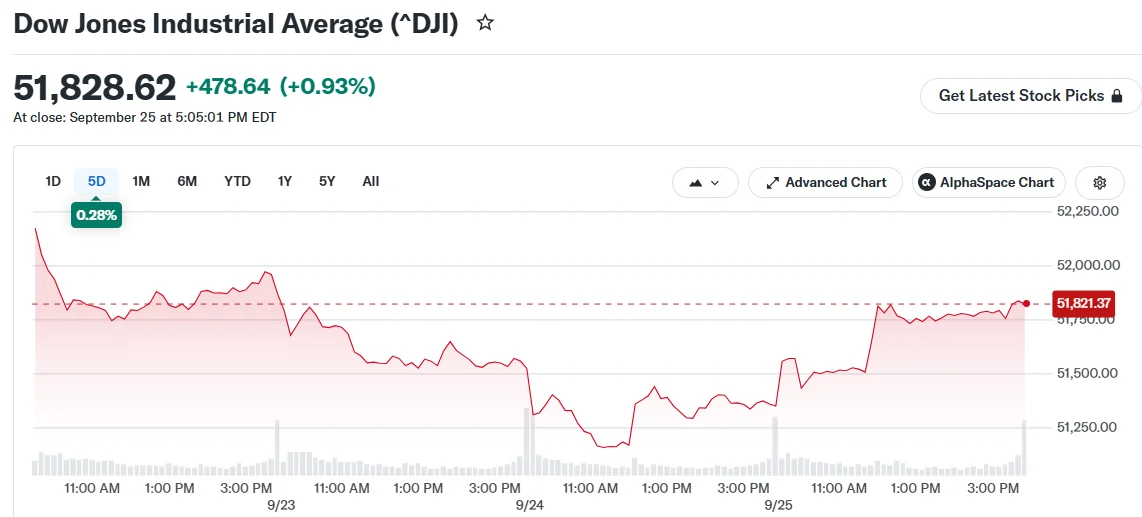
U.S. stocks finished Friday's session in positive territory, capping a tumultuous week of trading on Wall Street. The advance came even as Treasury yields climbed to heights not seen in nearly two decades, leaving stocks and long-dated Treasuries to move in opposite directions.
All three major indexes secured positive weekly results despite a turbulent stretch of midweek trading.
The Dow Jones Industrial Average advanced 479 points, a gain of 0.9%, settling at 51,829. Both the S&P 500 and the Nasdaq Composite registered increases of roughly 0.5%. On a weekly basis, the posted a 0.3% advance, the S&P 500 recorded a 1.2% gain, and the Nasdaq climbed 2%, successfully recovering from midweek losses.
Among individual movers, Akamai Technologies stood out with a notable 3% rally following its announcement of an extended partnership agreement with Anthropic. Meta Platforms delivered one of the week's strongest performances, surging nearly 13% as investors reacted enthusiastically to the company's latest artificial intelligence initiative, Muse, underscoring how prominently AI-related announcements featured in the week's trading.
Treasury Market Turbulence Shakes Investor Confidence
Fixed income markets experienced significant fluctuations throughout the week, with the sharpest moves concentrated in long-dated maturities. The benchmark 10-year Treasury yield climbed to its loftiest level since 2007, briefly touching 5.228% before moderating. By Friday's close, it stood at 5.18%, marking a new 19-year peak.
The 30-year Treasury yield finished at 5.5%, having breached that threshold for the first time in more than two decades. The two-year yield, by contrast, declined modestly, settling at 4.862%.
The 10-year yield's reach extends well beyond the bond market: it serves as a reference point for mortgage rates and corporate borrowing costs and as a baseline in equity valuation models, making its return to 2007-era levels a meaningful shift in the economy's benchmark cost of capital.
Market commentary highlighted the fiscal backdrop to the yield move:
The last time US Treasury yields were this high, total US national debt stood at just $8.9 trillion. Today, US debt stands at $40.1 trillion. That's +$31.2 trillion more, or over 4.5 TIMES higher. This means every 1 percentage point in the average cost of servicing the debt now… pic.twitter.com/xnKNXeMGuR
— The Kobeissi Letter (@KobeissiLetter) September 25, 2026
Several catalysts have propelled yields higher. Among them are aggressive rhetoric from Federal Reserve policymakers, elevated energy costs stemming from Middle Eastern tensions, and purchasing managers' index data that exceeded forecasts.
Current Fed funds futures pricing suggests approximately 64% to 66% odds of a rate increase when the Federal Reserve meets in October. Market participants are also anticipating three additional quarter-percentage-point increases through the conclusion of 2027.
Crude Markets Retreat on Diplomatic Progress
Oil prices declined throughout the week following indications that American and Iranian officials were exploring an agreement to resume normal operations through the Strait of Hormuz, a critical artery for global oil shipments through which roughly one-fifth of the world's oil passes. Iranian representatives have reportedly requested a return to the terms outlined in a June memorandum of understanding.
West Texas Intermediate crude, the U.S. benchmark, declined 2.33%, finishing at $92.41 per barrel. Brent crude, the global pricing standard, dropped 2.14% to close at $104.32 per barrel.
Market participants also monitored ongoing diplomatic engagement between Washington and Beijing during Chinese President Xi Jinping's visit to the United States. Treasury Secretary Scott Bessent indicated that both nations had reached consensus on a two-month extension of their existing trade agreement. Additional specifics regarding the negotiations are anticipated in the near term.
Consumer Sentiment in Focus
Friday brought fresh consumer sentiment figures from the University of Michigan, one of the most closely watched gauges of U.S. household confidence. The September index weakened from previous levels but exceeded initial projections. The report revealed elevated inflation expectations among consumers across both near-term and extended timeframes — figures the Fed weighs against its stated 2% inflation objective — presenting another consideration for Federal Reserve officials as they deliberate future monetary policy.
Market observers remain divided on the implications. Some warn that persistently elevated yields could ultimately pressure equity valuations and economic expansion. Others point to the economy's demonstrated durability thus far.
Looking forward, market participants will remain focused on Treasury yields, energy prices, and the trajectory of trade negotiations for signals on the market's direction.
Source: Blockonomi

