Dow, S&P 500 and Nasdaq Decline as Treasury Yields Reach Multidecade Highs
Key Takeaways
- •Surging Treasury yields, with the 10-year near 5.3% at multidecade highs, drove U.S. stocks lower despite an earlier rally, while materials, real estate and financials led declines.
- •The S&P Global Manufacturing PMI for September came in at 55.9, below the prior estimate of 57, and an ISM report showed factory input prices rising sharply, fueling inflation concerns.
- •Micron beat fourth-quarter expectations with revenue of $54.23 billion and adjusted EPS of $33.42, and guided first-quarter revenue to $61.5 billion, yet its stock finished the session little changed.
- •Initial jobless claims fell for a fourth straight week and announced job cuts declined in September, though hiring remains slow ahead of Friday's monthly jobs report.
- •Nike was set to report earnings after Thursday's close, with its shares trading near levels last seen in 2014 as investors watch for signs of a turnaround.
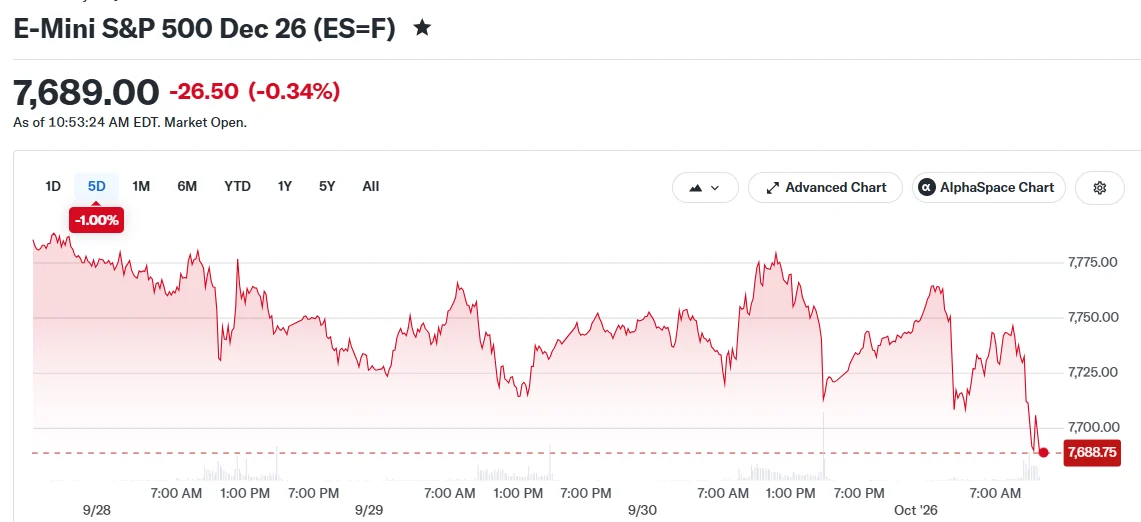
U.S. stocks fell on Thursday, giving back earlier gains as rising Treasury yields outweighed Micron’s stronger-than-expected earnings and improved outlook. The decline came on the first trading day of October.
The Dow Jones Industrial Average dropped about 0.5%, while the S&P 500 and Nasdaq Composite each fell approximately 0.3%. All three indexes had traded higher earlier in the session before bond-market pressure intensified.
By late morning, the Dow was down about 328 points, the S&P 500 had declined 0.36%, and the Nasdaq was lower by 0.31%. The 10-year Treasury yield stood at 5.33%, while the 2-year yield fell to 4.852%. The two maturities respond to different forces: the 2-year yield is particularly sensitive to expectations for Federal Reserve interest-rate policy, while the 10-year helps set pricing for mortgages and a wide range of corporate and consumer loans.
Treasury Yields Continue to Rise
The 10-year Treasury yield climbed to about 5.3%, reaching a new multidecade high. The move followed a difficult quarter for bonds, which had just recorded their worst quarterly performance in decades heading into October.
Higher yields can increase borrowing costs and make stocks appear less attractive relative to bonds, where investors can earn more from comparatively safer assets. Interest-rate-sensitive sectors came under particular pressure. Materials, real estate and financial stocks were among the session’s largest decliners.
Energy and technology were the only sectors that remained in positive territory. At one point during the morning, fewer than one-third of S&P 500 stocks were advancing.
$550 billion has been wiped out from US stocks in the last 45 minutes. Reasons: 1. US 10-year, 20-year, and 30-year Treasury yields all just hit a new 24-year high. 2. US Manufacturing PMI also came in below expectations. pic.twitter.com/38Fnouv1ja — Bull Theory (@BullTheoryio) October 1, 2026
$550 billion has been wiped out from US stocks in the last 45 minutes.
Reasons:
-
US 10-year, 20-year, and 30-year Treasury yields all just hit a new 24-year high.
-
US Manufacturing PMI also came in below expectations. pic.twitter.com/38Fnouv1ja
— Bull Theory (@BullTheoryio) October 1, 2026
Manufacturing Reports Slower Growth
Two manufacturing reports released Thursday pointed to slower-than-expected growth. The S&P 500’s Manufacturing Purchasing Managers’ Index came in at 55.9 for September, below the earlier estimate of 57. Readings above 50 on purchasing managers’ indexes indicate expansion in factory activity, so the data still pointed to growth, just at a slower pace than forecast.
A separate report from the Institute for Supply Management showed that manufacturing prices rose sharply during the month. Higher input costs can pressure corporate profits and contribute to concerns about inflation.
The data followed a weak end to the third quarter. The Dow recorded losses in both September and the quarter as a whole, while the Nasdaq posted a gain for the period.
Micron Beats Estimates, but Shares Barely Move
Micron reported fourth-quarter earnings above Wall Street expectations and raised its outlook for the first quarter. The memory-chip maker’s shares, however, were little changed during Thursday’s session as broader bond-market moves remained the main focus. As one of the world’s largest memory-chip producers, Micron is often watched as a gauge of semiconductor demand, which helps explain why its results drew attention even with bond-market moves dominating the session.
MICRON $MU Q4’26 EARNINGS HIGHLIGHTS 🔹 Revenue: $54.23B (Est. $51.07B) 🟢; +379% YoY 🔹 Adj. EPS: $33.42 (Est. $31.61) 🟢 🔹 Adj. Gross Margin: 87.0% (Est. 86.1%) 🟢 Q1 FY27 Guide: 🔹 Revenue: $61.5B ± $1.5B (Est. $57.02B) 🟢 🔹 Adj. EPS: $38.15 ± $1.00 (Est. $35.40) 🟢 🔹… pic.twitter.com/DvLalHRPYe — Wall St Engine (@wallstengine) September 30, 2026
MICRON $MU Q4’26 EARNINGS HIGHLIGHTS
🔹 Revenue: $54.23B (Est. $51.07B) 🟢; +379% YoY 🔹 Adj. EPS: $33.42 (Est. $31.61) 🟢 🔹 Adj. Gross Margin: 87.0% (Est. 86.1%) 🟢
Q1 FY27 Guide: 🔹 Revenue: $61.5B ± $1.5B (Est. $57.02B) 🟢 🔹 Adj. EPS: $38.15 ± $1.00 (Est. $35.40) 🟢 🔹… pic.twitter.com/DvLalHRPYe
— Wall St Engine (@wallstengine) September 30, 2026
Other chip and technology stocks produced mixed results. One major chipmaker edged higher after a strong September, while another semiconductor stock declined after gaining 30% during the previous month.
Labor Data Ahead of Monthly Jobs Report
Recent labor-market data indicated stability. Initial jobless claims declined for a fourth consecutive week, while a separate report from Challenger, Gray & Christmas showed that companies announced fewer job cuts in September.
At the same time, companies have not been moving quickly to hire new workers. The reports came ahead of the monthly jobs report scheduled for Friday, which is expected to provide a broader view of hiring and unemployment trends. Labor-market releases are also closely watched for their influence on expectations for Federal Reserve interest-rate policy, a key driver of Treasury yields.
Nike is scheduled to report earnings after Thursday’s market close. The company’s stock has been trading near its lowest levels since 2014, with investors focused on potential signs of a turnaround. Its results are also frequently read as a barometer of consumer spending, a major component of the U.S. economy.
Source: CoinCentral.

