Stock Market Today: Dow, S&P 500 and Nasdaq Fall as 10-Year Treasury Yield Tops 5%
Key Takeaways
- •The 10-year Treasury yield rose above 5.05%, its highest level since 2007, and the rate influences mortgage costs, corporate financing and equity valuations across the US economy.
- •The Nasdaq Composite fell about 0.8% while the Dow slipped 0.3% and the S&P 500 dropped 0.4%, with technology stocks leading the retreat after record highs earlier in the week.
- •S&P Global's flash US composite PMI showed business activity expanding faster than expected but flagged higher input costs tied to energy, reinforcing concerns that inflation will be difficult to control.
- •Brent crude climbed above $101 a barrel and West Texas Intermediate approached $92 as the war in Iran and hopes for renewed diplomacy kept energy-driven inflation in focus.
- •Thursday's Trump-Xi meeting is expected to address trade, rare earth supplies, artificial intelligence, Taiwan and Iran, though investors are not broadly anticipating a major deal.
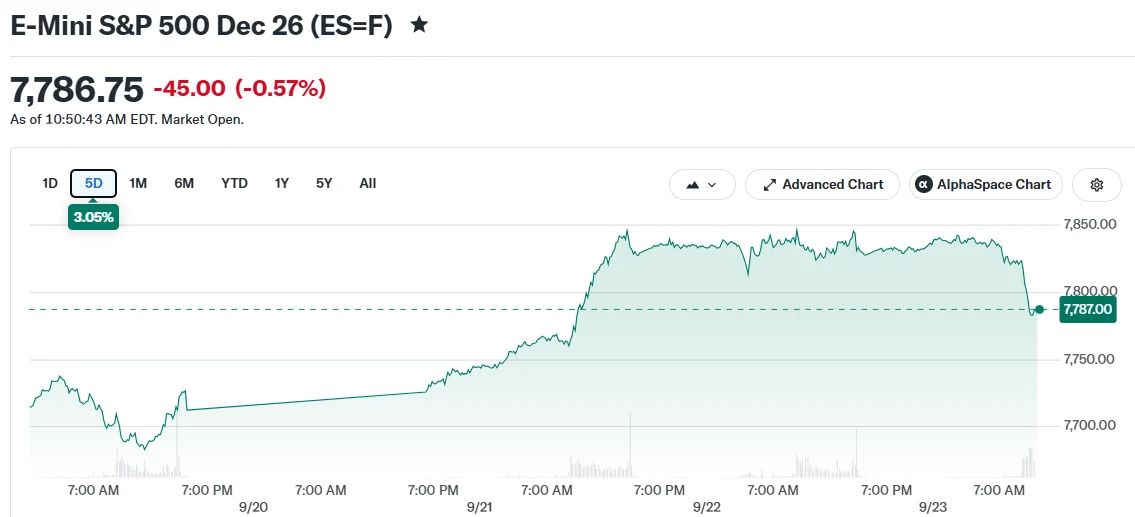
US equities moved lower on Wednesday as a sharp rise in Treasury yields pressured technology shares and investors looked ahead to a Thursday meeting between President Donald Trump and Chinese President Xi Jinping in Washington.
The Dow Jones Industrial Average fell about 0.3%, while the S&P 500 dropped roughly 0.4%. The Nasdaq Composite declined around 0.8% after posting back-to-back record highs earlier this week, with technology stocks leading the retreat. All three benchmark indexes traded in negative territory.
10-Year Treasury Yield Tops 5%
The heaviest pressure came from the bond market. The 10-year Treasury yield climbed above 5.05%, its highest level since 2007, after briefly moving back above the key 5% mark. The 10-year rate serves as a benchmark for borrowing costs across the US economy, influencing mortgage rates, corporate financing and equity valuations, and it last traded at comparable levels in 2007, before the global financial crisis.
Rising yields can weigh heavily on growth and technology stocks because they reduce the present value of future earnings. The move came as investors continued to assess inflation risks tied to energy prices and a still-resilient US economy.
S&P Global's flash US composite PMI showed business activity expanding faster than expected, while the report also pointed to higher input costs linked to energy. Flash estimates are published ahead of final data and are closely watched for early signals on the pace of growth. The readings reinforced concerns that inflation could remain difficult to bring under control.
Oil added to those worries after climbing again. Brent crude moved above $101 a barrel, while West Texas Intermediate approached $92. Both benchmarks have swung in recent sessions amid the war in Iran and hopes for renewed diplomacy, keeping energy-driven inflation concerns in focus for investors.
Trump-Xi Meeting Moves Into Focus
Markets are also preparing for Thursday's meeting between Trump and Xi. Reuters has reported that trade, rare earth supplies, artificial intelligence, Taiwan and Iran are among the issues likely to feature in the talks. Rare earths carry particular weight because China accounts for the overwhelming majority of global mining and processing of these materials, which feed into products ranging from electric vehicles to defense systems, making export policy one of Beijing's clearest points of leverage in trade discussions.
The X account Coin Bureau (@coinbureau) posted on Wednesday:
🚨LATEST:🇨🇳President Xi Jinping just left Beijing to meet President Trump in Washington, his first state visit to the US capital since 2015. AI is on the agenda, but expectations for a major deal are low. So far, the US has proposed a way for both countries to alert each other… pic.twitter.com/NLZGeK8c9A
— Coin Bureau (@coinbureau) September 23, 2026
Xi is visiting the United States from September 23 to September 25, his first US state visit in years. Investors are not broadly expecting a sweeping agreement, but any comments on tariffs, chip restrictions or rare earth exports could move technology and semiconductor shares. Chip policy is a long-running flashpoint: Washington has progressively tightened export controls on advanced semiconductors and chipmaking equipment bound for China, restrictions that have become a recurring source of friction for semiconductor companies with business on both sides of the Pacific.
Artificial intelligence will be watched especially closely, as competition between the US and China has become a central part of their economic relationship. Reuters reported that investors remain exposed to both countries' AI ecosystems despite rising political pressure and technology restrictions.
Iran also remains part of the market picture. Trump said US-Iran talks were continuing and that he believed a settlement could eventually be reached, although geopolitical risks remain elevated. The conflict has been a key driver of oil's recent swings, and Iran's standing as a major OPEC oil producer means energy markets track any shift in the standoff closely.
For investors, the near-term direction of the market may depend less on Wednesday's losses than on whether yields stay above 5%, oil remains elevated and Thursday's Trump-Xi talks produce any unexpected policy changes.

