US Stocks Fall as Weak Tech Earnings and Binance Hack Pressure Markets
Key Takeaways
- •The Nasdaq Composite dropped 2.86% to 25,437.00 on October 30, its largest one-day decline since June, while the S&P 500 fell 1.82% and the Dow lost 572 points.
- •Earnings misses from Amazon and Alphabet intensified questions about whether massive spending on data centers and AI infrastructure will generate matching returns, with Intel additionally plunging 28.58% after a disappointing fourth-quarter forecast.
- •Bitcoin fell more than 2% as crypto markets reacted to a $6.3 billion hack of Binance, described as the largest of its kind in history, though BNB rose marginally.
- •Oil prices climbed, with Brent crude reaching $112 per barrel, and ExxonMobil and Chevron briefly touched record highs as widened refining margins tied to the Middle East war offset tech weakness.
- •In October, the Nasdaq declined 5.2%, its worst month since March 2025, as investors shifted away from Big Tech toward more defensive market sectors.
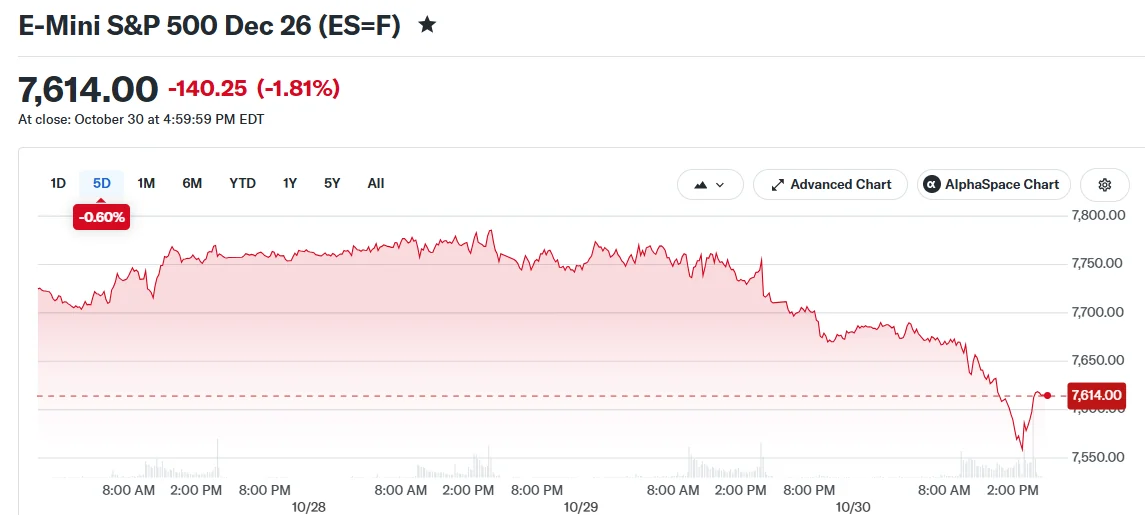
US stocks fell sharply on Friday, October 30, the final trading day of the month, as weak earnings from major technology companies renewed concerns about Big Tech’s artificial-intelligence spending. Crypto markets also came under pressure after a $6.3 billion hack of Binance, one of the world’s largest cryptocurrency exchanges, described as the largest of its kind in history.
The Nasdaq Composite dropped 2.86% to 25,437.00, its biggest one-day decline since June. The S&P 500 fell 1.82% to close at 7,580.07, while the Dow Jones Industrial Average declined 1.09%, or 572 points, to 51,770.31. Stocks fell for a second consecutive session.
Tech Earnings Drive the Sell-Off
Amazon and Alphabet reported rare earnings misses during the week, reviving concerns over the scale of Big Tech’s investment in artificial intelligence. The results sharpened a question that has shadowed the sector’s AI buildout: whether the heavy outlays on data centers and computing capacity will generate returns to match.
This is unbelievable. Nearly $2,000,000,000,000 has been wiped out from the US stock market today. pic.twitter.com/tlQLTPDRzo — Ted (@TedPillows) October 30, 2026
The post is available on X at https://x.com/TedPillows/status/2116241523335438728?ref_src=twsrc%5Etfw.
Alphabet shares continued to decline after the stock recorded its worst day in more than 20 years. Amazon fell 2% on Friday. Intel dropped 28.58% to $65.76 after its fourth-quarter outlook fell short of expectations; the stock had been down 29% in premarket trading. ServiceNow declined 4.15% to $105.12.
The information technology sector led the S&P 500’s decline. Mark Hackett, chief market strategist at Nationwide’s Investment Management Group, said it was unclear whether the market slide represented a shift in the AI trade or a short-lived decline.
“Next week, particularly after the midterms, will be the test if this is a momentary blip or something more enduring,” Hackett said. Data centers have been a prominent topic in the midterm elections.
Oil, Energy and Crypto
Oil prices rose, adding pressure to markets. Brent crude futures reached $112 per barrel, while West Texas Intermediate crude reached $104. ExxonMobil and Chevron briefly touched record highs, a counterpoint to the weakness in technology stocks. The companies said refining margins widened because of the war in the Middle East.
AstraZeneca reported earnings that exceeded expectations before the opening bell, making it one of the few positive developments in the market.
Bitcoin fell more than 2% on Friday as cryptocurrency markets reacted to the $6.3 billion Binance hack. Binance’s BNB token was up 0.06% on the day, an outlier against bitcoin’s slide.
For October, the Dow gained 1.5%, while the S&P 500 fell 1.2% and the Nasdaq declined 5.2%. October was the Nasdaq’s worst month since March 2025. Investors have been moving out of Big Tech and into more defensive areas of the market.
Source: CoinCentral

