US Stock Futures Surge as Traders Buy the Dip After Fed's First Rate Adjustment in Over Three Years
Key Takeaways
- •Dow and S&P 500 futures each climbed approximately 1.2%, while Nasdaq 100 futures rose 1.6%.
- •The Federal Reserve raised its benchmark rate by 25 basis points and signaled that another increase could come before the end of the year.
- •President Trump opposed the rate increase and said he had urged Fed Chair Kevin Warsh to support lower borrowing costs.
- •Brent crude fell about 1% to near $99 per barrel, while West Texas Intermediate declined 0.6% to roughly $101.77.
- •The 10-year Treasury yield dropped three basis points to 4.99% as weaker oil prices provided some relief for inflation expectations.
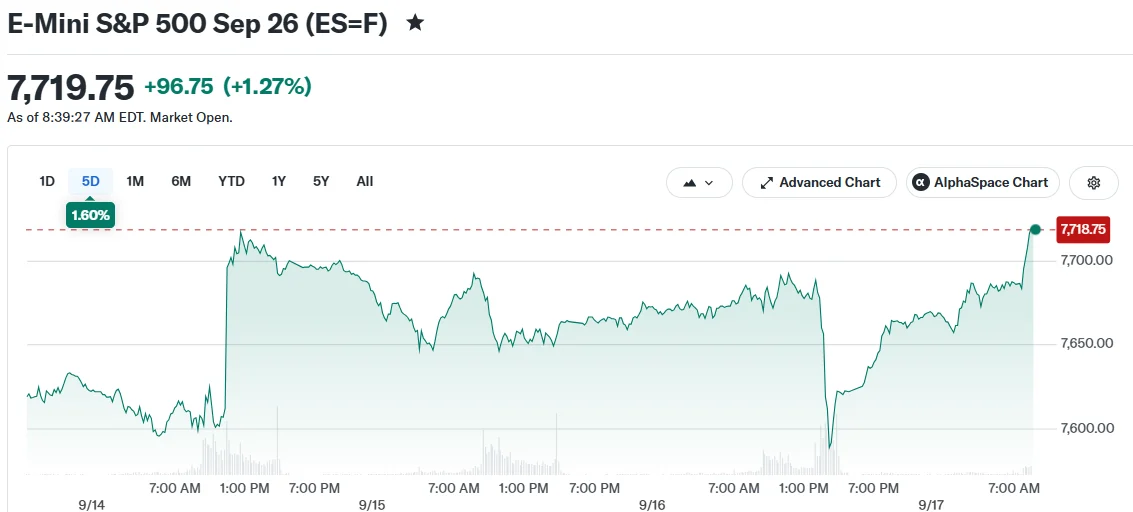
US stock futures are posting substantial gains on Thursday morning as market participants rebound from the previous session's rate-driven downturn and move to capitalize on discounted valuations following the Federal Reserve's first rate adjustment in more than three years. Futures contracts, which trade outside regular market hours, offer an early read on how major benchmarks may open later in the session.
Futures tied to the Dow Jones Industrial Average climbed approximately 1.2%, adding more than 600 points. Futures for the S&P 500 increased 1.2%, while Nasdaq 100 futures surged 1.6%, signaling a broad-based rebound across US equity benchmarks.
Federal Reserve Delivers First Rate Adjustment Since 2022
The Federal Reserve implemented a 25 basis point increase to its benchmark lending rate during Wednesday's policy meeting, marking the central bank's first adjustment in over three years and ending a run of more than three years without a change to the benchmark rate. Fed Chair Kevin Warsh communicated that additional tightening measures could materialize before the calendar year concludes. Benchmark rate decisions are the central bank's primary policy lever, shaping the cost of credit for households and businesses across the economy.
Wednesday's announcement triggered declines across major indices, with both the S&P 500 and the Dow Jones Industrial Average posting losses as market participants processed Warsh's relatively aggressive messaging. Market strategists, however, suggest the negative response may have been excessive.
Bob Edwards, chief investment officer at Edwards Asset Management, characterized the post-announcement decline as “an overreaction and a buyable dip.”
“When stock prices fall without a comparable decline in prospects, that is a classic sign of a buying opportunity,” Edwards said.
Several Wall Street professionals expressed support for the increase, arguing that it strengthens the Fed's anti-inflation stance, even as it creates tension with the administration.
President Trump voiced opposition to the policy change. The President indicated that he had advocated for lower borrowing costs and revealed that he had spoken with Warsh ahead of the Federal Open Market Committee's deliberations.
“You might as well vote with the board because it's not going to matter,” Trump said he told Warsh.
Energy Market Retreat Provides Market Support
Oil prices are contributing to the improved market sentiment on Thursday. Brent crude declined roughly 1% to approximately $99 per barrel, while West Texas Intermediate decreased about 0.6% to trade around $101.77 per barrel.
US Energy Secretary Chris Wright announced that Saudi Arabia's East-West pipeline, a critical oil transportation route that circumvents the Strait of Hormuz, would resume operations shortly. The development added to the downward pressure on energy prices. The Strait of Hormuz is one of the world's most heavily used chokepoints for seaborne oil shipments, a factor that gives alternative transportation routes significance for global supply.
Falling crude prices are providing modest relief on inflation expectations and allowing Treasury yields to moderate. The benchmark 10-year Treasury note yield declined 3 basis points to 4.99% in early Thursday trading. The 10-year yield serves as a reference point for mortgages and a wide range of long-term borrowing costs.
Thursday's economic calendar includes releases on initial unemployment claims and housing construction data. Initial claims offer a weekly gauge of the labor market, while construction figures provide a window into housing activity. Elsewhere, the Bank of England maintained its benchmark rate at 3.75%, opting to preserve its current monetary policy stance and highlighting a divergence in policy direction between major central banks.
Financial markets remain focused on assessing the economic implications of the Fed's first rate adjustment in three years, with attention turning to what the move means for both expansion and price stability in the coming weeks. With Warsh signaling the possibility of further tightening, upcoming economic data and any additional guidance from Fed officials are set to be closely watched.
This article was originally published on Blockonomi.

