US Senate Passes DEATH BETS Act Restricting Prediction Market Contracts on War, Terrorism and Assassination
Key Takeaways
- •The US Senate has passed the DEATH BETS Act, which would bar CFTC-registered exchanges from listing prediction market contracts tied to war, terrorism, assassination or death.
- •The bill still needs to pass the House of Representatives and receive a presidential signature before it can become law.
- •The legislation focuses on contracts connected to violent events and human fatalities rather than imposing a general prohibition on prediction market activity.
- •Because the restriction applies specifically to CFTC-registered exchanges, it targets trading venues operating under federal derivatives oversight.
- •If implemented, the ban would directly affect the range of contracts such exchanges could list and make available to participants.
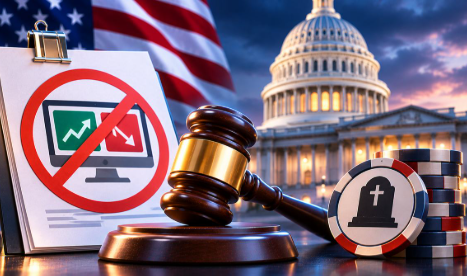
The US Senate has passed the DEATH BETS Act, legislation that would prohibit exchanges registered with the Commodity Futures Trading Commission (CFTC) from listing prediction market contracts tied to war, terrorism, assassination or death. The measure targets a class of event-based financial products that has raised questions about the boundaries of prediction markets and the types of outcomes that should be open for trading.
DEATH BETS Act Targets Violent-Event Contracts
If enacted, the bill would bar CFTC-registered exchanges from offering contracts that allow participants to take positions on outcomes involving war, terrorist incidents, assassination or death. Products of this kind generally let users stake financial positions on the likelihood of a specific future event, with contract values linked to whether the defined outcome occurs.
The Senate's passage marks a deliberate legislative effort to restrict prediction market products involving violent events and human fatalities. Rather than addressing prediction markets as a whole, the legislation concentrates on specific categories of contracts associated with serious real-world harm. Under the standard US legislative process, Senate passage is one stage on the way to enactment: the bill would still need to pass the House of Representatives and receive a presidential signature to become law.
The inclusion of war and terrorism alongside assassination and death gives the proposed restrictions a broad scope across several types of events (CoinMarketCap on X). If implemented, the prohibition would directly affect the range of contracts that exchanges registered with the CFTC could list and make available to participants.
Implications for Regulated Prediction Market Exchanges
Prediction markets have become an increasingly visible part of discussions on financial innovation, event-based trading and market regulation. Their contracts allow participants to express views on the probability of future developments through financial positions, rather than through conventional investments in stocks, commodities or cryptocurrencies.
Contracts connected to violence and fatalities, however, raise distinct ethical and regulatory concerns. The DEATH BETS Act addresses the issue by seeking to prevent regulated exchanges from facilitating trading tied to outcomes involving war, terrorism, assassination or death.
Because the legislation specifically names CFTC-registered exchanges, the regulatory status of trading platforms sits at the center of the proposed restrictions. The CFTC is the federal agency responsible for overseeing the US derivatives and futures markets, and exchanges registered with the agency operate within its supervisory framework. Anchoring the prohibition in this registered category ties the restriction to venues under federal oversight rather than to prediction market activity as a whole. The Senate passage represents the latest development in the legislative debate over how prediction markets should operate and which event-based contracts should be permitted. Its focus remains on contracts linked to violent events and human death, rather than a general prohibition on prediction market activity.
The original report was written by Victoria Hale, a technology and blockchain writer at Hokanews who covers blockchain technology, digital infrastructure and the intersection of emerging technologies with finance.
Source: Hokanews

