Hedge Funds, Money Market Funds Dominate the $13.5 Trillion Repo Market, New York Fed Analysis Shows
Key Takeaways
- •Hedge funds running the Treasury cash-futures basis trade borrowed $3.0 trillion through repos in July 2025, up from $2.5 trillion a year earlier.
- •Money market funds lent $3.0 trillion to the repo market in January 2026, roughly triple their July 2020 level.
- •U.S. branches of foreign banks, U.S. depository institutions, and REITs were the next-largest borrower categories, with combined borrowing of $1.2 trillion as of October 2025.
- •Hedge funds lent $1.3 trillion while borrowing $3.0 trillion, leaving them with net repo borrowing of about $1.7 trillion.
- •The Federal Reserve’s Standing Repo Facility was established in 2021 to contain liquidity strains, with its usage and repo-rate spikes indicating market stress.
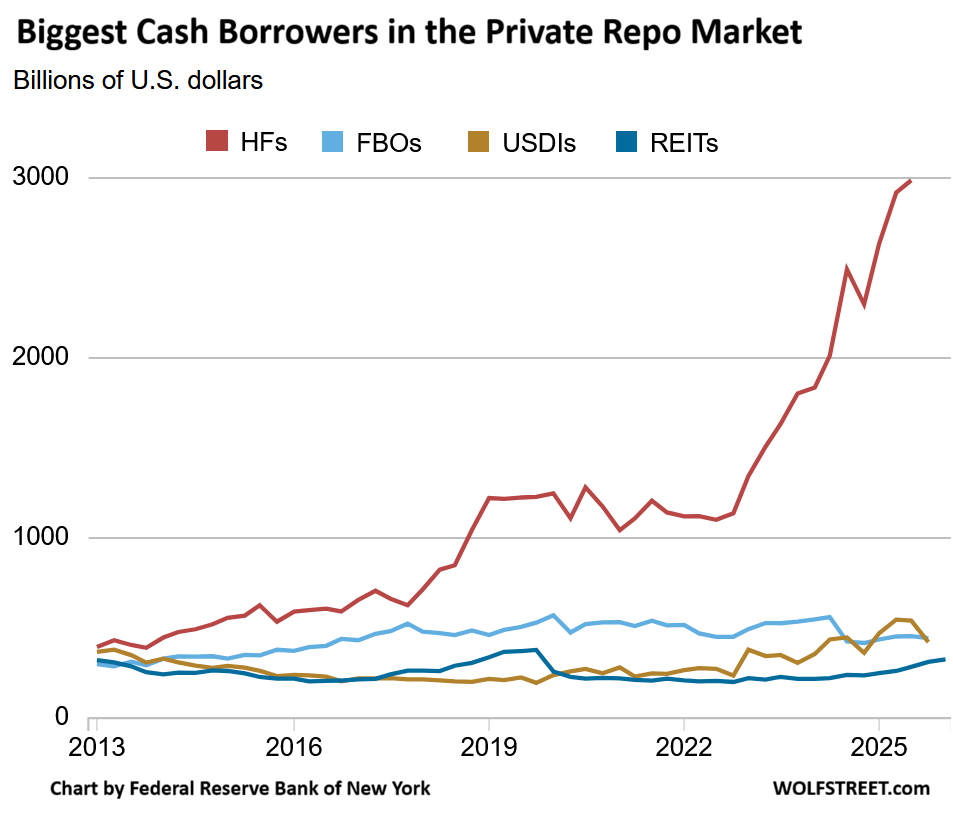
The U.S. repurchase agreement (repo) market has ballooned to more than $13.5 trillion in outstanding agreements daily, according to the government’s Office of Financial Research (OFR). A new analysis published Monday by the New York Fed, highlighted in a report by Wolf Street’s Wolf Richter, lays out who the market’s biggest cash borrowers and lenders are — and hedge funds running the Treasury “basis trade” and money market funds top the two lists by wide margins.
Via the repo market, financial institutions borrow from and lend to one another — mostly overnight, but also for longer periods such as one week — with each transaction secured by high-quality liquid collateral subject to a “haircut,” a discount applied to the collateral’s value. About 70% of repos are secured by Treasury securities. Most of the remainder is secured by agency securities, such as MBS issued by government-sponsored enterprises (GSEs) Fannie Mae and Freddie Mac, and by high-grade corporate bonds and asset-backed securities. Across all collateral types, the bigger the risk, the bigger the haircut.
Some institutions lend cash into the repo market for the yield and liquidity, such as money market funds. Others lend cash in order to borrow the Treasury securities they need for margin requirements on other trades, such as hedge funds. Still others borrow cash from the repo market to lever up financial positions or trades, among other reasons. Dealers act as intermediaries between lenders and borrowers.
Hedge funds, far ahead, are the biggest borrowers
Hedge funds engaged in the “basis trade” borrowed $3.0 trillion in the repo market as of July 2025, up from $2.5 trillion in July 2024, $1.1 trillion in July 2022, and $664 billion in July 2017, according to the New York Fed’s analysis — far ahead of every other category of borrower.
Under the Treasury cash-futures basis trade, hedge funds purchase Treasury securities and sell Treasury futures contracts, profiting from the spread between the two. Because the spread is small, they lever up the strategy by borrowing cash in the repo market and posting the Treasury securities as collateral, multiplying their returns through vast amounts of leverage — which is why the trade’s growth has fed directly into repo borrowing totals.
Funds running the trade provide liquidity to the Treasury market as big leveraged buyers of Treasury securities. But when the basis trade hit a rough patch in March 2020 and hedge funds had to unwind some of their positions, Treasury market locked up. The effort to untangle that dysfunction was one of the reasons the Fed cited for its massive Treasury purchases in March 2020. The Fed has cited hedge funds, with their vast leverage and dense opacity, as a primary risk to financial stability — and they did not disappoint in March 2020, having also come to the Fed’s attention for their part in the repo market blowout in the fall of 2019.
Far behind, the next three largest cash borrowers, as of October 2025, were U.S. branches and agencies of “Foreign Banking Organizations” (FBOs) at $445 billion; U.S. banks, or U.S. depository institutions (USDIs), at $422 billion; and real estate investment trusts (REITs), especially mortgage REITs, at $313 billion — a combined $1.2 trillion.
The New York Fed’s data draw on the OFR, the Federal Financial Institutions Examination Council (FFIEC), and the St. Louis Fed’s FRED database — a level of detail that shows who depends on short-term funding, and by how much.
Money market funds, far ahead, are the biggest lenders
Money market funds (MMFs) far outpace all other cash lenders, having lent $3.0 trillion to the repo market as of January 2026 — triple their July 2020 level. The high came in April 2023, at $3.3 trillion.
Lending into the repo market provides MMFs with short-term investments, including overnight repos with next-day liquidity, in high-grade securities backed mostly by Treasuries. Overnight repos allow money market funds to manage redemptions while keeping their cash invested.
Total MMF balances rose by nearly $1 trillion over the past 12 months, to $8.4 trillion in the second quarter of 2026, including a record $5.1 trillion held by households — and a substantial portion of that money was invested in the repo market, as Wolf Street has reported. That inflow has made household cash a growing pillar of the market’s lending base, tying everyday cash management to the banks, funds, and dealers that fund themselves in repo.
Far behind, hedge funds lent $1.3 trillion to the repo market as of July 2025 — in part to park otherwise uninvested cash over the short term, and in part for “collateral transformation” through a dealer, under which they in effect borrow Treasury securities from the repo market that they then post as collateral, such as to meet strict margin requirements on derivative trades. Hedge fund leverage is multi-layered and complex. On net, hedge funds are far bigger borrowers from the repo market ($3.0 trillion) than lenders to it ($1.3 trillion), with net borrowing amounting to about $1.7 trillion at the time.
Further behind among lenders were U.S. banks (USDIs) at $689 billion and U.S. branches of foreign banks (FBOs) at $419 billion, both as of October 2025, and the GSEs at $249 billion as of July 2025.
A tightly interconnected market, with a Fed backstop
The $13.5 trillion repo market interconnects a broad spectrum of financial institutions — dealers, banks, hedge funds, money market funds, and the GSEs — through short-term cash and collateral exchanges. The machinery works really well, until it suddenly doesn’t: given the market’s interconnectedness and vastness, liquidity problems in one corner of the repo market — visible when repo rates such as the Secured Overnight Financing Rate (SOFR) soar — can spiral out into the rest of the financial system in no time.
To tamp down on liquidity issues before they spread, the Fed set up its Standing Repo Facility (SRF) in July 2021. Under the facility, approved banks can borrow from the Fed at the SRF rate — 4.0% since the rate hike on September 16 — subject to a haircut, and lend the cash into the repo market, profiting from the spread and bringing repo rates back down in the process. That is what occurred during the repo market squiggles from September through December 2025, which Wolf Street documented, strains that might otherwise have spiraled out into the financial system. Repo rates and SRF usage are the market’s real-time stress gauges: spikes in rates show where cash is running short, and borrowing at the facility shows how heavily participants are leaning on the Fed’s backstop.

