US PPI Inflation Hits 6.5% as Bitcoin Slides Below $70,000
Key Takeaways
- •October final-demand producer prices rose 0.3% monthly, below the 0.4% economists expected, while the annual rate reached 6.5%, up from September's 6.3%.
- •Traders assigned an approximately 88% probability to a quarter-point Federal Reserve rate increase in December, ahead of the Fed's Dec. 8–9 policy meeting.
- •Bitcoin fell roughly 6.4% over 24 hours to trade near $68,828, with about $919 million in futures liquidations, approximately 95% from long positions.
- •Ether dropped below $2,000, and U.S. spot Bitcoin exchange-traded funds recorded roughly $47.7 million in net outflows for Nov. 12.
- •Equity futures rose after the report, with S&P 500 futures up 0.6%, while the ten-year Treasury yield hovered near 5.13%.
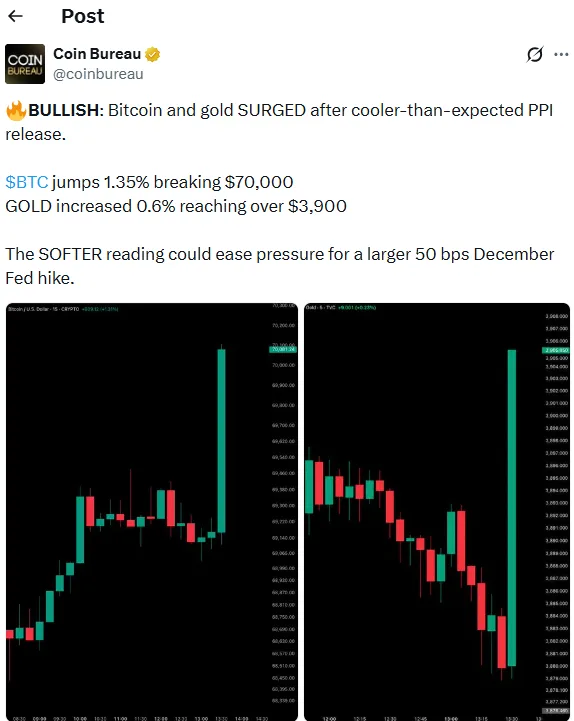
US producer-price inflation accelerated in October, with the annual rate climbing to 6.5% even as monthly gains undershot forecasts, a mixed report that complicates the Federal Reserve's next interest-rate decision. The Bureau of Labor Statistics published the figures on Nov. 13. Bitcoin slipped below $70,000 as liquidations intensified, and technology shares faced selling pressure as markets digested the data.
The report offered mixed signals for the crypto market. Slower-than-forecast wholesale inflation eased one immediate concern, but the elevated annual increase reinforced expectations of tighter U.S. monetary policy. Higher borrowing costs can pressure assets whose valuations depend on investors' willingness to take risk.
Producer Prices Climb Annually as Monthly Gains Miss Forecasts
The Bureau of Labor Statistics said final-demand producer prices increased 0.3% in October after September's revised 1.4% advance. Economists had expected a 0.4% monthly increase, according to Danske Bank's economic calendar. The PPI tracks the selling prices U.S. producers receive for their goods and services, a measure analysts often use to spot inflation pressure before those costs reach consumers.
Annual producer inflation reached 6.5%, up from September's 6.3% and the highest reading since November 2022. The annual figure also came in below the 6.6% forecast.
The official release showed goods prices rising 0.5%, while services prices increased 0.2%. Food prices advanced 1.3%, although energy prices edged down 0.1%. Transportation and warehousing services climbed 2.0%, reflecting continued price pressure outside the energy sector. Truck freight prices rose 3.9%, according to the same release.
The Bureau reported a 4.9% annual increase in final-demand prices excluding food, energy and trade services. That measure differs from the commonly cited core PPI series, which excludes only food and energy. The latter rose 5.0% annually, matching economists' expectations, according to the Associated Press.
Earlier in the week, the statistics agency reported a 0.4% monthly increase in October consumer prices. September's consumer reading had risen 0.6%. Taken together, the releases suggested that inflation remained persistent, despite slower monthly increases in selected measures.
Fed Rate-Hike Odds Stay in Focus
Investopedia reported that traders assigned an 88% probability to a quarter-point December increase ahead of Friday's market session. That figure represented market pricing, not a Federal Reserve decision, and the probability can move as futures prices respond to inflation data and officials' remarks. December rate-hike odds remained elevated despite the softer monthly inflation readings.
The Federal Reserve's calendar placed its next policy meeting on Dec. 8–9. Policymakers had left their benchmark interest-rate range at 3.75%–4.00% during October's meeting. The next decision will reflect broader evidence than any single inflation report.
For investors, the distinction between annual and monthly inflation mattered. The below-consensus monthly result offered limited relief, while elevated yearly readings complicated expectations for easing financial conditions. Traders also faced uncertainty over the size of any potential increase.
A rate hike would raise short-term financing costs and could affect leveraged trading. However, the data did not establish that officials would choose a particular path. CME FedWatch probabilities describe traders' positions rather than a commitment from the central bank.
Crypto Market Slides as Equity Futures Point Higher
CoinGlass futures data showed Bitcoin trading near $68,828, down approximately 6.4% over 24 hours during Friday's selloff. Its tracked intraday range stretched from $67,449 to $73,608. Ether also traded below $2,000, extending losses across larger digital assets.
The derivatives platform recorded roughly $919 million in Bitcoin futures liquidations over its rolling 24-hour window, with long positions accounting for approximately 95% of that total. Liquidations occur when exchanges force-close leveraged positions whose losses have eroded the collateral backing them. Bitcoin futures open interest fell 5.92%, suggesting traders closed or lost leveraged exposure during the decline.
CoinGlass's Bitcoin ETF dashboard also displayed about $47.7 million in net outflows from U.S. spot Bitcoin exchange-traded funds for Nov. 12. That preliminary figure concerned the preceding trading session, not flows triggered by Friday's PPI release, and fund flows can lag spot-market movements.
Meanwhile, Barron's reported that Dow futures gained 0.5% after the wholesale inflation figures appeared. S&P 500 futures advanced 0.6%, while Nasdaq 100 futures rose 0.5%. Those early gains followed Thursday's stock-market weakness rather than confirming a sustained recovery.
Investopedia said the ten-year Treasury yield hovered near 5.13% amid expectations for further monetary tightening. Elevated yields can compete with equities and non-yielding digital assets for capital. Still, Friday's divergent futures and cryptocurrency moves showed that markets had not responded uniformly.
The next scheduled Federal Reserve meeting on Dec. 8–9 offers a defined policy catalyst. Before that decision, investors will examine further inflation releases and officials' statements for evidence of sustained price pressure. This article reports market conditions, not investment advice.
Source: The Market Periodical

