U.S. Producer Prices Rise 5.4% Annually in August as Energy and Core Goods Costs Accelerate
Key Takeaways
- •Final-demand PPI rose 5.4% year over year and 0.40% month over month in August, equivalent to a 5.0% annualized monthly pace.
- •Services prices increased 4.5% annually and represented 68% of final-demand PPI, while core goods prices rose 5.0%.
- •Final-demand energy prices surged 24.3% from a year earlier and 4.16% from July, whereas food prices increased just 0.1% on both measures.
- •Core final-demand PPI advanced 4.6% year over year, with its monthly increase translating to a 2.0% annualized rate.
- •Wolf Street argued that the breadth of the price increases should lead the Federal Reserve to consider higher interest rates.
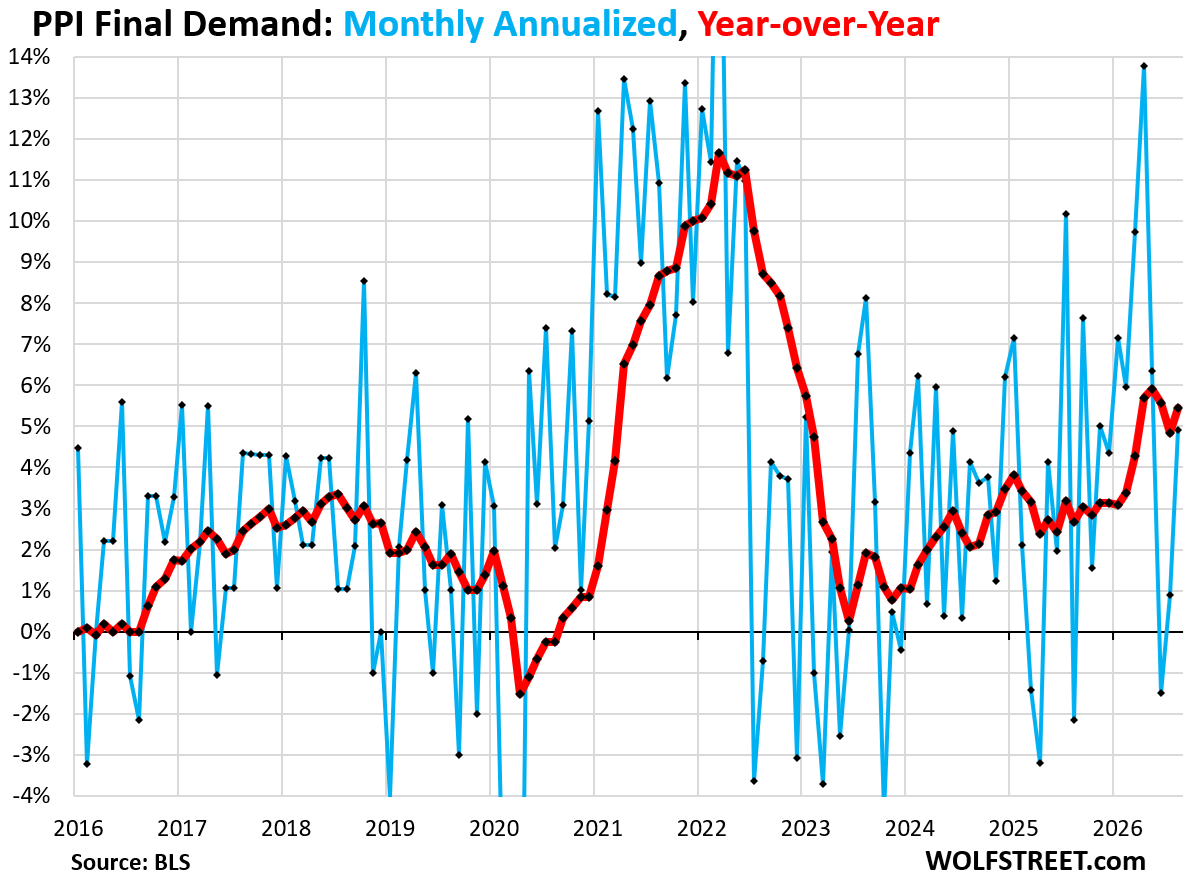
U.S. producer prices rose sharply in August, with inflation accelerating across services, goods and energy, according to data released by the Bureau of Labor Statistics.
The Producer Price Index (PPI) for final demand increased 5.4% year over year in August. On a monthly basis, the index rose 0.40%, equivalent to a 5.0% annualized rate. July readings were revised higher.
The data measure prices that businesses pay one another, making the composition of the increase important for interpreting the headline figure. Services prices increased 4.5% year over year, while goods prices excluding energy rose 5.0%. Final-demand energy prices surged 24.3% from a year earlier. Food prices, by contrast, were almost unchanged after a previous surge.
Services accounted for 68% of overall final-demand PPI. The services PPI rose 0.11% month over month in August, or 1.3% annualized, and its July reading was revised higher.
Within services, the PPI for transportation and warehousing climbed 10.3% year over year. The increase was attributed to higher input costs, including fuel. The index has moved higher in a zigzag pattern since reaching a low point in July 2023. It rose 1.2% month over month in August, equivalent to a 15.1% annualized rate.
Core final-demand PPI, which excludes food and energy, increased 4.6% year over year. The index is dominated by services and has moved higher in a zigzag pattern since its low point in January 2024. On a monthly basis, it rose 0.16%, or 2.0% annualized.
The PPI for core goods, which also excludes food and energy, increased 5.0% year over year. It has remained around that level for four consecutive months, the highest reading since February 2023. The index has moved higher in a zigzag pattern since March 2024. It rose 0.38% month over month in August, equivalent to a 4.6% annualized rate.
Final-demand energy prices increased 4.16% month over month, equivalent to a 63% annualized rate, in addition to the 24.3% year-over-year increase. The accompanying chart shows the energy PPI price level rather than its percentage change.
Final-demand food prices rose 0.1% both year over year and month over month, with the monthly increase equivalent to a 1.4% annualized rate. Food prices paid by businesses surged 36% from mid-2020 through February 2025 and have since been broadly range-bound. Some prices, including eggs, have fallen sharply after earlier spikes, while others have continued to rise.
PPI inflation measures price changes faced by businesses. Consumer-facing inflation is tracked separately by the Consumer Price Index, which was scheduled for release the following day, and by the Personal Consumption Expenditures price index. Both measures have been somewhat less elevated than business inflation. Those consumer-focused releases provide the next comparison for assessing how the August increase in business prices relates to inflation measured further along the economic chain.
A separate measure covering consumers, businesses, nonprofits and governments is published quarterly as part of the gross domestic product data. That measure was also revised higher. Inflation across the overall economy rose at a 6.4% annualized rate in the second quarter from the first quarter and increased 4.4% year over year.
Wolf Street said the breadth and depth of the increases should prompt the Federal Reserve to stop waiting for inflation to ease and that the 12 voting members of the Federal Open Market Committee, chaired by Warsh, should vote for higher interest rates.
