Trump Administration Opens Fiscal 2027 With Record Spending and a $404 Billion October Deficit
Key Takeaways
- •The federal government posted a $404.06 billion deficit in October, the first month of fiscal 2027, and the gap still reached $285 billion after accounting for benefit spending moved forward because November 1 fell on a weekend.
- •Total receipts declined 9 percent year-on-year to $368.94 billion, with net customs (tariff) revenue falling 39 percent to $19.2 billion and individual non-withheld tax receipts dropping 36 percent, partly against a base inflated by wildfire-extended California filings in October 2025.
- •Federal spending climbed 12 percent to $773 billion, as Agriculture Department outlays surged 80 percent on $28 billion in farm relief payments and War Department spending rose 30 percent.
- •Treasury interest payments reached $115.46 billion in October, and fiscal 2026 interest totaled $1.36 trillion, making debt service the second-largest federal spending category behind Social Security.
- •Treasury Secretary Scott Bessent has set a goal of reducing the deficit to 3 percent of GDP, but the fiscal 2026 shortfall stood at 6.2 percent, leaving that effort off to a difficult start.
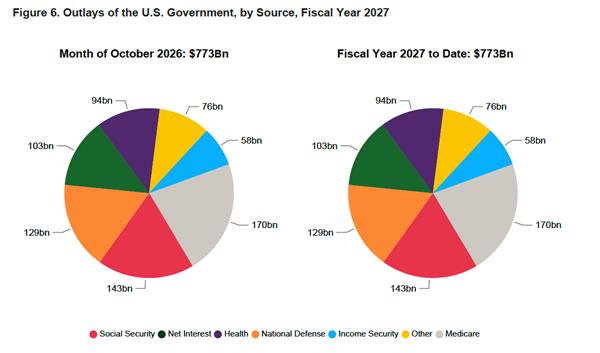
The US federal government opened fiscal year 2027 with a record October deficit. After running the third-largest budget deficit in history in fiscal 2026, the Trump administration spent $404.06 billion more than it took in during the month, according to GoldSeek columnist Mike Maharrey.
Part of the gap reflects a calendar quirk: November 1 fell on a weekend, and the government pushed some November benefit spending back into October. Even after accounting for the adjustment, however, the October deficit still totaled $285 billion — 49 percent higher than October 2025.
Receipts declined broadly. Net customs receipts — the tariff revenue collected on imported goods — fell 39 percent to $19.2 billion, helping drive total government receipts down 9 percent year-on-year to $368.94 billion. Individual non-withheld tax receipts dropped 36 percent to $51 billion compared with a year earlier. The steep percentage decline owes something to an unusually strong base: tax receipts swelled in October 2025, when Californians who had received extensions because of the 2025 wildfires filed their returns.
The monthly dip runs counter to a multiyear upward trend in revenue. Government receipts grew 3.2 percent in fiscal 2026. Revenue in 2025 was 6 percent higher than in 2024, which in turn was 11 percent higher than in 2023.
On the spending side, the federal government showed no signs of slowing down. The administration outlaid $773 billion in October, a 12 percent increase over the same month last year. November 1 also fell on a weekend in 2025, meaning last year's October figure likewise incorporated shifted benefit spending. U.S. Department of Agriculture spending surged 80 percent, driven by $28 billion in farm relief payments, while the Department of War reported a 30 percent year-on-year increase in outlays.
To Maharrey, the figures underscore a persistent pattern: the federal government consistently finds new ways to spend. Despite recurring, non-specific talk of "spending cuts," he sees little commitment to reining in outlays, arguing that policymakers continually discover fresh reasons to spend money — whether a crisis at home or a war overseas.
Treasury Secretary Scott Bessent has set a goal of reducing the deficit to 3 percent of GDP. The fiscal 2026 shortfall amounted to 6.2 percent of GDP, so by that measure the effort is off to a rough start. How fiscal 2027 develops against that target will come into focus month by month — including whether individual tax receipts rebound once the wildfire-extended filing surge of October 2025 drops out of the year-over-year comparison.
Debt-service costs keep climbing as the government borrows more to cover the gap. The Treasury paid out $115.46 billion in interest last month, an 11 percent increase from the same period a year earlier. Net interest — interest expense minus interest receipts — came to $103 billion. In fiscal 2026, interest payments totaled $1.36 trillion, up 11.5 percent from fiscal 2025, making interest the second-largest spending category in the federal budget behind only Social Security.
Much of the debt currently on the books was financed at very low rates before the Federal Reserve began its hiking cycle. Every month, some of that low-yielding paper matures and must be replaced with bonds yielding far more. Treasury yields have meanwhile been spiking as more countries spurn the dollar.
That dynamic, Maharrey writes, leaves the Federal Reserve in a Catch-22: it needs to raise rates to battle inflation, yet the government cannot handle significantly higher borrowing costs. In his assessment, calling the spending unsustainable is an understatement, and it is fair to describe the federal government as insolvent. Very few in the political class, he argues, appear interested in tackling the problem — and at some point, he warns, the problem will tackle them.

