US Debt Tops Economy, Raising Fiscal and Market Concerns
Key Takeaways
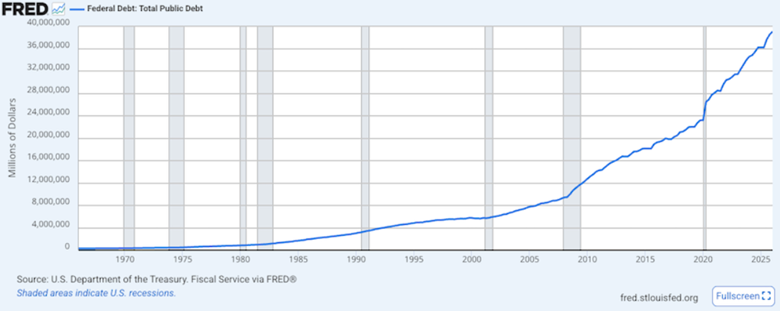
- •The US national debt stands at $39 trillion, and publicly held debt reached 100.2% of GDP on March 31, exceeding the size of the economy for the first time since 1946.
- •A $25 billion offering of 30-year bonds on August 13 drew a 5.24% yield, the highest borrowing cost for the US government since 2001.
- •Net interest payments now exceed $1 trillion annually and surpassed defense spending in 2024, with the CBO projecting interest costs of 4.6% of GDP versus 2.4% for defense by 2036.
- •The CBO projects the full-year federal deficit at $2.1 trillion and expects it to rise to more than $3.1 trillion annually by 2036.
- •Gold has overtaken US Treasuries in global central bank reserves, and recent surveys show more central banks plan to reduce dollar allocations than increase them.
US Debt Tops Economy, Raising Fiscal and Market Concerns
Richard Mills
The United States has the largest national debt in the world, at $39 trillion. While the U.S. debt-to-GDP ratio of 122% is below Japan’s 204% and Singapore’s 172%, economists say the size of America’s debt matters because it limits the policy tools available to the Federal Reserve and the government.
Investors are demanding higher yields on long-term U.S. bonds, while the federal deficit is nearing $2 trillion. The government can finance that gap only by borrowing more or by creating money, which carries inflationary risks.
Concerns are rising not only about Washington’s ability to keep financing deficits and debt, but also about the possibility that inflation could erode returns for bondholders. If that happens, some observers argue that demand for U.S. Treasuries could weaken materially.
Deficits and interest payments
High interest rates and large short-term debt service costs are forcing the U.S. government to spend more than $1 trillion a year on net interest. That spending crowds out public investment, widens federal deficits, and raises the risk of higher taxes or cuts to essential programs.
Heavy government borrowing also pulls capital away from private markets, pushing up borrowing costs for businesses and consumers. Higher credit costs can slow business expansion and reduce productivity growth over time. If the government responds by printing money or continually expanding deficits, it risks adding further inflationary pressure.
Bloomberg reported that on Thursday, Aug. 13, the U.S. government offered $25 billion of 30-year bonds at a 5.24% yield, the highest rate in 25 years and the highest borrowing cost since 2001.
The report said long-term yields moved above 5% this year as investors worried that higher energy prices could add to cost pressures and force the Federal Reserve to keep rates elevated for years. It also noted that interest on public debt remains a key driver of the budget deficit. For the fiscal year to date, the tally stood at $1.17 trillion, up 15% in part because of higher Treasury yields.
As traditional demand for Treasuries has weakened, private-market buyers have stepped in, but only at higher yields. Bloomberg strategist Brendan Fagan said, “Borrowing at fresh multi-decade highs may simply become the norm from now on.”
A new Congressional Budget Office report said the nearly $40 trillion national debt is now costing the Treasury more than $3 billion a day in service payments. Interest payments have risen by $117 billion, or 14%, compared with the same period last year.
Debt hawks point to first-10-month deficits of $1.8 trillion, which is $169 billion more than during the same period a year earlier. The CBO projects the full-year deficit will reach $2.1 trillion, up $200 billion from its February forecast.
The Bipartisan Policy Center said each year’s deficit adds to the already large national debt, while interest costs drive additional spending growth. At the end of June, the federal government’s cumulative fiscal year 2026 deficit totaled $1.4 trillion, 3% higher than at the same point a year earlier. Fiscal year-to-date revenues were up 4%, while spending was up 3%.
Bridgewater Associates founder Ray Dalio has warned of a “debt-induced heart attack” as debt payments crowd out public spending.
Debt-to-GDP ratio
The U.S. debt and deficit problem looks even more severe when measured against GDP. National debt now exceeds the size of the economy.
The last time U.S. debt-to-GDP rose above 100% was in 1946, in the aftermath of World War II. The latest milestone was reached on March 31, when publicly held U.S. debt hit $31.265 trillion, or 100.2% of GDP, according to the Atlantic Council.
Atlantic Council president and CEO Frederick Kempe wrote that the real problem with debt above 100% of GDP is that it constrains choices and reduces room to respond to crises, including financial shocks, global conflicts, or natural disasters at home.
Washington now spends more on interest payments than on many core government functions. For decades, U.S. defense spending was about twice as large as net interest payments. In 2024, net interest payments surpassed defense spending. The CBO projects that by 2036, interest payments will nearly double defense spending, reaching 4.6% of GDP versus 2.4% for defense.
The scale of indebtedness has also renewed questions about whether the U.S. dollar should remain the world’s reserve currency. As noted in a previous article, the issue is not only financial but also geopolitical.
Kempe said the United States’ ability to borrow at scale, the so-called “exorbitant privilege” of the world’s leading reserve currency, depends on international trust in the economy, institutions, and democracy. Persistent deficits, rising debt, and growing policy unpredictability test that confidence. If trust erodes, Kempe said, the consequences would include higher borrowing costs, a weaker dollar, and diminished global influence.
Economic historian Niall Ferguson has summarized this as Ferguson’s Law, named for philosopher Adam Ferguson: “any great power that spends more on debt servicing than on defense risks ceasing to be a great power.”
Interest-to-GDP ratio
Globe and Mail columnist Andrew Coyne has highlighted another measure of U.S. debt stress: the interest-to-GDP ratio.
He notes that interest costs on U.S. government debt currently equal about 3.3% of GDP. That ratio is projected to nearly triple over the next 30 years, assuming the average interest rate on U.S. debt rises only to 4.2%.
If the average rate instead rises to 5.2%, the interest-to-GDP ratio would climb to 15%. At 6.2%, it would rise to 22%. Even in a 10%-of-GDP “rosy” scenario, interest costs would consume more than half of all federal revenues.
Coyne’s conclusion is blunt: the U.S. is heading straight for a fiscal cliff.
Japan as a warning
In late July, the U.S. Treasury intervened in the foreign exchange market to buy up to $10 billion in Japanese yen in support of Japan’s currency. Japan had reportedly spent an estimated $59 billion to $85 billion selling reserves to support the yen.
The U.S. intervention was intended to prevent a disorderly currency collapse that could have triggered large Japanese sales of U.S. Treasury bonds. Such a move would have raised American borrowing costs, increased financial volatility, and destabilized trade across Asia.
Japan holds $1.4 trillion in U.S. Treasury securities, more than any other country.
A recent article in The Daily Economy said Japan’s problems could accelerate the U.S. path toward crisis. The key issue is rising interest rates.
In July, the Japanese yen was at its weakest level against the U.S. dollar in 40 years, with $1 buying 162 yen. To support the currency, the Japanese government sold U.S. bonds for dollars and used those dollars to buy yen. That pushed up U.S. Treasury yields, which in turn raised borrowing costs for U.S. debt.
The U.S. Treasury’s move to buy yen with dollars may have been a temporary fix, but the underlying problem remains. As Robin Brooks noted, Japan’s bond yields are still not high enough to reflect its true fiscal situation, but Japan cannot afford for them to rise any higher.
Japan, in effect, has borrowed itself into a corner. Many other countries, including the United States, are on track to follow.
Can AI solve the problem?
High interest rates are a clear problem for heavily indebted governments. The Economist notes that every percentage-point increase in America’s bond yields adds interest costs equal to 1.3% of annual GDP within a decade.
In theory, the government could offset those costs through spending cuts or tax increases, but neither appears likely. The tax cuts from the Trump administration’s Big Beautiful Bill Act alone are estimated to cost $5.8 trillion.
That has led policymakers to look for productivity growth as a way out, and many are turning to artificial intelligence.
So far, however, AI has not boosted productivity in a meaningful way, even in China, where the technology is furthest ahead. There is also the possibility that AI will reduce employment, increasing government spending on displaced workers. If AI fuels an arms race, defense spending could rise. If it extends lifespans, pension costs could increase.
Economists at the Brookings Institution estimate that these factors, along with higher interest rates, could more than halve the positive effect of AI-driven growth on American deficits.
The Center for American Progress argues that if AI materially raises productivity, it could support faster GDP growth and lower debt ratios over time. But that would require productivity growth far above historical norms.
Whether AI improves the productivity of existing workers or displaces labor remains debated. For fiscal analysis, the key point is that output could rise either way. The question is how much.
Most economists’ forecasts range from 0.1% to 1.5% a year, well below the projections of many AI advocates.
CAP says the biggest challenge to the “AI-to-the-rescue” thesis is sustained productivity growth. AI may provide an initial boost, but it is uncertain whether that pace can continue.
To illustrate the point, consider a factory where five people make 10 widgets. Output per person is two widgets. If AI allows those workers to produce 15 widgets, output per person rises to three widgets, a 50% productivity gain. But if the same five workers continue producing 15 widgets with AI, productivity no longer rises. Continued productivity growth would require AI to make them increasingly productive over time.
Dot-com versus AI boom
The early-2000s dot-com boom was fueled by cheap and easy money. Today’s AI boom is being financed in a much higher-rate environment, where borrowing is more expensive.
During the dot-com era, companies often backed loans with speculative collateral such as overvalued stock, brand names, or unproven intellectual property. Today, technology firms are using physical assets such as high-end AI microchips and cloud data centers to secure billions of dollars in debt.
That may seem safer, but it introduces a different risk: hardware depreciation.
If Nvidia or a competitor launches a vastly superior chip generation next year, older chips used as collateral could quickly lose value. If an AI startup then defaults in a market flooded with newer technology, lenders could be left with warehouses full of obsolete, nearly worthless silicon.
Conclusion
The U.S. federal budget deficit is projected to rise from $1.9 trillion in fiscal year 2026 to more than $3.1 trillion annually by 2036, driven largely by soaring net interest payments on the national debt, mandatory spending, and higher military spending.
That outcome is unattractive for the government, but it may still be preferable to the alternative: inflation rising so far that foreign investors stop buying Treasuries because real yields are near zero or negative.
The 10-year Treasury yield is currently 4.6%, while CPI inflation is 3.4%, leaving a net yield of 1.2%. If inflation returns to its May level of 4.2%, the net yield would fall to just 0.4%.
Gold has overtaken U.S. Treasuries in global central bank reserves, and recent surveys show more central banks plan to reduce dollar allocations than increase them.
Gold is climbing a staircase — Richard Mills
