Monthly GDP Flat Since March, S&P Global Market Intelligence Estimate Shows
Key Takeaways
- •S&P Global Market Intelligence’s monthly GDP estimate indicates that U.S. monthly GDP has been flat since March.
- •The Econbrowser analysis was published on August 22, 2026, and uses the SPGMI estimate released on August 3, 2026.
- •The report compares monthly GDP with payroll employment, civilian employment, industrial production, real personal income excluding transfers, and real manufacturing and trade sales.
- •The analysis also places quarterly GDP and the New York Fed’s August 21 nowcast alongside the monthly series for comparison.
- •Latest GDP growth nowcasts cited in the report are 4.0% from the Atlanta Fed, 2.3% from SPGMI, 2.4% from the St. Louis Fed, and 2.3% from Goldman Sachs.
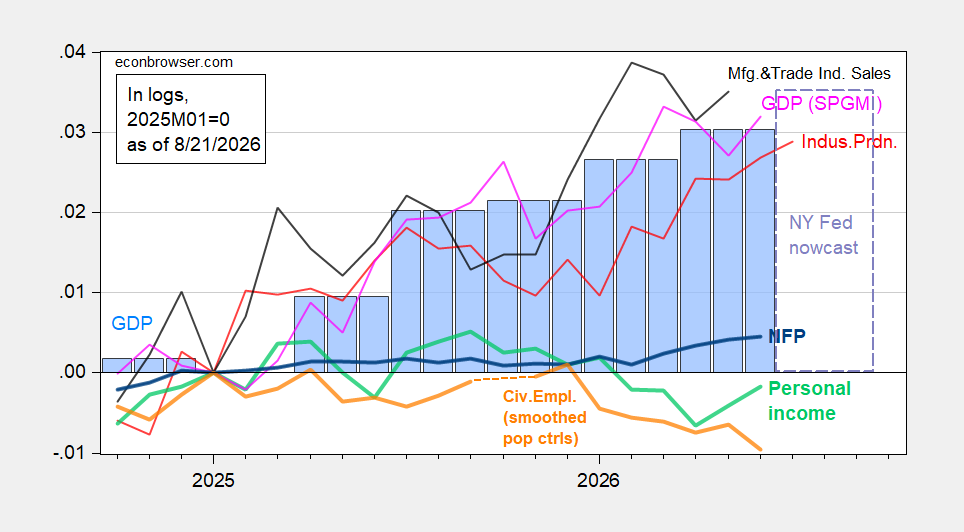
Monthly GDP in the United States has been flat since March, according to the S&P Global Market Intelligence (SPGMI) monthly GDP estimate released on August 3, 2026.
Econbrowser tracks the estimate alongside the principal coincident monthly indicators of US economic activity: nonfarm payroll (NFP) employment; civilian employment with smoothed population controls; industrial production; personal income excluding current transfers in chained 2017 dollars; manufacturing and trade sales in chained 2017 dollars; and monthly GDP in chained 2017 dollars. Quarterly GDP, from the Bureau of Economic Analysis' 2026 first-quarter advance release, and the New York Fed's nowcast dated August 21 are plotted alongside the monthly series. All series are log-normalized so that January 2025 equals zero, putting them on a common basis for comparison.
These monthly indicators are useful because they provide a more frequent read on economic activity than the BEA’s quarterly GDP releases, while still lining up with the series the National Bureau of Economic Research’s Business Cycle Dating Committee uses when dating US business cycles. That makes the monthly GDP estimate a complementary reference point rather than a replacement for the official quarterly measure.
Underlying data come from the Bureau of Labor Statistics via FRED, the BLS, the Federal Reserve, the BEA 2026 Q1 advance release, S&P Global Market Insights (formerly Macroeconomic Advisers and IHS Markit; August 3, 2026 release), and the author's calculations.
Background. SPGMI's monthly GDP index originated at Macroeconomic Advisers, passed through IHS Markit, and is now published by S&P Global; it provides an estimate of GDP at a monthly frequency between the BEA's quarterly releases. The indicator set shown alongside it — payroll employment, real personal income less transfers, industrial production, and real manufacturing and trade sales — corresponds to the monthly series the National Bureau of Economic Research's Business Cycle Dating Committee draws on when establishing US business cycle chronology, supplemented here by monthly GDP. Chained 2017 dollars denotes the inflation-adjusted basis the BEA uses for its real (volume) measures.
Nowcasts. The latest GDP growth nowcasts stand at 4.0% (Atlanta Fed, August 18), 2.3% (SPGMI, August 21), 2.4% (St. Louis Fed), and 2.3% (Goldman Sachs tracking estimate).
The analysis was published by Econbrowser on August 22, 2026.
