The Gateway to Mexico: Border Cities Caught Between Nearshoring Boom and Trade Policy Uncertainty
Key Takeaways
- •The Trump administration decided in July 2026 not to renew the USMCA, placing the trade pact under annual reviews for ten years before its eventual expiration.
- •US-Mexico bilateral trade reached a record $404.6 billion in 2026, with Mexico accounting for 16.5% of all US trade and maintaining its position as America's largest trading partner.
- •Record FDI of $40.9 billion in 2025 was driven primarily by reinvestment from existing operators, as new investment comprised only 7.4% of total FDI in Q1 2025.
- •Both BYD and Tesla suspended planned manufacturing facilities in Mexico, explicitly citing US tariff and trade policy uncertainty as the deciding factor.
- •Mexico's total gross fixed investment declined 10% in 2025, while national industrial availability rose approximately 51% year-over-year in Q1 2026 amid softening border property markets.
The Gateway to Mexico: Border Cities Caught Between Nearshoring Boom and Trade Policy Uncertainty
By Jacob Shapiro
The author recently spent several days in Laredo, Texas, conducting field research in 108-degree heat to examine how the city's geography has long positioned it as the primary gateway to Mexico and the wider Americas. This marked a second extended research trip to US-Mexico border cities, following visits to Brownsville and Matamoros the previous year.
In both Brownsville and Matamoros, a striking sentiment shift was immediately apparent: unbridled optimism and an almost giddy assurance that nearshoring was still in its early stages, with exceptional prospects on both sides of the border. Laredo displayed optimism as well, but of a far more cautious and caveated variety. The word "uncertainty" hung over nearly every conversation.
The Situation
Earlier in July 2026, the Trump administration decided not to renew the United States-Mexico-Canada Agreement (USMCA), the trade pact that replaced NAFTA in 2020. The United States has not exited the agreement, but it is now subject to annual reviews for the next 10 years, after which it will expire.
A considerable element of negotiating strategy is at play. The US could have triggered a USMCA withdrawal within six months but chose not to do so. Negotiations continue bilaterally between the US and Canada, and between the US and Mexico. If all three parties reach an accord, the deal could be extended beyond 2036. However, those negotiations are not progressing smoothly.
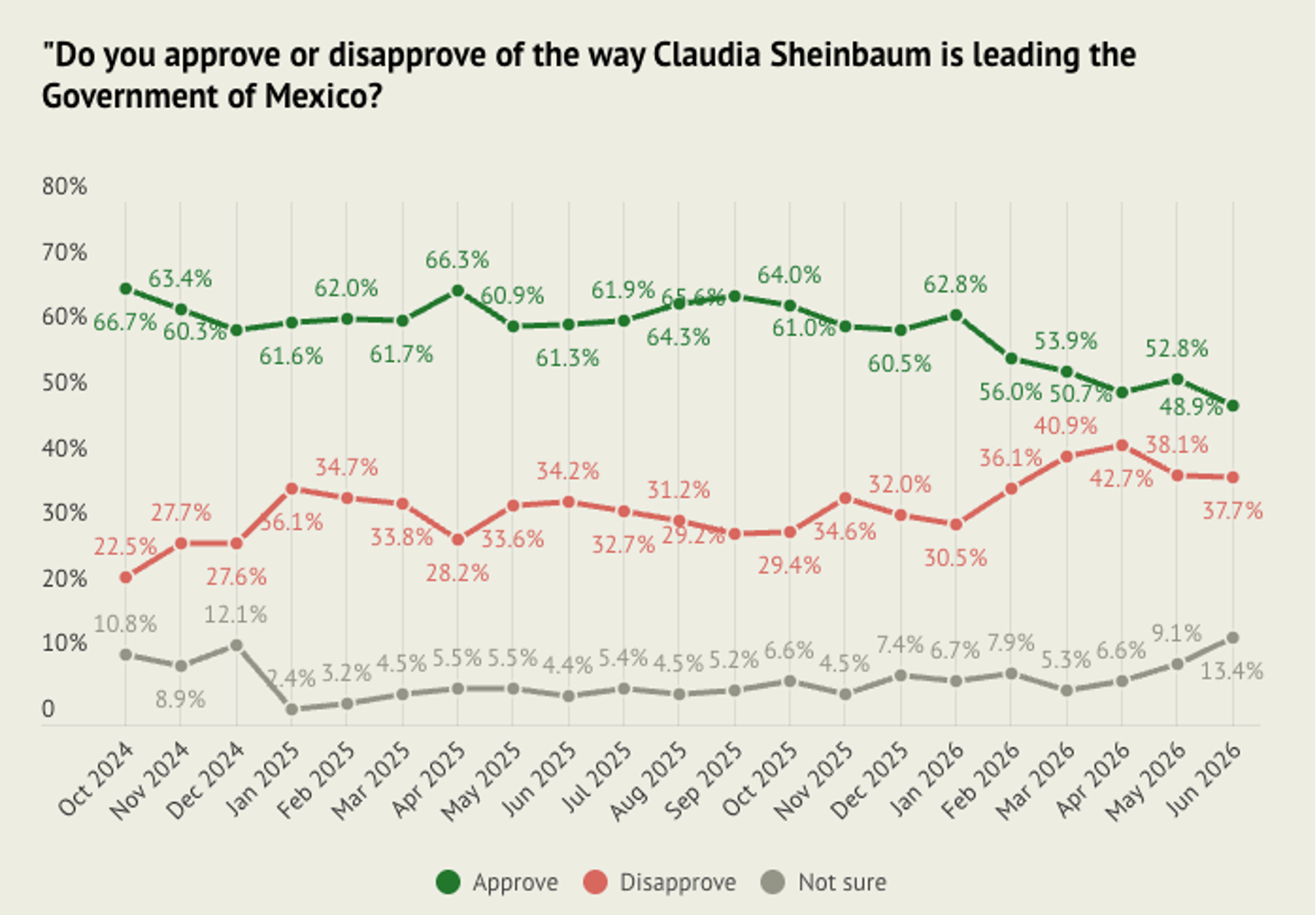
While the author was in Laredo, the US invoked the Tariff Act of 1930 (commonly known as Smoot-Hawley) to impose additional 50% tariffs on Canadian imports, described as "covering products ranging from wine to hockey sticks to cement." The original Smoot-Hawley Tariff Act of 1930 is widely regarded by economic historians as having deepened the Great Depression by triggering retaliatory tariffs from US trading partners. US-Mexico relations have been tense since April, when the US Justice Department indicted a sitting Mexican governor—Sinaloa's Rubén Rocha Moya—and nine other Mexican officials on drug trafficking charges. That pressure has coincided with Mexican President Claudia Sheinbaum's approval rating slipping below 50% and the signing of a new EU-Mexico trade agreement.
The optimism surrounding border economies was punctured on what has been termed "Liberation Day." It was not merely the tariffs themselves but the haphazard, volatile, and inconsistent manner in which tariff policy has been implemented that has slowed momentum. Tariffs can be effective instruments when wielded with precision—and disastrous when applied improperly. Many of the tariffs the US imposed in April 2025 were struck down by the Supreme Court, and most of President Trump's newer levies will likely face similar judicial review.
Existing agreements and understandings have not tempered US behavior in tariff negotiations. The latest round of tariffs against Canada covers goods "regardless of whether a good originates under the USMCA." Until April, President Sheinbaum had earned praise for accommodating the Trump administration's demands—deploying more Mexican troops to the border, increasing fentanyl seizures, and imposing tariffs on Chinese goods entering Mexico at whatever levels Washington requested.
When the time came to extend the USMCA—or even to obtain assurances that US-Mexico trade would remain unaffected by whatever disputes Washington had with Ottawa—Mexico was met with indictments rather than reassurances.
Macro Prospects
At the macro level, nearshoring and the broader US-Mexico relationship remain a net positive story. So far in 2026, bilateral trade between the US and Mexico has reached a record $404.6 billion. Mexico became the top US trading partner in 2023—displacing China—and has maintained that position, now accounting for 16.5% of all US trade.
In April 2026, bilateral trade was up over 23% year-on-year, a trend expected to continue through year-end. Foreign direct investment (FDI) figures are equally notable, reaching a record $40.9 billion in 2025—nearly an 11% year-on-year increase and a fifth consecutive annual rise.
The decoupling of US-China trade was never going to happen overnight and will likely take years, if not decades, to fully materialize. However, the data confirms that the decoupling has begun, and Mexico has emerged as the leading destination for relocating factories that serve the North American market. Nearshoring is real and underway, and the macroeconomic prospects for border cities in both countries are positioned for significant growth.
Nearshoring Without Growth
While top-line figures appear strong, a closer examination reveals a less favorable picture. The Trump administration's unpredictable and outdated approach to trade policy is undermining what should be an unambiguous growth narrative.
Although headline FDI numbers are positive, the majority represents reinvestment by companies already operating in Mexico rather than new capital arriving from abroad. In Q1 2025, new investment accounted for just 7.4% of total FDI, below the 2024 average of 8.6%. A record built primarily on reinvestment signals a maturing installed base, not a fresh wave of factory relocations.
Furthermore, those FDI figures sit atop an otherwise weak investment landscape. Total gross fixed investment declined 10% in 2025, with private investment down 2% and public investment down 26%. Mexico's GDP remains sluggish, with 2026 projections ranging between 0.6% and 1.5%.
Following a border construction frenzy from 2022 to 2024, the property market has reversed course. National industrial availability rose approximately 51% year-over-year in Q1 2026, and northern border markets such as Ciudad Juárez and Reynosa experienced vacancy increases described as "material," as developers extend delivery timelines and grow more selective about new projects.
Leasing activity remains positive but sits well below its 2024 peak. In Laredo, newly constructed warehouses dot the landscape, and local reports indicate vacancy rates have been climbing. Official data puts the increase at 1.4 percentage points to 4.5% for the year, but anecdotal accounts from the ground suggest the actual figures are considerably higher.
BYD shelved its planned Mexican EV facility, and Tesla suspended the timeline on its Nuevo León gigafactory, with both companies citing US tariff and trade uncertainty. As a CSIS report characterized it, this amounts to "nearshoring without growth."
Good News, Bad News
The positive case is straightforward: the border region remains primed for expansion, and that expectation has already driven substantial infrastructure investment. Laredo is the largest US port by dollar value—surpassing the Port of Los Angeles, Chicago O'Hare International Airport, and the Port of New Orleans. No US city can easily replicate Laredo's unique geographic and infrastructural advantages, just as no US city can match Matamoros for competitive, low-cost manufacturing capability.
The negative case is equally clear. Uncertainty surrounding tariffs, the USMCA's future, and the overall US-Mexico relationship is constraining that growth potential. Even if every trade dispute were resolved immediately, Mexico would still face challenges in improving logistics infrastructure, restoring confidence in the rule of law following controversial judicial reforms that, in 2024, made Mexico the first country to elect all judges by popular vote, and reining in cartel activity and cargo theft along key transit corridors. The country is led by a populist government, in part because Mexico has accumulated Latin America's lowest GDP and GDP-per-capita growth rate over the past 35 years, excluding Venezuela.
The self-inflicted nature of the current situation is difficult to ignore. Had the current Trump administration governed like its first-term predecessor—emphasizing non-interventionism, challenging Chinese trade practices through negotiation, and securing new trade agreements for alternative US export markets—the US economy would likely be experiencing a combined boom driven by AI and data-center capital expenditure, affordable energy, and nearshoring.
Instead, the US is constraining the AI sector by imposing restrictions on companies such as Anthropic and even considering national equity stakes in AI firms. Energy prices have risen partly due to what appears to be a misguided effort to foment regime change in Iran. Most critically, Washington is short-circuiting its greatest structural advantage: the combined economic power and potential of an integrated North America.
Policy cannot completely derail macroeconomic fundamentals. Laredo and other border cities will perform well over the long term, even if growth arrives more slowly than hoped and policy limits its ceiling. But policy can unquestionably slow the pace. While politicians argue, the real economy is eager to move forward. What it requires is not any particular policy prescription but rather clarity about what the future holds. Until the United States provides that clarity, Laredo and the broader border region will remain stuck in first gear.
Chart of the Week
Data suggests growing US engagement with soccer—a potential indicator of shifting cultural and demographic trends.
Blind Spot: India's "Cockroach" Protests
Over the past two months, a wave of Gen Z demonstrations has swept across India—the so-called "cockroach protests"—with tens of thousands marching in Delhi and amassing a substantial online following.
The English-language press has largely framed these protests as yet another challenge to Prime Minister Narendra Modi. The Wall Street Journal's headline read: "India's 'Cockroach' Protesters Renew Challenge to Modi." That framing, however, misses the deeper story.
The protests began after a medical entrance exam drove some prospective test-takers to suicide, though that trigger is unrelated to the "cockroach" organizing principle itself. In a separate, unrelated case, India's Chief Justice referred to some jobless youth as "cockroaches" in a ruling concerning individuals with fake degrees entering the legal profession. Gen Z organizers seized on the slur, stripping it from its original context to create the Cockroach Janta Party—a pointed jab at the ruling BJP that attracted tens of millions of followers without articulating a formal manifesto.
India's political opposition has since attempted to co-opt the movement, but the phenomenon extends well beyond domestic politics. It represents yet another Gen Z protest movement rooted in educated discontent. India's official unemployment rate stands at just 3.2%, but that figure obscures the most relevant data: only about a quarter of Indians hold salaried employment, graduate unemployment runs near 11%, and the ILO has previously placed the figure as high as 29%. Only approximately 5% of medical exam takers secure a place in an undergraduate medical program. These figures carry particular weight given that India has the world's largest youth population, with a median age of approximately 28.
In Nepal and Bangladesh, protests of this nature have toppled governments. In Indonesia and Morocco, they have generated headlines but produced limited concrete change. There is a distinct echo of the Arab Spring, when unemployed Egyptian graduates and engineers working as taxi drivers joined the movement against the regime. With AI increasingly threatening white-collar employment, the conditions underlying India's groundswell may intensify rather than abate.
