US Labor Market Holds Steady: Payrolls Jump 162,000 in August, Clearing the Way for the Fed to Focus on Inflation
Key Takeaways
- •US employers added 162,000 jobs in August, with July revised up from a 21,000 loss to a 21,000 gain and June revised up by 11,000.
- •Average hourly earnings rose 3.1% year-over-year to $37.75, lagging CPI inflation of 3.4% and delivering real wage losses to workers.
- •The labor force has declined by 2.07 million since December, driven by immigration crackdowns and boomer retirements, keeping unemployment historically low at 4.1%.
- •Nearly 400,000 combined federal and state government job cuts largely ended, meaning recent employment gains reflect private-sector hiring alone.
- •Leisure and hospitality led August job gains with 62,000, while information (-23,000) and financial activities (-11,000) shed jobs.
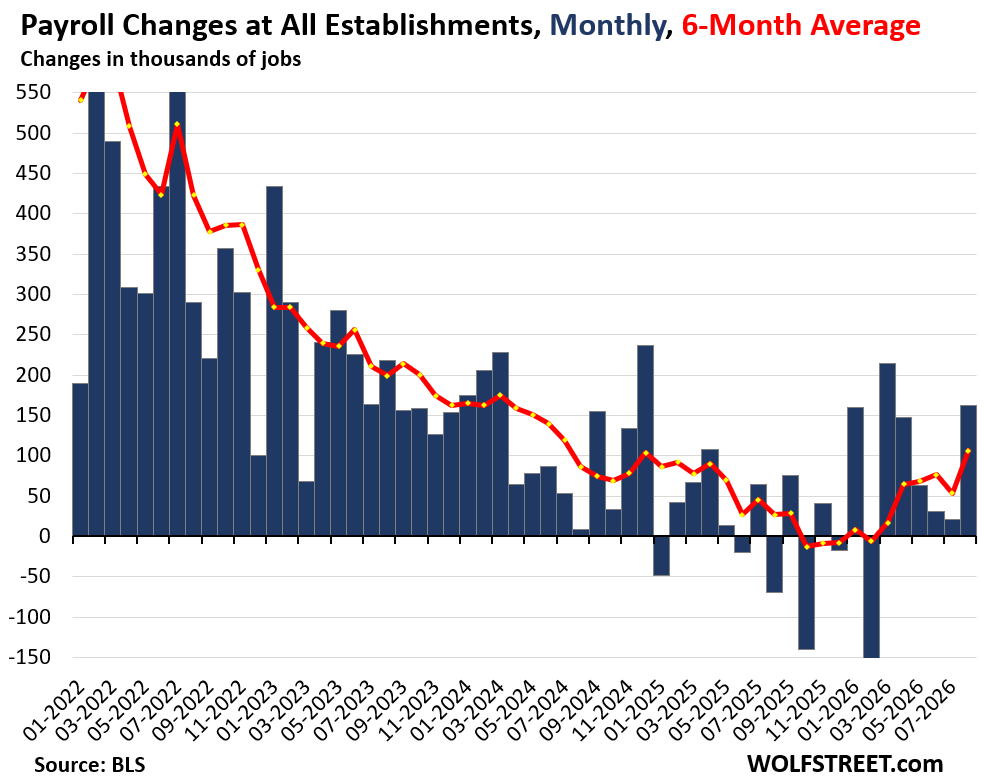
Nonfarm employers added 162,000 workers in August compared with July, according to the Bureau of Labor Statistics' payrolls report, released today and based on surveys of employers. The prior two months were revised up substantially: July by 44,000, turning an originally reported drop of -21,000 into a gain of +21,000, and June by 11,000. In addition, most of the huge July drop in local government employment — mostly educators — of -62,000, the biggest month-to-month drop in years, largely bounced back in August with a gain of +50,000.
The six-month average job gain, which irons out month-to-month squiggles and revision quirks, rose to +107,000, the biggest gain since July 2024. This job growth is occurring despite a declining labor force, the result of the crackdown on illegal immigration and the wave of boomer retirements. That combination — steady hiring against a shrinking pool of workers — is an unusual configuration for a mature economic expansion, and it underpins much of what follows in the rest of the report.
The August report ironed out some of the quirks in the July data. For the Federal Reserve, as it weighs whether or not to hike its policy rates, the data removed any remaining worries about the labor market. The Fed's mandate covers both employment and price stability, so a labor market that is neither overheating nor cracking shifts the policy debate squarely onto the inflation side of that mandate. The 12 voting members of the FOMC can now focus solely on getting their messy inflation-house in order.
By category of private-sector employers
Two major private-sector categories shed jobs:
- Financial activities (-11,000)
- Information (-23,000)
All other major private-sector categories gained jobs:
- Leisure and hospitality (+62,000); July revised up to -21,000 from -40,000
- Healthcare (+28,400); July revised down to +13,100 from +22,000
- Construction (+22,000)
- Manufacturing (+16,000); July revised up to +14,000 from +5,000; year-to-date: +58,000
- Professional and business services (+10,000)
- Wholesale trade (+7,800)
- Transportation & warehousing (+5,000); July revised up to +13,800 from +10,000
- Other services (+3,000)
- Retail trade (+1,400); July revised up to +13,200 from -19,000
The breadth of gains across service sectors, together with continued manufacturing additions, marks a contrast with the period of flat total employment earlier in the year.
The level of total nonfarm employment rose to 159.1 million in August.
Notably, employment was flat from April 2025 through February 2026 before rising since then. That flat spot was in part caused by massive job cuts at the federal government, which reduced federal payrolls by 11%, or 336,000 jobs; those reductions have largely ended. State governments cut 55,000 jobs over the same period, mostly in higher education, as many state universities and colleges came under enrollment pressures. Combined, federal and state governments cut nearly 400,000 jobs at a time when private-sector job growth was already slow. With those government reductions largely complete, the recent employment gains reflect a private sector adding jobs on its own.
Wages
Average hourly earnings rose by 0.27% in August from July, and by 3.1% year-over-year, to $37.75 per hour.
Inflation has been running hot for months, with the most recent CPI rising 3.4%. The wage gain of 3.1% is lagging the rate of CPI inflation, after outrunning CPI inflation over the past three years through early 2026. In practical terms, average hourly earnings are now losing ground to prices in real terms, a reversal of the trend that had delivered real wage gains to workers in the preceding three years.
The shrinking labor force
The labor force has been on a downward trend as a result of the crackdown on illegal immigration, the tightening of legal immigration, and continuing boomer retirements. The labor force consists of people who are working and people who are not working but are actively looking for work; when a person decides to retire, they exit the labor force. The data is collected via surveys of households.
The labor force rose in August after two big monthly drops. Given the large month-to-month swings in the labor force data and the huge adjustments, the three-month average — which irons them out and shows the trend — is the more useful measure.
The three-month average in August dropped by another 100,000 people. Since the peak in December, the labor force has dropped by 2.07 million.
This continued drop in the labor force — a drop in the supply of labor — has changed the dynamics of the labor market, leading among other things to a very low unemployment rate despite so-so job creation. A tighter labor supply is also a dynamic the Fed watches closely, since a scarce pool of available workers is one of the channels through which the inflation side of the economy can stay sticky.
Unemployment and participation
The unemployment rate remained at 4.1%, historically low within a 50-year timeframe, largely because of the shrinking supply of labor. The unemployment rate reflects the number of unemployed people actively looking for a job (7.03 million) divided by the labor force (169.8 million).
The prime-age labor force participation rate remained at 83.4% in August, the same as in July, with both months up from June. The three-month average declined to 83.4%. The range that has prevailed since mid-2024 is the highest in over 20 years.
The prime-age labor force consists of people between 25 and 54 years old, which eliminates the issue of retiring boomers. When people retire and stop looking for a job, they are no longer "participating" in the labor force but remain in the population until they die. It is the surge of boomer retirements over the past 15 years that has pushed down the overall labor force participation rate, but not the prime-age labor force participation rate. The resilience of prime-age participation indicates that the overall decline in the labor force stems from demographic and immigration factors rather than from working-age adults leaving work, which is the distinction that matters for reading labor-market health.
Source: Wolf Street
