US CPI Eases to 3.4% in July, Weakening Case for Further Fed Tightening
Key Takeaways
- •The U.S. Consumer Price Index rose 0.1% in July after a 0.4% decline in June.
- •Headline inflation slowed to 3.4% year over year, while core CPI eased to 2.5% from 2.6% in June.
- •Shelter costs increased 0.1% and accounted for about two-thirds of the monthly CPI gain.
- •The Federal Reserve held its policy rate at 3.50%–3.75% on July 29, with three policymakers favoring a quarter-point increase.
- •The next major inflation release is the July Producer Price Index report scheduled for August 13.
US Inflation Cools to 3.4%
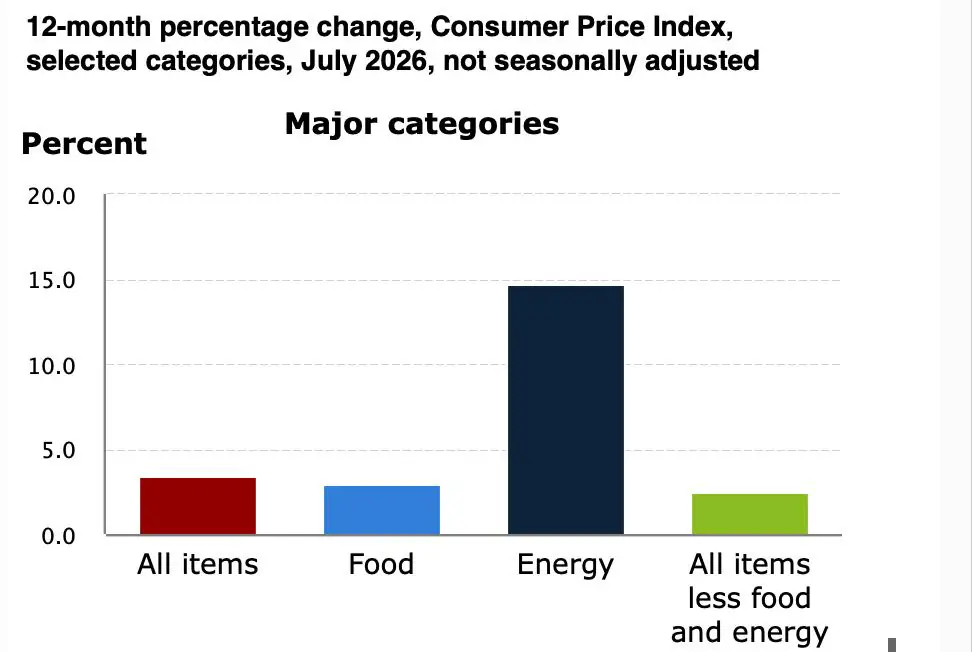
The U.S. Consumer Price Index edged up 0.1% in July on a seasonally adjusted basis, following a 0.4% decline in June. Over the trailing 12 months, headline inflation decelerated to 3.4%, down from 3.5% the previous month, according to the Bureau of Labor Statistics. The reading marks continued progress toward the Federal Reserve's 2% longer-run objective, though a meaningful gap remains.
Core CPI, which excludes food and energy components, rose 0.2% during the month and softened to 2.5% year over year, compared with 2.6% in June. At 2.5%, core inflation sits just half a percentage point above the Fed's 2% target, suggesting that underlying price pressures—beyond the often-volatile food and energy categories—are also easing. The deceleration in core inflation indicates that July's improvement was not solely driven by volatile energy costs.
Shelter costs increased just 0.1% in July yet still accounted for approximately two-thirds of the overall monthly index gain. Food prices rose 0.1%, while energy declined 1.5% during the month. Despite the monthly energy drop, energy prices remained 14.7% higher than a year earlier, and food costs were up 3.0% over the same period.
Fed Hike Justification Grows Harder
The Federal Reserve maintained its policy rate at 3.50%–3.75% at its July 29 meeting, though the decision was not unanimous. Three policymakers favored a 25-basis-point increase, and the Fed continued to characterize inflation as elevated. The central bank left rates unchanged amid divided views on the path forward.
July's CPI report provides additional ammunition for the dovish camp, especially given recent labor-market softness. As reported following the June jobs release, the U.S. economy added only 57,000 jobs—well below expectations—while unemployment fell to 4.2% alongside declining labor-force participation.
Slowing inflation and weakening employment trends point the Fed in the same direction. With hiring losing momentum and price growth already moderating, policymakers have diminishing incentive to continue aggressive tightening—particularly with core inflation now within half a percentage point of their formal 2% target.
A single CPI report will not determine the September decision. However, if upcoming inflation and labor-market data reinforce the current trend, justifying another rate increase becomes considerably more difficult.
For Bitcoin, an immediate rate cut is not a prerequisite for an improved macroeconomic environment. A reduced probability of further tightening alone can alleviate one of the key constraints on speculative assets. Markets observed a comparable response after June CPI, when Bitcoin and Ethereum rose as traders sharply scaled back expectations for a July hike.
Why Inflation Data Matters for Crypto
The link between inflation and Bitcoin operates primarily through interest-rate expectations. When investors anticipate the Fed holding rates elevated or raising them further, cash and government bonds become more attractive, financing conditions tighten, and capital faces a higher barrier before flowing into Bitcoin, Ethereum, and other speculative assets.
Cooling inflation can shift that dynamic by pulling rate expectations lower. Treasury yields and the U.S. dollar serve as useful barometers: falling yields combined with dollar weakness would indicate that markets are pricing in a less aggressive Federal Reserve. Conversely, if yields rise despite the CPI improvement, investors would be signaling that a single inflation report is insufficient to materially alter the rate outlook. Monitoring that market reaction can be more informative for crypto investors than the initial Bitcoin price move immediately after the release.
Improvement, but Disinflation Not Yet Established
The Federal Reserve formally targets inflation using the Personal Consumption Expenditures (PCE) price index rather than CPI, with a longer-run objective of 2%. July's figures nonetheless provide policymakers with further evidence that consumer-price growth is moderating.
Shelter remains a category to monitor closely. Despite its modest 0.1% monthly increase, it drove roughly two-thirds of the overall CPI gain. Given shelter's outsized weight in the index, its trajectory will be decisive in determining whether headline inflation continues to decline or plateaus. Energy presents a contrasting picture: prices fell sharply in July but remain substantially elevated compared with a year ago.
The direction is encouraging, but one month of data does not confirm a durable disinflationary trend. Further confirmation must come from the next round of economic releases.
PPI Report Is the Next Inflation Signal
The Bureau of Labor Statistics is scheduled to publish July Producer Price Index data on August 13. PPI captures prices received by producers rather than those paid directly by consumers, and investors track it for early indications that shifts in business costs may eventually pass through to consumer inflation.
A softer producer-price reading would bolster the case that inflation is easing beyond July CPI. A stronger-than-expected increase, however, would complicate that narrative by demonstrating persistent cost pressures upstream.
What to Watch Next
The most immediate confirmation of the CPI report's impact may come from rates and the dollar rather than from Bitcoin's initial price reaction. Lower short-term Treasury yields would signal traders reducing expectations for tighter Fed policy, and dollar weakness would reinforce that interpretation. Renewed strength in either would undermine the case for a sustained post-CPI crypto rally.
Thursday's PPI report delivers the next direct inflation data point. A second favorable release could solidify expectations that the Fed can remain on hold, while a hotter reading would reopen elements of the debate that July CPI appeared to settle.
The Federal Reserve's next scheduled meeting is September 15–16, giving policymakers an additional month of inflation, labor-market, and growth data before their next decision. The immediate picture for crypto investors is clear: CPI has improved the macroeconomic backdrop, and PPI will determine whether that improvement is confirmed or begins to unravel.
