US October Import Prices Rise 1.1% Month-over-Month; Semiconductor Import Costs Surge
Key Takeaways
- •U.S. import prices for all goods increased 1.1% month-over-month in October, based on Bureau of Labor Statistics data that do not include tariffs.
- •Import prices rose even as the nominal dollar appreciated, leading the author to consider what would occur if the dollar were depreciating instead.
- •A 2014 study estimates long-run exchange rate pass-through into U.S. import prices at approximately 0.35, implying a sustained 10% dollar depreciation would raise import prices by roughly 3.5% over the longer run.
- •Semiconductor import prices, tracked separately from overall import prices and in principle quality-adjusted, are up 33% in log terms since January 2026.
- •The BLS publishes the import and export price indexes monthly, and the measures are used to deflate U.S. trade flows in the national accounts.
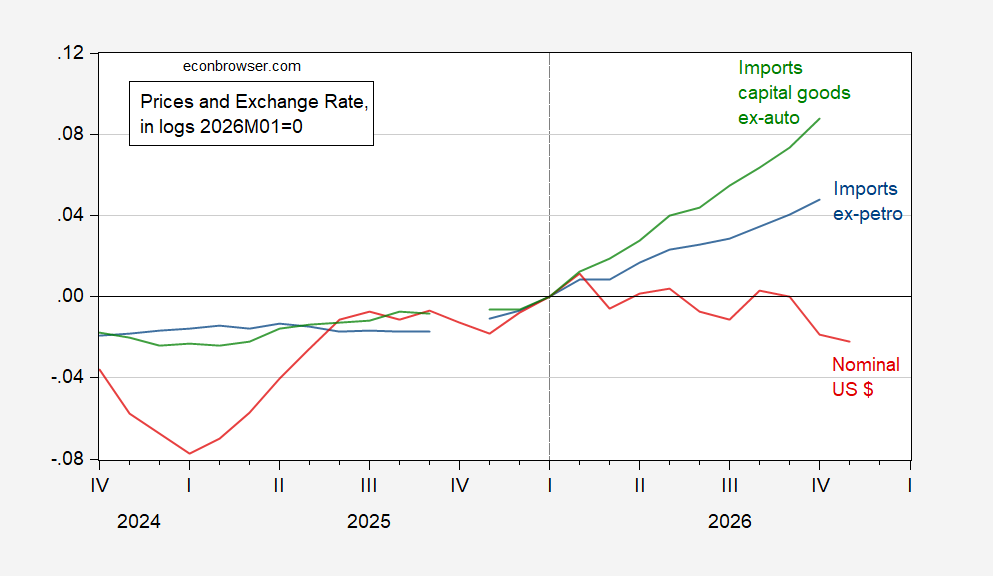
Import prices for all goods entering the United States rose 1.1% month-over-month in October, compared with a +0.7% figure cited for reference in the underlying report, according to the Bureau of Labor Statistics (BLS), which compiles the monthly U.S. import and export price indexes. These indexes measure price changes in goods and services traded between the United States and the rest of the world and are used to deflate U.S. trade flows in the national accounts, so shifts in import costs also register in real trade measures.
Figures published with the report chart prices for goods imports excluding petroleum and imports of capital goods excluding automobiles against the U.S. dollar exchange rate, where an upward movement denotes a depreciation of the dollar. Both series are plotted in logarithms, indexed to January 2026 = 0, with the exchange rate data running through Nov. 13. Sources: BLS and the Federal Reserve via FRED — the St. Louis Fed's economic data platform — together with the author's calculations.
Notably, import prices — which, as the report emphasizes, do not include tariffs — are rising even as the nominal dollar appreciates. The author observes that this invites consideration of what would happen if the dollar were depreciating instead. A study by Bussiere, della Chiaie and Peltuonen (2014) estimates the long-run exchange rate pass-through into U.S. import prices at approximately 0.35, covering the 1990–2011 period. Pass-through measures how much of a currency movement is ultimately reflected in the prices of imported goods. By that study's estimate, a sustained 10% dollar depreciation would translate into roughly a 3.5% longer-run increase in import prices, all else equal.
Semiconductor import prices continue to climb rapidly, up 33% in log terms since January, according to the report. A second chart tracks the import price index for semiconductor and other electronic manufacturing against the dollar exchange rate (up is depreciation), in logs indexed to January 2026 = 0, with the exchange rate through Nov. 13; sources are again BLS, the Federal Reserve via FRED, and the author's calculations. The semiconductor price index is, in principle, quality-adjusted, meaning it aims to account for changes in product quality so that measured gains reflect price movements for comparable goods. Semiconductors are inputs across a broad range of electronic products, and the report tracks the component separately from overall import prices. The BLS publishes these indexes monthly, so the next release will add a further data point on the trajectory.
Addendum: The author points readers to further discussion in a Marketplace segment aired Nov. 17: Marketplace (11/17).
This article originally appeared on Econbrowser: October Import Prices Up.

