US Suspends Green-Card Filings for Microsoft, Adobe, and Six IT Outsourcing Firms Amid AI Talent Race
Key Takeaways
- •The US Department of Labor has suspended all new and pending PERM green-card labor certification requests for Microsoft, Adobe, Cognizant, Infosys, Tata Consultancy Services, Wipro, HCL Technologies, and Capgemini, effective Thursday.
- •Labor Secretary Keith Sonderling said that since 2009 the eight companies had requested nearly three million foreign workers and received more than 100,000 permanent labor certifications.
- •Vice President JD Vance said the suspension will last until the companies modify their hiring practices, and Microsoft rejected accusations of abuse by stating that roughly 80% of its recent H-1B applications covered existing employees and that it pays visa holders the same rates as comparable staff.
- •The freeze follows President Trump's September 18 executive order tightening H-1B rules, together restricting both temporary and permanent employment pathways for foreign technology workers.
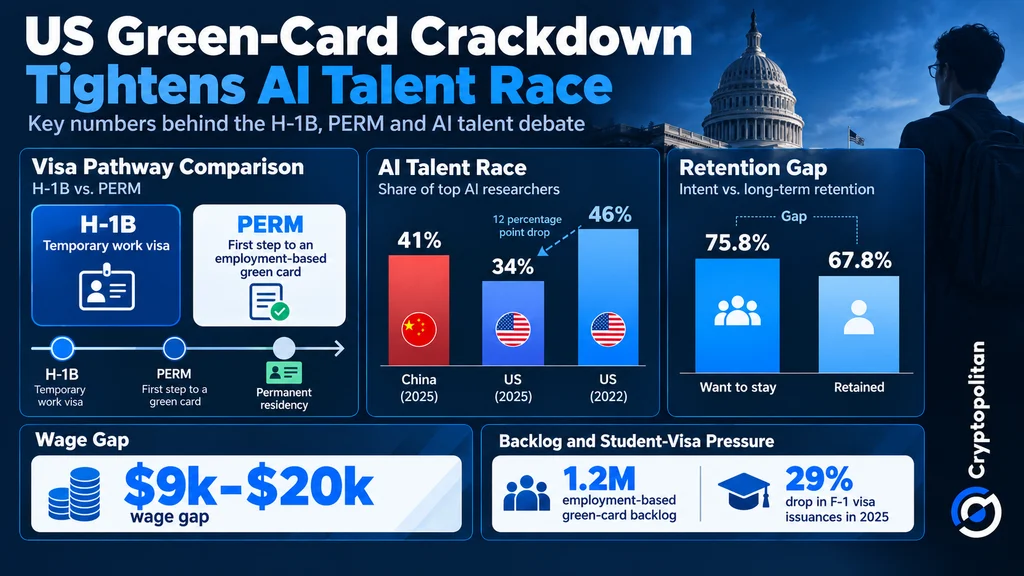
- •Carnegie research found that 41% of top AI researchers were working in China in 2025 versus 34% in the United States, and analysts warn tighter immigration controls could push more technology work overseas to countries such as India, China, and Canada.
The US Department of Labor has suspended the processing of all new and pending green-card labor certification requests for Microsoft, Adobe, and six IT outsourcing companies, effective Thursday. The move creates yet another hurdle for foreign technology professionals seeking permanent residency in the United States as competition for artificial intelligence talent intensifies.
A freeze on the PERM pipeline
The suspension targets PERM, the labor certification process employers must complete before sponsoring foreign nationals for employment-based green cards. In a PERM application, an employer must demonstrate that hiring foreign workers will not disadvantage US workers. Because the freeze covers pending cases as well as new filings, applications already in the pipeline at these companies are on hold too.
Beyond Microsoft and Adobe, the measure affects Cognizant, Infosys, Tata Consultancy Services, Wipro, HCL Technologies, and Capgemini — all major multinational IT services providers.
Labor Secretary Keith Sonderling announced that since 2009, the eight companies had requested nearly three million foreign workers and received more than 100,000 permanent labor certifications — totals that underscore the scale of the group's participation in the program.
Vice President JD Vance said the ban will continue until the companies modify their hiring practices, a formulation that ties the length of the freeze to corporate behavior rather than any fixed timetable.
How the move differs from the September H-1B order
President Donald Trump's executive order of September 18 tightened H-1B regulations, while the current action concerns permanent residency. The H-1B visa allows employers to hire foreign professionals for temporary, skilled positions, whereas the PERM procedure is a step toward obtaining a green card. Restrictions on both pathways could make it harder for foreign workers to build long-term careers in the United States.
The White House maintains that misuse of the H-1B program places downward pressure on American wages, though broader assessments have not established employer wrongdoing.
Vance's allegations and Microsoft's response
Vance accused Microsoft of abusing immigration rules while laying off American workers. Microsoft rejected that characterization, saying that roughly 80% of its recently submitted H-1B applications covered existing employees, with new hires accounting for only about 1% of its US workforce. The company added that it pays H-1B workers the same rates as comparable employees.
The accusations followed a July investigation by the Labor Department's inspector general into allegations of visa fraud, wage theft, and worker trafficking. The investigations, however, have not proven misconduct by every company now facing the suspension.
Why the timing matters for the AI race
The United States increasingly depends on foreign researchers to preserve its lead in artificial intelligence, yet retaining that talent is becoming more difficult. The Stanford 2026 Report highlighted America's reliance on foreign graduates in STEM fields and the challenges surrounding their retention.
China, meanwhile, is catching up. According to recent Carnegie research, 41% of top AI researchers in its 2025 data were working in China, compared with 34% in the United States — down from 46% in 2022. With China drawing a growing share of top talent, stricter migration controls could leave American research institutions and enterprises worse off in the competition for AI specialists.
Offshoring risk and the knock-on for crypto
Brookings researchers warn that tighter immigration rules could push more technology work overseas, including to India, China, and Canada. The shift may already be under way: Cryptopolitan reported on Alphabet's planned expansion in Bangalore, although only building has been confirmed as leased.
AI and crypto companies compete for many of the same engineers. Prolonged restrictions could make US-based development more difficult while encouraging more hiring abroad. Meanwhile, nine universities — including Harvard, Yale, Stanford, Brown, and MIT — face investigations over the alleged misuse of exchange-visitor visas, adding further uncertainty to America's international research pipeline.

