US Government Moves Bitcoin Seized From Alameda Research, On-Chain Data Shows
Key Takeaways
- •Arkham identified a US government transfer of Bitcoin seized from Alameda Research, and the funds were reportedly sent to Coinbase Prime, an institutional custody and trading service.
- •Alameda Research was the trading firm tied to FTX, and its co-founder Sam Bankman-Fried was convicted of fraud in 2023 following the exchange's November 2022 collapse.
- •Moving coins to a custodian is not the same as selling them, and the Department of Justice has an announced arrangement to custody its digital asset holdings on Coinbase Prime.
- •Government wallets are among the largest single holders of Bitcoin, so their transfers can shift market sentiment even without any confirmed sale.
- •Official confirmation of a planned disposal would come through agency statements or court filings under the DOJ's Asset Forfeiture Program, not from a single on-chain transfer.
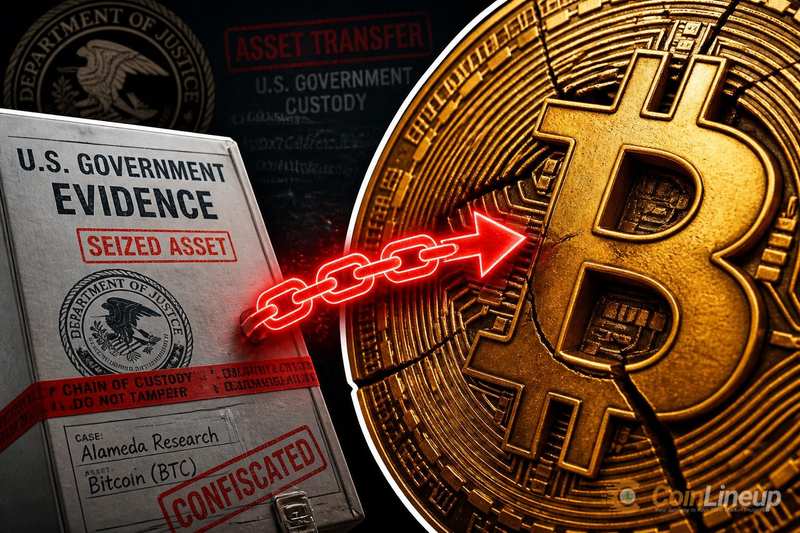
The US government has moved Bitcoin seized from Alameda Research, and on-chain watchers spotted the transfer as it happened. A wallet transfer of this kind simply means coins were sent from one blockchain address to another. On its own, it does not mean the government is selling.
The movement was flagged by Arkham, a blockchain analytics firm that tracks large government-controlled wallets. Arkham published details of the transfer in its research note on the US government moving Alameda assets. According to reporting from crypto.news, the seized Alameda-linked funds were sent to Coinbase Prime, an institutional custody and trading service. Alameda Research was the trading firm tied to FTX, the exchange that collapsed in November 2022. Its co-founder, Sam Bankman-Fried, was convicted of fraud in 2023 for his role in the collapse.
The associated on-chain activity can be viewed directly on the public ledger through the Etherscan address page, which lets anyone verify the wallet movement without relying on a middleman.
The key distinction for newcomers is this: moving coins to a custodian is not the same as selling them on the open market. A transfer is a change of storage; a sale means coins are actually offloaded for cash.
Why government Bitcoin transfers get so much attention
Large government-held wallets are watched closely because their activity can shift market sentiment. When observers see coins moving, some worry the government is preparing to sell.
Traders often watch specifically for coins heading toward exchanges or custodians like Coinbase Prime. A custodian can hold assets safely, but it can also serve as a staging point before a sale, which is why the destination of a transfer matters. The Department of Justice, for its part, has an announced arrangement to custody its own digital asset holdings on Coinbase Prime, so a government transfer to that destination fits a known custody relationship as much as it suggests anything else.
Even without an actual sale, a visible transfer can move short-term expectations. Price reactions are frequently driven by interpretation of what a move might mean rather than by any confirmed selling. For context on the scale of state holdings, the US government's crypto holdings have grown by billions in recent months. These wallets matter because government stashes are among the largest single holders of Bitcoin, and research has shown that a handful of entities hold a large slice of Bitcoin's supply, so their decisions carry weight.
The attention also reflects a mixed track record. The US Marshals Service has historically disposed of forfeited Bitcoin through public auctions, including coins seized in the Silk Road case, so government disposals are not unprecedented. More recently, in March 2025, the United States established a Strategic Bitcoin Reserve built from bitcoin it already held, much of it forfeited in criminal cases, with a stated policy of not selling it. Those two precedents, past auctions on one side and a current stated hold policy on the other, are part of why each new transfer gets read so closely.
What to watch next
Follow-up wallet activity will be the most informative signal. If the coins sit at the custodian and do not move further, the transfer was likely administrative housekeeping.
Official confirmation is the next real signal. Agency statements or court filings, rather than a single on-chain move, are what confirm whether a disposal is planned. That follows from how the system works: under the Department of Justice's Asset Forfeiture Program, forfeited assets are handled through a formal process that surfaces in filings and announcements rather than in wallet movements alone. Seizure cases move slowly, as seen when a separate Bitcoin seizure in an Irish drug case reached 1,000 BTC before any resolution.
A single transaction should not be overread. One transfer is a data point, not a verdict, and the market has a habit of reacting before the facts are settled. For a regular crypto holder, the practical takeaway is simple: this is a wallet movement to watch, not a confirmed sell-off, and headline alarm is best treated with patience until an official filing or a follow-up transfer to an exchange makes the picture clearer.
Disclaimer: This article is for informational purposes only and does not constitute financial or investment advice. Cryptocurrency and digital asset markets carry significant risk. Always do your own research before making decisions.
