US Goods Trade Deficit Larger Than Pre-Election Level, an $18 Billion Upside Surprise Versus Consensus
Key Takeaways
- •The U.S. goods trade deficit now exceeds its pre-election level, with the latest figures beating the Bloomberg consensus forecast by $18 billion on the upside.
- •Goods imports are rising rather than falling back toward pre-tariff levels, contrary to expectations that tariffs would reduce them.
- •The Census-basis goods balance ran about $2 billion higher than the balance-of-payments basis in May and June, a discrepancy dwarfed by the $18 billion consensus miss.
- •Monthly U.S. trade figures are compiled jointly by the Census Bureau and the BEA, with Census-basis goods numbers published first in an advance report.
- •Monthly goods balances are among the inputs the BEA uses to estimate GDP, and the persistent U.S. goods deficit is partly offset by a surplus in services.
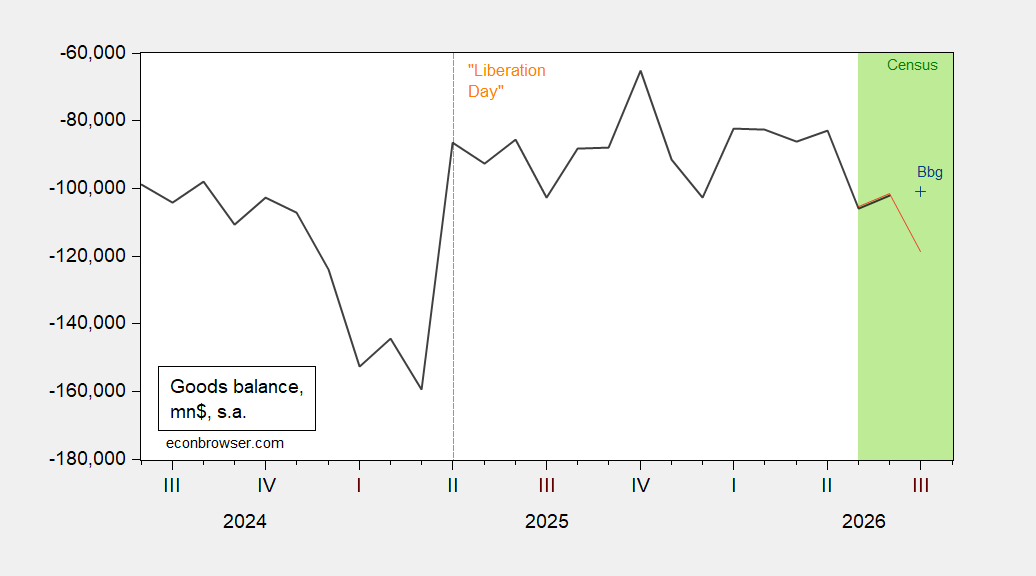
The U.S. goods trade deficit is now larger than it was before the election, Econbrowser reports, with the latest figures surprising to the upside by $18 billion relative to the Bloomberg consensus forecast.
"So much for tariffs reducing goods imports relative to pre tariff," the author writes, observing that goods imports are rising rather than falling back toward pre-tariff levels.
Figure 1: Goods trade balance, BoP basis (black), Census basis (red), Bloomberg consensus (blue +), all in millions of dollars, seasonally adjusted. Source: BEA via FRED, Census, and author's calculations.
Figure 2: Goods imports (black), BoP basis through April, Census basis thereafter, all in millions of dollars, seasonally adjusted. Source: BEA via FRED, Census, and author's calculations.
On the gap between the two measurement bases, the Census basis runs about $2 billion higher than the BoP basis in May and June, a small difference by the standards of the monthly trade data. The $18 billion consensus miss therefore dwarfs the discrepancy between the two bases, an order of magnitude larger than any difference attributable to the choice of measurement convention.
The pre-election reference point is the November 2024 U.S. presidential election, after which the incoming administration implemented a broad program of tariffs on imports into the United States.
The monthly U.S. trade figures are compiled jointly by the Census Bureau and the Bureau of Economic Analysis (BEA). The Census basis records goods trade as reported in customs documents, while the balance-of-payments (BoP) basis adjusts those figures for differences in timing, valuation, and coverage so that trade flows align with the national accounts. Census-basis goods numbers are published first, in an advance report that precedes the full goods-and-services release, and the import chart's switch from BoP to Census data after April reflects that earlier availability. The BEA series plotted in the figures is distributed through FRED, the economic database maintained by the Federal Reserve Bank of St. Louis. The Bloomberg consensus reflects forecasts aggregated from economists surveyed by Bloomberg.
The goods balance covers merchandise trade only. The United States records a persistent deficit in goods that is partly offset in the overall trade balance by a surplus in services. Because net exports enter the national accounts directly, monthly goods balances are among the inputs the BEA uses in estimating GDP, and the coming monthly releases will show whether goods imports hold above their pre-election level, the comparison at the center of the tariff debate the article engages.

