US backs Madagascar rare earths project with up to $4.84 million
Key Takeaways
- •The DFC is providing up to $4.84 million to the Ampasindava rare earths project in Madagascar.
- •Harena Rare Earths holds a 75% stake in the project, which has a total estimated investment of about $150 million.
- •The project is targeting about 4,000 metric tons of rare earth oxides a year by mid-2028, including roughly 1,700 metric tons of magnet materials.
- •China accounts for more than 70% of global rare earth production, making alternative supply sources strategically important.
- •Harena is still working through permitting, impact studies and a pilot plant, and the company’s London-listed shares rose after the funding announcement.
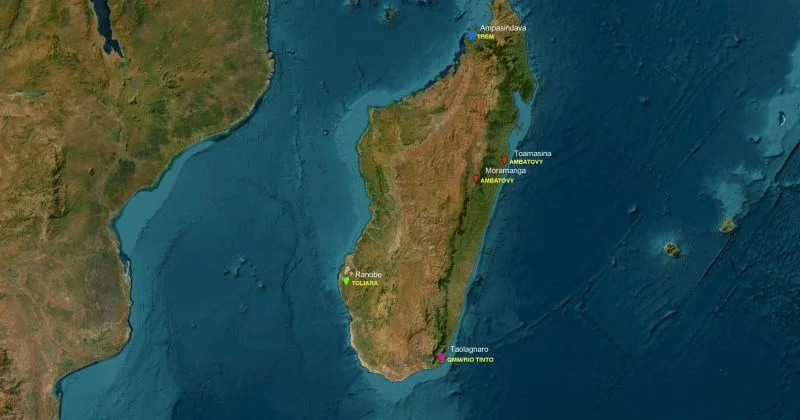
The US International Development Finance Corporation has committed up to $4.84 million to a rare earths project in Madagascar, a small but pointed bet in Washington’s broader campaign to loosen China’s chokehold on the minerals that power everything from fighter jets to electric vehicles.
The funding targets the Ampasindava ionic clay rare earths project, operated by London-listed Harena Rare Earths Plc, which holds a 75% stake. The total project investment is about $150 million, meaning the DFC’s contribution is more of a down payment on a relationship than a full bankroll.
Why rare earths matter more than ever
China currently dominates more than 70% of global rare earth production. The materials involved — including Neodymium, Praseodymium, Dysprosium and Terbium — are essential ingredients in permanent magnets used in EV motors, wind turbines, consumer electronics and defense systems.
The Ampasindava project is targeting annual output of about 4,000 metric tons of rare earth oxides by mid-2028. Of that total, roughly 1,700 metric tons a year would be high-value magnet materials, specifically NdPr (Neodymium-Praseodymium) and DyTb (Dysprosium-Terbium).
Harena Rare Earths is currently working through the permitting process, conducting environmental and social impact studies, and building a proof-of-concept pilot plant. Those steps matter because rare earth projects often face long development timelines before commercial production begins, especially where technical processing, local approvals and infrastructure all have to line up. Commercial production is expected within the next few years, with mid-2028 serving as the benchmark.
The wider strategic push
The US State Department confirmed its support for the project as part of a broader strategic effort to diversify rare earth sourcing away from China.
This is the DFC’s first commitment to Harena Rare Earths, indicating that Madagascar’s ionic clay deposits have drawn the attention of US policymakers looking for alternative supply sources.
Harena’s stock, traded in London under HREE.L, rose on the funding news. While a $4.84 million government commitment attached to a $150 million project is not transformational on its own, it serves as a credibility signal that the US government considers the project strategically important enough to back financially.
What this means for the supply chain
Australia’s Lynas Rare Earths has long been the most prominent non-Chinese producer, and the US has also invested in domestic projects such as MP Materials’ Mountain Pass mine in California. However, those operations alone cannot offset China’s scale.
Projects like Ampasindava represent the next stage of diversification: smaller operations spread across multiple jurisdictions that can help reduce concentration risk. For buyers in sectors such as EVs, defense and electronics, the practical significance is not a single mine replacing China, but a wider set of supply options that can support sourcing resilience over time.
A $150 million project in Madagascar carries execution risk that a mine in Nevada does not. Political stability, permitting timelines, infrastructure gaps and the challenge of scaling from pilot plant to commercial production remain significant hurdles. The mid-2028 production target is ambitious for a project that is still in the permitting and study phase.

