US Could Seize $1 Billion in Iran-Linked Cryptocurrency, Treasury Secretary Bessent Says
Key Takeaways
- •Treasury Secretary Scott Bessent said the United States could seize approximately $1 billion in cryptocurrency connected to Iran, a figure roughly triple the $344 million frozen in a prior Iran-related enforcement case.
- •No court order or completed seizure exists yet, because crypto forfeiture requires identifying wallet controllers, proving ties to a sanctioned party, and obtaining federal court approval.
- •U.S. officials accuse Iran of using cryptocurrency to fund government operations and circumvent sanctions imposed over its nuclear program.
- •The potential action targets specific Iran-linked wallets and poses no direct risk to everyday crypto holders, though exchanges serving U.S. customers must block transactions involving sanctioned addresses published on OFAC's Specially Designated Nationals List.
- •Upcoming developments to monitor include official Justice Department or Treasury announcements, court filings naming specific wallets or custodians, possible OFAC designations of linked addresses, and exchange responses to related account freezes.
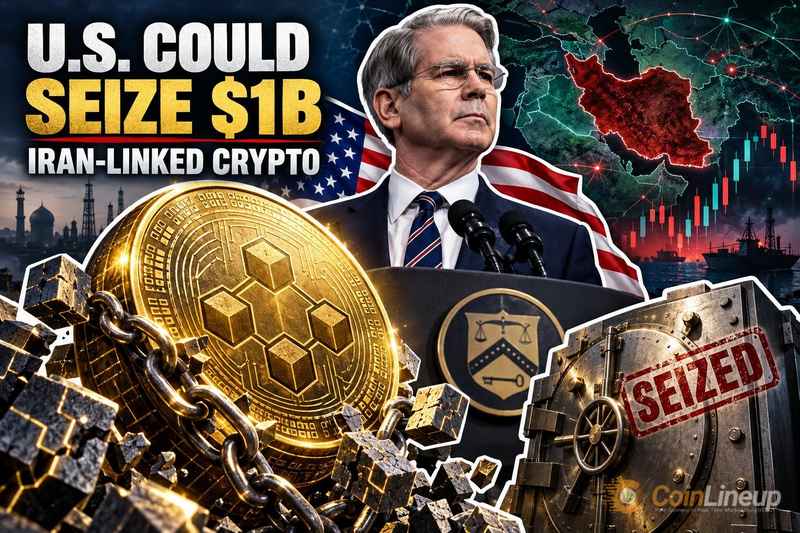
U.S. Treasury Secretary Scott Bessent has said the United States could seize approximately $1 billion in cryptocurrency linked to Iran, a statement signaling that Washington may be preparing one of the largest crypto asset enforcement actions ever tied to sanctions violations.
Bessent's remarks put a specific dollar figure on what U.S. authorities have been working toward: locking down digital assets that allegedly help Iran sidestep economic sanctions. A potential seizure at this scale would mark a major escalation in how the U.S. deploys crypto enforcement as a tool of foreign policy.
It is important to note that Bessent described this as something the U.S. could do, not something that has already happened. No court order or completed seizure has been confirmed at this time. The distinction matters because crypto asset seizures require legal process, including identifying wallet addresses, establishing jurisdiction, and obtaining court approval.
What a $1 Billion Iran-Linked Seizure Would Mean
If U.S. authorities move forward, the action would dwarf prior enforcement efforts. In an earlier case, U.S. authorities froze $344 million in crypto tied to Iran, which was itself considered a landmark action at the time. A $1 billion seizure would roughly triple that figure.
For the U.S. government to seize crypto, investigators typically need to identify the private keys or custodians controlling the wallets, prove the funds are connected to a sanctioned party, and secure a federal court order authorizing forfeiture. That process can take months or years, and a public statement by a Treasury official can sometimes indicate that investigations are already well advanced.
Seized digital assets do not simply vanish. The U.S. government has confiscated cryptocurrency in past enforcement actions and has periodically liquidated holdings through public auctions and sales, so a completed seizure here would follow an established playbook rather than require a new capability.
Iran has been accused by U.S. officials of using cryptocurrency to fund government operations and circumvent sanctions imposed over its nuclear program. While crypto is harder to freeze than bank accounts, it is not impossible, particularly when funds move through regulated exchanges that must comply with U.S. law.
What Crypto Users and Exchanges Should Watch
For everyday crypto holders, the news does not signal any direct risk to their own assets. Seizures of this kind target specific wallets tied to specific bad actors, not the broader crypto market.
For exchanges and compliance teams, the signal is clearer. When a senior Treasury official publicly discusses a potential billion-dollar seizure, it usually means enforcement agencies are actively tracing these assets, a task that relies heavily on blockchain analytics since public ledgers record every transfer between wallets. Exchanges that operate in the U.S. or serve U.S. customers are legally required to block transactions involving sanctioned addresses, which Treasury's Office of Foreign Assets Control (OFAC) publishes on its Specially Designated Nationals List, where cryptocurrency wallet identifiers have been added since 2018. Bessent has previously shaped crypto-adjacent policy through the Treasury Department, making his statements on enforcement worth taking seriously.
The next developments to watch include an official Department of Justice or Treasury announcement of a seizure action, court filings naming specific wallet addresses or custodians, any OFAC designation adding the linked addresses to its sanctions list, and any response from exchanges regarding account freezes connected to the investigation.
Disclaimer: This article is for informational purposes only and does not constitute financial or investment advice. Cryptocurrency and digital asset markets carry significant risk. Always do your own research before making decisions.

