US Consumer Confidence Slips Far Below Consensus as Conference Board Index Falls to 81.9
Key Takeaways
- •The Conference Board's Consumer Confidence Index fell to 81.9 in September, missing the consensus forecast of 89.2 by 7.3 points and declining from the previous reading of 88.6.
- •Econbrowser's analysis places the index three standard deviations below its mean, underscoring the severity of the slump.
- •Consumer appraisals of current business conditions turned negative for the first time since September 2024, while labor market perceptions worsened but remained in positive territory.
- •The good-bad differential on family finances went negative for the first time since 2022, meaning unfavorable views of household finances now outnumber favorable ones.
- •Over the next six months, consumers expect both business conditions and the labor market to weaken, though they still anticipate household income growth at a diminished pace.
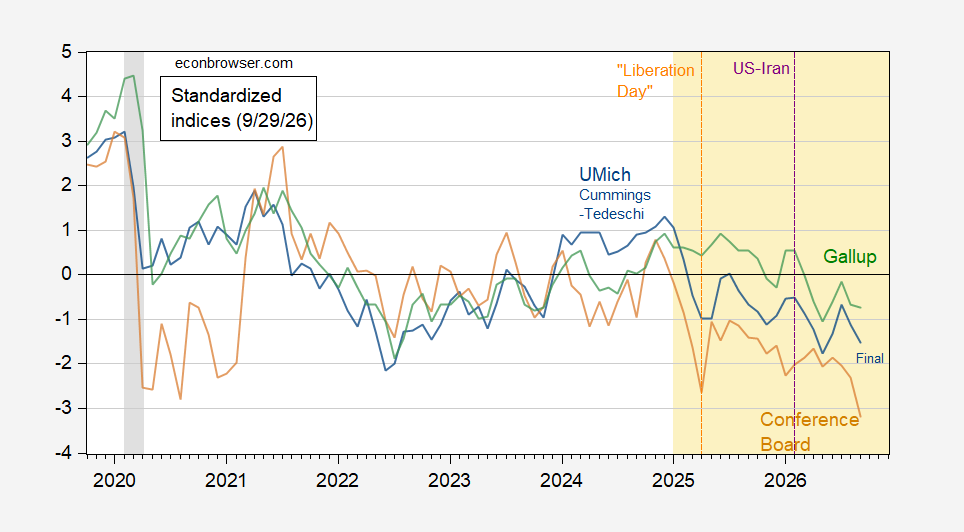
US consumer confidence deteriorated sharply in September, according to newly released data from The Conference Board. The Conference Board's Consumer Confidence Index registered 81.9 for the month, missing the consensus forecast of 89.2 by a wide margin — a 7.3-point shortfall — and down from the previous reading of 88.6. According to Econbrowser's analysis, the index currently stands three standard deviations below its mean. Confidence readings of this kind are closely tracked because they capture how US households assess the same dimensions highlighted in this release: current business conditions, the labor market, and the outlook for their incomes.
An accompanying chart places the slump in context. It plots the University of Michigan Economic Sentiment series — using the Cummings-Tedeschi adjustment (blue) — alongside the Conference Board Confidence Index (brown) and Gallup Confidence (green), with all three series demeaned and divided by their standard deviation over January 2021 through February 2025. A red dashed line marks “Liberation Day,” and a purple dashed line marks the US-Iran war. Data sources: the University of Michigan, Gallup, the Conference Board, Cummings and Tedeschi (2024), and the author's calculations.
From the release:
“The Consumer Confidence Index deteriorated notably in September, following two prior months of softening,” said Dana M. Peterson, Chief Economist, The Conference Board. “The Present Situation Index fell sharply, while the Expectations Index slipped further into negative territory. Consumer appraisals of current business conditions became negative for the first time since September 2024. Perceptions of the current labor market also worsened, though remained within positive territory. Over the next six months, consumers expected both business conditions and the labor market to weaken. Consumers still anticipated their household incomes to rise, but less so compared to previous months.”
A further chart in the analysis details the sharp deterioration in consumers' expectations.
Regarding family finances, the current measure indicates a switch in outlook in September: the good-bad differential has gone negative for the first time since 2022 — meaning unfavorable assessments of household finances now outnumber favorable ones. The Conference Board updates the index monthly, so the next release will show whether September's deterioration continues or reverses.

