US Auto Loan Balances Reach $1.71 Trillion in Q2 as New-Vehicle Financing Hits Record $42,500
Key Takeaways
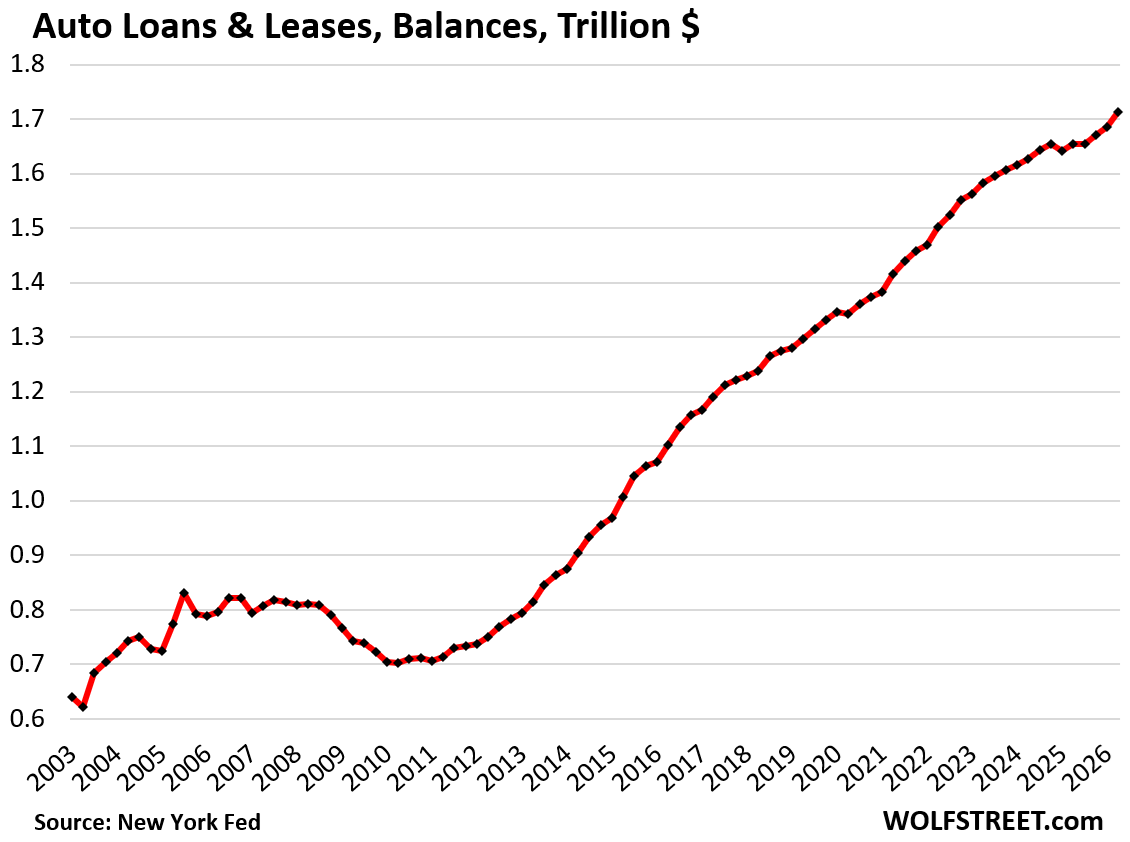
- •US auto loan and lease balances climbed to $1.71 trillion in Q2, an increase of $28 billion from Q1 and $58 billion (3.5%) from a year earlier.
- •The average amount financed for a new vehicle reached a record $42,500 amid automakers' upmarket shift, while used-vehicle financing averaged $24,900, below its pandemic peak.
- •Subprime loans made up 15.6% of Q2 originations, down from a typical 20-22% before the pandemic, while a near-record 54.6% of originations went to prime borrowers with credit scores of 720 or higher.
- •June's 60-plus-day delinquency rate was 1.42% for all auto loans, down 2 basis points year over year, with the subprime rate at 5.67% (down 64 basis points) and the prime rate at 0.37%.
- •The auto-loan-to-disposable-income ratio of 7.25% in Q2 sits in the middle of its range over the past two decades, indicating household income has grown roughly in line with auto debt.
US Auto Loan Balances Reach $1.71 Trillion in Q2 as New-Vehicle Financing Hits Record $42,500
Loan and lease balances outstanding for new and used vehicles rose by $28 billion in the second quarter from the first, and by $58 billion (+3.5%) year over year, to $1.71 trillion, according to the New York Fed’s report on consumer credit, based on Equifax data. Outside of housing, auto debt is one of the largest slices of US household balance sheets, which is part of why these quarterly figures are watched as a broad gauge of consumer credit.
Balances have tracked vehicle prices
Auto loan balances have climbed over the years alongside vehicle prices as automakers moved upmarket with bigger, fancier, and more advanced vehicles. Balances rose further as vehicle prices spiked during the high-inflation years and chip shortages of 2020–2023.
Two factors, however, did not contribute to the increase in loan balances. Vehicle unit sales have remained below pre-pandemic levels, and the average length of new vehicle loans is where it was a decade ago and shorter than in 2020.
The average amount financed for new-vehicle loans soared to a record $42,500 as automakers continued their shift upmarket. US legacy automakers killed off most of their sedan models even before the pandemic, handing that lower-priced market segment to foreign brands. Luxury 4X4 Crew Cab pickup trucks with a $100,000 sticker are what Ford now wants to sell — and Americans are buying them, which pushes up loan balances and the average amount financed.
For used vehicles, the average amount financed peaked at the end of the 50% price spike during the pandemic. Used-vehicle prices have since declined from that peak, and the average amount financed, at $24,900, remains below it, according to data from the Federal Reserve Board of Governors for Q1.
The average loan length for new vehicles ticked up to 66.5 months, a level first reached in 2016, but that is down from the free-money pandemic peaks.
Auto loans by credit score
Of all auto loans and leases originated in Q2, a near-record share of 54.6% were made to borrowers with a prime credit score of 720 or higher. The record in the data was set last year at 56.1%.
The share of subprime originations dropped to 15.6% in Q2, after hitting record lows last year. In the years before the pandemic, the share of subprime originations ranged from 20–22%, and it was higher still before the Financial Crisis.
Subprime means “bad credit,” not “low income” — a history of not paying bills and obligations. The young dentist who got in over his head is a classic example of a high-income borrower with a subprime credit rating. Such borrowers will get it worked out eventually; subprime status is not permanent.
Subprime lending is a high-risk, high-profit business, often conducted by specialized dealer-lenders that securitize the loans and sell them as asset-backed securities to bond funds, pension funds, and similar investors. Subprime borrowers pay very high interest rates and often pay a lot more for their vehicles than prime-rated customers. Default rates are large, but so are the profits on the loans and the vehicles, and the credit losses are part of the cost of doing subprime business. Periodically, some of these subprime-specialized dealers implode — and some have recently — which is why the business is considered high-risk.
Debt-to-income ratio
The aggregate burden and credit risk of auto loans can be evaluated via a debt-to-income ratio. For household income, the measure used is “disposable income,” released by the Bureau of Economic Analysis.
Disposable income consists of after-tax wages, plus income from interest, dividends, rentals, farm income, small business income, transfer payments from the government, and similar items. It excludes capital gains, which is where the wealthy make most of their money. Excluded as well are income from stock-based compensation plans and capital gains, where billionaires make their billions.
Disposable income has grown over the years because the number of households has grown and income per household has grown, so total household income has grown — and it turns out it has grown about as fast as auto loans, with some ups and downs in between. The auto-loan-to-disposable-income ratio in Q2 ticked up slightly to 7.25%, right in the middle of its range over the past two decades.
Delinquency rates: overall, subprime, and prime
The 60-plus-day delinquency rate for all auto loans and leases was 1.42% in June, down 2 basis points year over year, according to Equifax. Because the vehicle itself serves as collateral for the loan, missed payments can end in repossession, one reason these delinquency figures are tracked as a window on household finances.
The available monthly Equifax data only goes back to 2020, the free-money era when delinquency rates dropped to ultra-low levels. The increase since then began from those ultra-low levels, and a comparison with normal pre-pandemic years is not available.
The 60-day-plus delinquency rate of subprime auto loans ran at record highs starting in 2023, as a number of subprime dealer-lenders imploded — including Tricolor, under a mushroom cloud of fraud allegations, and some PE-firm-owned dealer-lender chains. Many of their customers stopped making payments at that point.
Delinquency rates are seasonal, and January is the high point of the year. In January 2026, the delinquency rate was a record 6.90%, up 34 basis points from January a year earlier. The delinquency rate has improved this year and started running below year-over-year levels. In June, the subprime delinquency rate was 5.67%, down 64 basis points year over year, according to Fitch Ratings, which rates these ABS.
The 60-day prime delinquency rate was 0.37%, according to Fitch, which tracks prime auto loans that were securitized into prime ABS. Prime-rated auto loans are nearly always in good shape.
The Equifax delinquency series is updated monthly and the New York Fed’s consumer credit report comes out quarterly, so coming releases will show whether the year-over-year improvements in the overall and subprime delinquency rates persist.
Related coverage
- Here Come the HELOCs: Mortgages, Housing-Debt-to-Income-Ratio, Serious Delinquencies, and Foreclosures in Q2 2026
- Household Debts, Debt-to-Income Ratio, Delinquencies, Foreclosures, Collections & Bankruptcies in Q2 2026
Source: Wolf Street
