Uniswap Price Jumps 16% After SEC Tokenized Stock Exemption
Key Takeaways
- •UNI gained roughly 18% on Friday, climbing from about $6.63 earlier in the rally toward the $9 area after moving above a long-running descending trendline.
- •The SEC granted temporary conditional relief on September 17 allowing tokenized National Market System stocks to trade on permissioned automated market makers for five years, though it did not approve Unwap as an authorized securities venue.
- •Uniswap v4's Permissioned Pools, introduced in July with launch partners Superstate, Securitize, and Dowgo, use on-chain hooks that provide the access controls required by the SEC's new permissioned framework.
- •Uniswap stated that 80% of all Robinhood Stock Token volume, approximately $10 billion cumulatively, has traded through its protocol since Robinhood Chain launched in July with Uniswap as its primary public automated market maker.
- •UNI futures volume increased 82.67% to about $1.40 billion and open interest rose 20.81% to roughly $601.45 million, while Standard Chartered has projected the token will reach $100 by 2030.
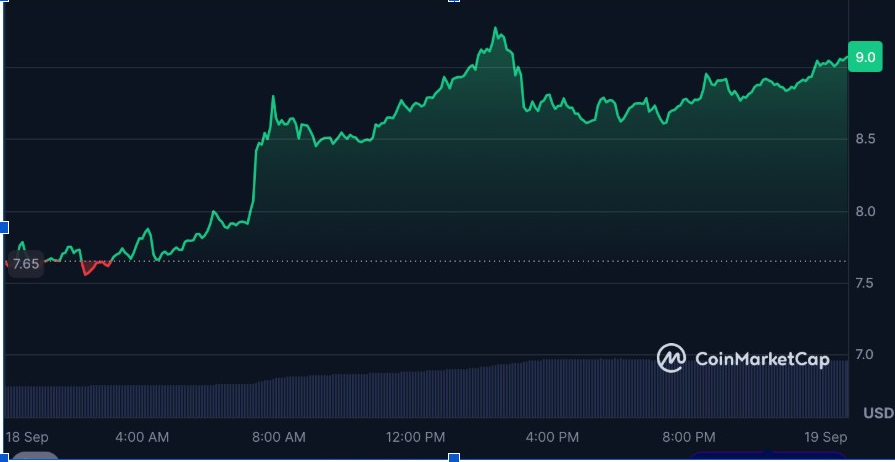
Uniswap's UNI token extended its rally on Friday, gaining roughly 18% on the latest daily move after breaking out of a months-long downtrend. The token climbed from levels near $6.63 earlier in the rally, traded above $8.50, and pushed intraday toward the $9 area.
UNI is the governance token of Uniswap, one of the largest decentralized exchanges in the cryptocurrency market. The protocol runs on an automated market maker model, in which users trade against pooled liquidity rather than a traditional order book. The latest advance has carried the token toward price not seen for several months, as traders respond to regulatory changes affecting tokenized U.S. stocks, growing tokenized-equity activity on Uniswap, and strengthening derivatives and technical momentum.
SEC Rule Puts Permissioned AMMs in Focus
The U.S. Securities and Exchange Commission on September 17 granted temporary, conditional relief allowing tokenized securities venues to trade tokenized National Market System stocks through permissioned automated market makers (AMMs) and liquidity pools. The exemption is set to run for five years after publication and includes limits on trading volume and eligible symbols. For decentralized finance, the practical significance is that tokenized-stock trading now has a defined window to operate on pooled-liquidity infrastructure rather than a conventional order book.
The SEC action does not approve Uniswap or designate its protocol as an authorized securities venue. However, the framework arrives after Uniswap Labs introduced Permissioned Pools for Uniswap v4 in July. Those pools use v4 hooks to enforce access rules on-chain, allowing issuers to limit trading and liquidity activity to approved participants. Because those hooks already provide the on-chain access controls a permissioned venue would require, the July launch left Uniswap with infrastructure that aligns with the permissioned requirement at the center of the new framework.
Uniswap said the product was built for regulated assets such as tokenized funds, securities, and equities, with launch partners including Superstate, Securitize, and Dowgo. That existing structure has placed Uniswap v4 in focus as the market assesses how permissioned AMMs could operate under the SEC's new framework.
Robinhood Stock Tokens Add Another Driver
A second factor is the amount of tokenized stock activity already moving through Uniswap. On Friday, Uniswap said 80% of all Robinhood Stock Token volume traded through its protocol, amounting to roughly $10 billion in cumulative volume. The figure underscores how much of a mainstream brokerage's tokenized-stock rollout has flowed through public DeFi liquidity.
Uniswap has been part of Robinhood Chain since the network's launch in July. Uniswap v2, v3, and v4, along with UniswapX, went live on the network from day one, with Uniswap serving as its primary public automated market maker. The integration lets users trade stock tokens and provide liquidity directly on Uniswap.
The reported stock-token figures were released one day after the SEC issued its tokenized-stock exemption. That timing placed Uniswap's existing activity in tokenized equities alongside a new regulatory route for permissioned onchain U.S. stock trading, bringing additional market attention to UNI.
UNI Breakout Draws More Derivatives Activity
The third driver comes from UNI's price structure, particularly after Standard Chartered predicted the token will hit $100 by 2030. UNI moved above a long-running descending trendline after forming a series of higher lows from its June bottom.
The breakout developed around the $4.00–$4.50 area before UNI accelerated through $7 and moved toward the most recent $9.25 region.
Derivatives activity rose alongside the move. Recent data showed UNI futures volume increasing 82.67% to about $1.40 billion, while open interest climbed 20.81% to roughly $601.45 million. The rise in open interest indicates that more capital entered active UNI futures positions as the price advanced.
UNI is now approaching the $10 psychological level. A sustained move above that area would bring the chart's projected $12.30 region into focus. If the Uniswap price retreats, $7.00–$7.50 forms the nearest support area, followed by roughly $6.00. The former $4.00–$4.50 breakout zone remains the broader structural level below the current UNI price.
Beyond the chart, near-term checkpoints include how the exemption's volume limits and eligible-symbol list shape tokenized-stock venue activity, and how much of Robinhood Chain's stock-token volume continues to route through Uniswap's pools.
This article is for informational purposes only and does not constitute financial or investment advice. Cryptocurrency investments involve risk, and past performance does not guarantee future results. Readers should conduct their own research before making investment decisions.
Source: The Market Periodical

