Uniswap Drops 9% as Weak Retail Demand Tests Key Support Level
Key Takeaways
- •Uniswap's UNI token fell approximately 9% on Wednesday, compounding a 5% loss from the prior session as traders de-risked ahead of July's US Consumer Price Index release.
- •Uniswap introduced Continuous Clearing Auctions on Avalanche, allowing blockchain projects to conduct fully on-chain token auctions and establish initial liquidity via Uniswap v4.
- •Social dominance for UNI dropped from 0.19% to 0.08% and futures open interest declined over 3% to $261.60 million, indicating reduced retail and leveraged market participation.
- •Long liquidations reached $2.88 million, vastly exceeding short liquidations of $1,950, showing that falling prices disproportionately forced bullish traders out of their positions.
- •UNI is testing its 100-day EMA at $3.55 with an RSI of 40 and MACD below its signal line, keeping the short-term technical outlook bearish unless the token reclaims the 50-day EMA at $3.65.
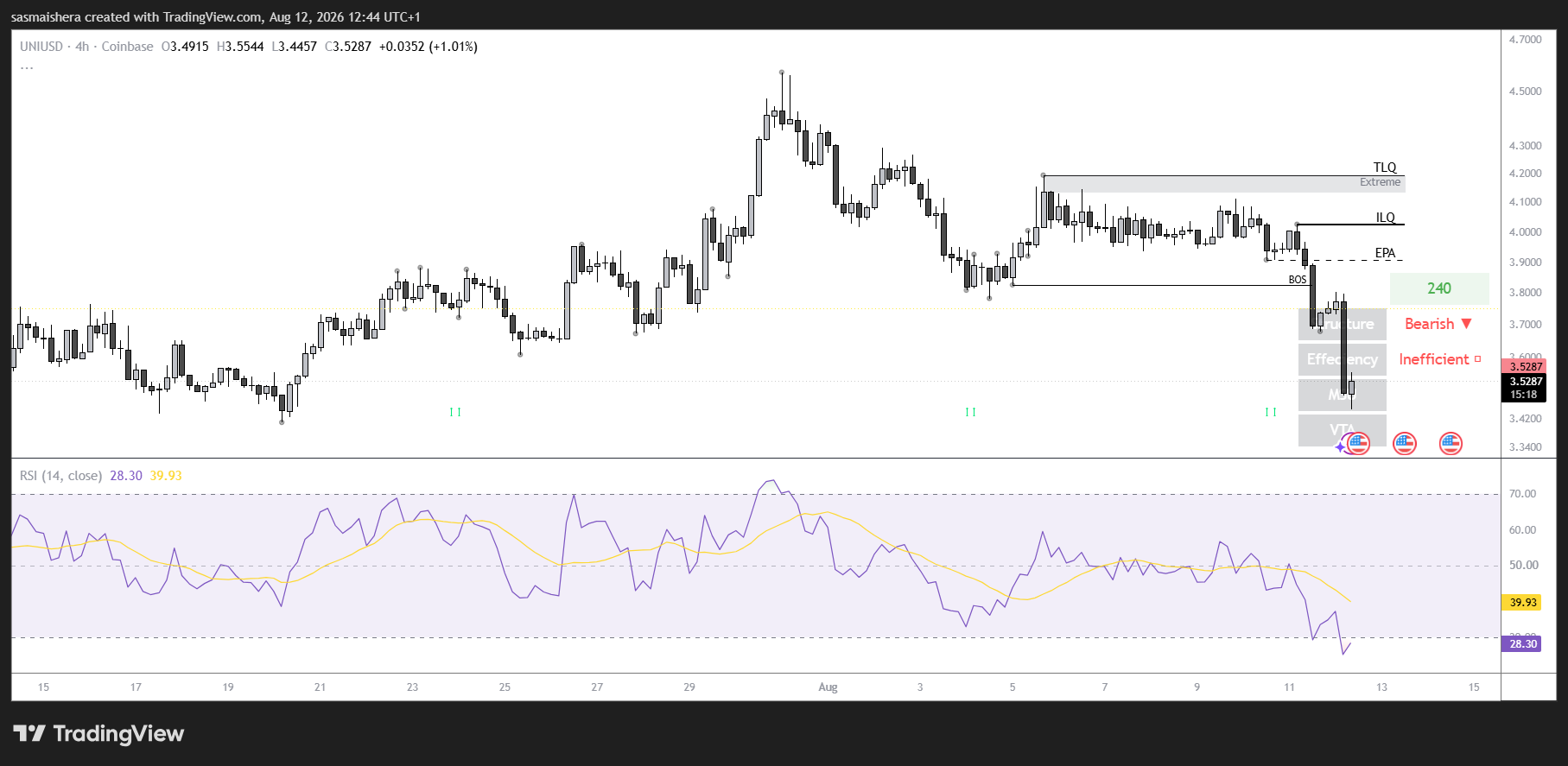
Uniswap (UNI) came under heavy selling pressure on Wednesday, declining nearly 9% after posting a 5% drop in the previous session. The pullback extends a broad-based retreat across major digital assets as traders de-risk ahead of key US inflation data.
The decline comes despite Uniswap's continued product expansion, including the introduction of Continuous Clearing Auctions on Avalanche. The feature enables blockchain projects to conduct fully on-chain token auctions and establish initial liquidity through Uniswap v4, the protocol's latest upgrade that introduces customizable pool logic via hooks. As the largest decentralized exchange by total value locked, Uniswap's expansion across additional chains reflects its effort to deepen its role as core trading infrastructure within decentralized finance.
However, declining social activity and weakening derivatives demand suggest the launch has not been sufficient to offset the broader risk-averse mood across cryptocurrency markets. UNI, which functions primarily as a governance token entitling holders to vote on protocol proposals rather than capturing trading-fee revenue directly, has historically shown limited correlation with individual product launches.
Continuous Clearing Auctions Launch on Avalanche
Uniswap's Continuous Clearing Auctions give Avalanche developers a new mechanism for launching tokens and bootstrapping liquidity on-chain. The model is designed to reduce friction during token distribution by enabling teams to conduct auctions transparently through smart contracts. Projects can then connect their newly distributed tokens with Uniswap v4 liquidity pools.
The launch expands Uniswap's presence on Avalanche and reinforces its role as infrastructure for token issuance, trading, and liquidity management. It follows the recent debut of the TradePools platform on Robinhood, which allows users to deposit USDC, USDT, or ETH in pursuit of yield. Together, these initiatives reflect a wider trend of both decentralized and traditional finance platforms building yield-generating and liquidity products around stablecoins and digital assets.
While these developments may support Uniswap's long-term utility, they have yet to translate into a meaningful improvement in near-term demand for UNI. The protocol also continues to operate under regulatory uncertainty, following a Wells notice issued by the US Securities and Exchange Commission to Uniswap Labs in April 2024 alleging unregistered securities-law violations — a case that remains unresolved and adds a layer of caution for some market participants.
Retail Attention Wanes Ahead of CPI Report
Retail interest in Uniswap is softening as traders prepare for the release of July's US Consumer Price Index report, scheduled for Wednesday at approximately 12:30 GMT. The CPI reading could influence the Federal Reserve's next interest-rate decision and shape demand for risk assets. A hotter-than-expected report could strengthen expectations for tighter monetary policy, while softer inflation could improve sentiment across cryptocurrency markets. Cryptocurrencies, as high-beta risk assets, have tended to react sensitively to shifts in rate expectations throughout the current monetary cycle.
Santiment data shows Uniswap's social dominance fell to 0.08% on Tuesday from 0.19%. Social volume also declined to 40 from 152. The sharp contraction indicates that UNI accounts for a smaller share of cryptocurrency-related discussions and is attracting less attention from retail traders.
Derivatives Market Signals Declining Participation
Uniswap's derivatives market reinforces the broader decline in retail participation. CoinGlass data shows UNI futures open interest fell more than 3% over the past 24 hours to $261.60 million, indicating that traders are closing positions and reducing leveraged exposure.
Long liquidations reached $2.88 million during the same period, significantly exceeding short liquidations of just $1,950. This imbalance shows that falling prices have disproportionately forced bullish traders out of their positions.
However, UNI's open-interest-weighted funding rate improved to 0.0016% from negative 0.0054% the previous day. The return to positive funding indicates that the remaining leveraged market carries a slight bullish bias. Still, falling open interest and heavy long liquidations suggest overall sentiment remains fragile.
Technical Outlook: UNI Tests 100-Day EMA
Uniswap is testing its 100-day Exponential Moving Average (EMA) at $3.55, an important near-term support level. UNI remains below the 50-day EMA at $3.65 and the 200-day EMA at $3.93. These moving averages create overhead resistance and reinforce the prevailing bearish structure.
The Relative Strength Index (RSI) has declined to 40, placing it below the neutral midpoint of 50 and indicating growing selling momentum. However, the indicator remains above the oversold threshold of 30. The Moving Average Convergence Divergence (MACD) indicator has also fallen below its signal line, and its expanding bearish profile suggests downside momentum is strengthening.
A decisive daily close below the 100-day EMA at $3.55 could extend Uniswap's decline toward the 50% Fibonacci retracement level at $3.25, measured from UNI's advance between $2.31 and $4.57.
A successful defense of $3.55 could allow buyers to attempt a recovery. However, UNI must reclaim the 50-day EMA at $3.65 to ease immediate selling pressure. Above that level, the 23.6% Fibonacci retracement at $3.89 and the 200-day EMA at $3.93 form a significant resistance cluster. Until Uniswap recovers above these moving averages with stronger trading activity, the short-term technical outlook is likely to remain bearish.

